Quick answers
- How many plants does a room need?
- There is no fixed number. Three to five well-placed plants usually look composed in a medium room, and fewer, larger plants read as more intentional than many small ones. Count only the plants the available light can actually keep alive.
- What is the best first statement plant?
- A rubber plant, monstera or fiddle-leaf fig gives height and bold leaves, but each needs bright indirect light. If your room is dim, choose a ZZ plant or a large snake plant instead, and see our low-light guide.
- How do I style plants in a dim hallway?
- Use low-light survivors such as ZZ plant, cast iron plant or snake plant, and rotate them every few weeks with plants from a brighter room. Alternatively add a full-spectrum LED bulb on a timer for 8 to 10 hours a day.
- Should pots match?
- They should relate, not match. Pick two or three tones and one or two materials across the whole home, then vary height and shape. Always use pots with drainage or a drainage insert inside a decorative cachepot.
Key takeaways
- Choose plants for the light first, then style around them
- Group in odd numbers and build height from tall to trailing
- Give one statement plant room and keep negative space around it
- Keep pots in two or three tones and always allow drainage
Table of contents12 sections
- Styling rules at a glance
- Map the light before you style
- Build with height
- Grouping that looks designed
- Choose containers that work together
- Styling by place
- Keep the arrangement alive
- Seasonal and low-effort styling
- Colour, texture and light in the arrangement
- How light and containers shape your indoor plant styling
- Common mistakes
- Next steps
Styling with indoor plants is a light-first design guide, because the plants you can keep alive depend on the light your windows give.
Two rooms can hold the same plants and look completely different. The difference is rarely the plants themselves: it’s whether they are placed where they can thrive, grouped with a plan and set in containers that relate to each other. Style that ignores light ends with dead plants, and light that ignores style ends with a crowded sill. This guide puts light first and then adds the arrangement rules designers use.
It belongs to the Indoor Plants guides and works with Best Low-Light Houseplants, Pet-Safe Houseplants and Garden Color Theory, whose colour logic applies indoors too.
Styling rules at a glance
| Rule | What to do |
|---|---|
| Light first | Map windows and match each plant to its zone before styling |
| Group size | Odd numbers: 3 or 5 in a cluster |
| Height | One tall, one medium, one trailing in each group |
| Statement plant | One per room, with clear space around it |
| Pots | Two or three tones, mixed heights, always drainage |
| Negative space | Leave bare wall, shelf or floor so groups read as intentional |
| Rotation | Quarter turn weekly; swap dim-spot plants monthly |
Map the light before you style
Plants that don’t get enough light stretch, drop leaves or stall, and no arrangement fixes that. Walk the room at midday and sort each spot into one of three zones.
- Bright (within 1 m of a south or west window): fiddle-leaf fig, rubber plant, bird of paradise, cacti, succulents, citrus and herbs.
- Medium (1 to 3 m from a window, or an east window): monstera, philodendron, pothos, calathea, peperomia, ferns.
- Low (more than 3 m away or a north window): ZZ plant, cast iron plant, snake plant, some pothos. Expect slow growth, not none.
A simple test: if you can read a book comfortably without turning on a lamp, the spot has medium light. Detailed ratings are in Best Low-Light Houseplants. In dim rooms an LED grow bulb on a timer for 8 to 10 hours adds real capacity and can be hidden in an ordinary lamp.
Build with height
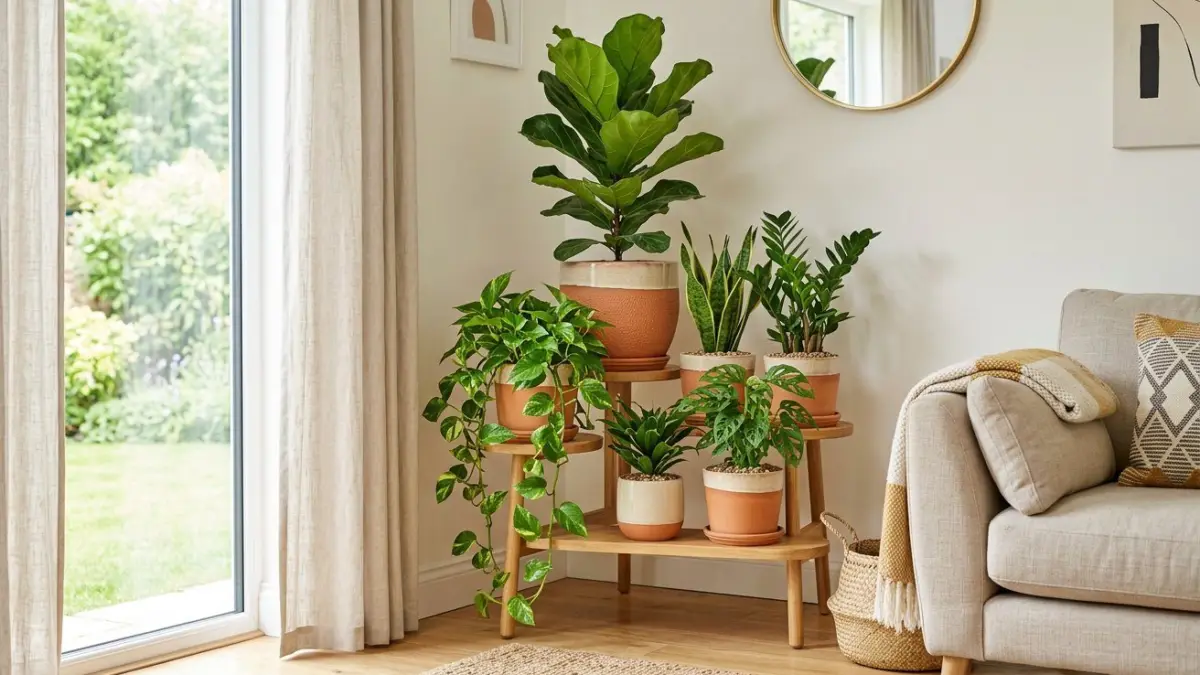
Every group looks balanced when it has three levels: a vertical element, a mid-height plant and something trailing or low. Use a tall plant such as a parlor palm, rubber plant or snake plant for the vertical, a monstera or calathea for the middle and a pothos, ivy or string-of-hearts for the trail. Raise short plants on stands, stacked books or stools to create a staggered line. Place the tallest plant against a wall or corner and the trailing plant on the edge of a shelf where it can fall freely.
Use scale as well. A 1.5 m (5 ft) floor plant in a corner makes a small room feel taller, while a row of tiny pots on a sill can look cluttered. Pet owners should check every plant first, using the list in Pet-Safe Houseplants.
Grouping that looks designed
- Cluster by care, not only by looks. Plants that share light and watering needs thrive together, and humidity-loving ferns and calatheas help each other through leaf transpiration. See Humidity for Houseplants.
- Use odd numbers. Three or five plants form a more natural composition than pairs.
- Repeat one plant or colour in two places in the room to link spaces together.
- Vary leaf shape. Mix big paddle leaves, fine fronds and spiky forms for contrast.
- Leave gaps. A bare stretch of wall or shelf lets the eye rest and makes each group feel deliberate.
Choose containers that work together
Pots matter as much as the plant. Pick two or three tones, such as terracotta, cream and charcoal, plus one or two materials, and repeat them through the home. Vary the heights and shapes, not the whole colour palette. For function, use a plain nursery pot with holes inside a decorative cachepot, lift it out to water and let it drain fully before returning it. That avoids the main cause of indoor plant death, which is sitting roots, covered in How to Water Houseplants. Size the pot 2 to 5 cm (1 to 2 in) wider than the root ball and repot only when roots circle, using Repotting Houseplants.
Match the pot to the plant’s personality. Heavy, matte ceramic suits large leafy plants, while terracotta suits succulents and anything you tend to overwater, because it breathes.
Styling by place
| Place | Good choices | Watch for |
|---|---|---|
| Living room corner | Rubber plant, fiddle-leaf fig, large palm | Direct afternoon sun burning leaves |
| Shelf | Trailing pothos, philodendron, string plants | Dim shelves: rotate monthly |
| Bathroom | Ferns, calathea, peace lily (not for pets), orchids | No window: add a grow light |
| Kitchen sill | Herbs, succulents, jade | Heat and draughts from oven or door |
| Bedroom | Snake plant, ZZ plant, small peace lily | Keep leaves clean for light |
| Hallway | ZZ plant, cast iron plant | Low light: use a timer lamp |
For an outdoor room feel, extend the look onto a balcony using Balcony and Terrace Gardens.
Keep the arrangement alive
- Rotate a quarter turn weekly so growth stays even.
- Dust the leaves every few weeks with a damp cloth, because dust blocks light.
- Swap dim-spot plants with brighter-room plants every 3 to 4 weeks.
- Prune leggy stems to keep shape, and propagate cuttings for free replacements using Propagation by Cuttings.
- Check for pests weekly when moving plants close together. Isolate any new plant for two weeks.
Seasonal and low-effort styling
Indoor plants change with the seasons. In winter, light drops and growth slows, so move plants closer to windows, stop feeding and water less. In summer, protect plants from strong afternoon sun through glass with a sheer curtain. A simple seasonal routine keeps the styling intact without constant fiddling.
- Autumn: bring outdoor plants in before nights drop below about 10°C (50°F), check them for pests and reposition for lower winter light.
- Winter: keep plants away from cold glass and radiators, and cluster humidity lovers together on a pebble tray.
- Spring: repot the root-bound, prune leggy growth and restart a light feeding schedule.
- Summer: rotate more often, since growth is fastest, and move sun-scorched plants back a step from the glass.
If you travel often, group plants in a bright bathroom or cluster them away from direct sun and use self-watering pots or wicks. Choose forgiving plants such as ZZ, snake plant and ponytail palm for the spots you care for least. A style that matches your real routine lasts longer than a perfect-looking arrangement that needs daily attention.
Colour, texture and light in the arrangement
Treat leaves as the palette. Deep green rubber plants and monsteras read as bold and calm, while variegated leaves on pothos or calathea add pattern and brightness in dim corners. Mix textures: glossy leaves beside matte ones, large paddles beside fine fronds. Against a white wall, dark foliage stands out, and against dark walls, pale or variegated plants lift the corner. Keep flowering plants such as orchids or African violets as occasional accents, rather than spreading small flowers everywhere, so the eye has a clear focal point.
Light changes through the day, so view the arrangement in the morning and evening. A shadow cast by a tall plant on a wall can be a design feature if the plant is placed with it in mind. Colour theory outdoors in Garden Color Theory applies equally to the shelf and the sill.
How light and containers shape your indoor plant styling
Monstera, rubber plant and fiddle-leaf fig need bright indirect light, so a spot near a window supports the large leaves that make a statement. Snake plant and zz plant tolerate shade and suit dim corners, while pothos trails from a shelf and softens edges. A hanging pot or trellis holds philodendron vines off the floor and frees 30 cm of floor space.
Terracotta, glazed pots and baskets change the mood, and a plastic liner inside a basket holds water and protects furniture. Grouping plants of different heights raises humidity by 5% to 10% and gives the display depth. Odd numbers of three or five feel natural, and a saucer protects shelves from standing water that encourages fungus gnat. Pothos, snake plant and spider plant tolerate neglect, so you’ll keep them alive while you learn your light. A grow light or led bulb supports plants in dark rooms and boosts photosynthesis for calathea and fern. A hygrometer shows when radiators dry the air below 40%, and a pebble tray or humidifier fixes it for orchid and palm. Cold glass and radiators both damage leaves, so keep plants 20 cm back. A vet or the ASPCA lists safe choices if cats chew leaves, and an extension service can help with local conditions. The low light houseplant guide lists tough plants for shelves.
A tall snake plant shades a low fern and protects it from hard light. Pothos trailing from a shelf softens corners and tolerates dim rooms. A grow light boosts photosynthesis for calathea, and a humidifier protects orchid leaves from dry air.
Common mistakes
- Choosing for looks before light. A beautiful dying plant isn’t styling. Match plant to zone first.
- Twelve small pots on one sill. Consolidate into three larger groups for a calmer look.
- Never rotating. One-sided plants lean toward the window and look lopsided.
- Cachepots without checking drainage. Standing water kills roots. Empty it after watering.
- Pots in every colour. Variety belongs in the plants, not the containers.
- Crowding the statement plant. Give it clear space so it can be a focal point.
Next steps
Map your light, choose a statement plant and build one group of three around it. Then explore Air-Purifying Indoor Plants, Houseplant Problems and Fixes and Small Garden Design Ideas for outdoor layout ideas. The Indoor Plants guides collects every guide on the topic.
Frequently asked questions
How do I arrange plants on a shelf so they look good?
Mix heights and shapes, with a trailing plant such as pothos at the edge and a taller plant at the back. Leave gaps so each group looks intentional. Raise short plants on stands or books, and swap dim-shelf plants with brighter ones monthly.
Why are odd numbers recommended for plant groups?
Groups of three or five look more natural than pairs, which can feel stiff. Aim for one tall, one medium and one trailing plant in each group. Repeating one plant or colour in two places in a room also ties the space together.
Can I decorate with plants if my room gets very little light?
Yes, but choose carefully. ZZ plant, cast iron plant and snake plant cope with dim rooms, and a full-spectrum LED bulb on a timer for 8 to 10 hours adds capacity. Rotate plants with brighter spots every 3 to 4 weeks.
What are the best plants for a bright living room corner?
Rubber plant, fiddle-leaf fig, bird of paradise and large palms suit a bright corner. Protect them from hot direct afternoon sun through glass, which can scorch leaves, with a sheer curtain. Check pet safety first if animals share the room.
How close to a window should plants sit?
Bright-light plants sit within about 1 m of a south or west window, and medium-light plants 1 to 3 m away or by an east window. Keep leaves 20 cm back from cold glass in winter, since cold glass and radiators both damage foliage.
Do plants look better in clusters or spread around a room?
Clusters usually look more intentional, so make three larger groups instead of twelve small pots on one sill. Group plants that share light and watering needs. Spread the groups around the room and leave bare wall or floor between them.
What colour pots work best with green plants?
Neutral tones such as terracotta, cream and charcoal let the foliage stand out. Pick two or three tones and one or two materials, then repeat them through the home. Vary the heights and shapes of pots rather than the colour palette.
How do I make a small room feel bigger with plants?
Use one tall plant in a corner, which draws the eye upward, and avoid many tiny pots that look cluttered. Trailing plants on shelves or in hanging pots free up floor space. Keep some bare wall and floor so the plants read as deliberate.
Should I move my plants when the seasons change?
Yes, adjust a little. In winter, move plants closer to windows but keep them off cold glass and radiators, and water less. In summer, pull plants back or add a sheer curtain against strong sun. Bring outdoor plants in before nights drop below about 10°C (50°F).
How do I style plants if I travel a lot?
Choose forgiving plants such as ZZ plant, snake plant and ponytail palm for the spots you tend least. Group them in a bright place away from direct sun, and use self-watering pots or a wick for moisture lovers. A simple routine lasts longer than a display that needs daily care.
More in Indoor Plants
Humidity for Houseplants: What Plants Need and What Actually Works
What a hygrometer reading really tells you, which plants care about humidity and which do not, why misting and pebble trays barely register, and the fixes…
Pet-Safe Houseplants: Non-Toxic Choices and Plants to Avoid
Which common houseplants are non-toxic to cats and dogs, which are dangerous, and how to reduce risk. Includes what to do if a pet chews a…
Succulents and Cacti Indoors: Light, Watering and Potting
How to keep succulents and cacti healthy indoors: how much light they need, how and when to water, the right gritty potting mix, and how to…