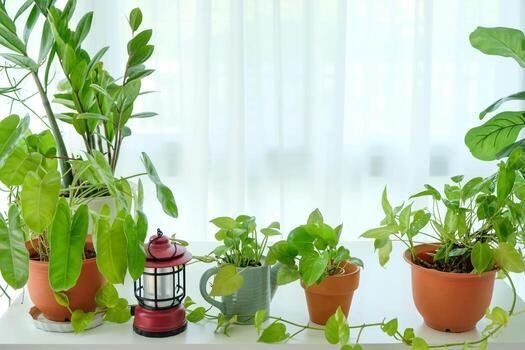
Quick answers
- Do houseplants really purify the air in a home?
- Not to a measurable degree. The 1989 NASA experiments used small sealed chambers, while a normal home swaps roughly 0.5 to 1 room of air with the outdoors every hour. A 2019 review estimated you would need about 10 to 1,000 plants per square metre of floor to match ordinary ventilation.
- What actually improves indoor air quality?
- Ventilation first: open windows for 5 to 10 minutes once or twice a day and run cooker extractors that vent outside. Remove sources such as aerosols and smoke, and use a HEPA purifier with activated carbon if you need more. See our humidity guide for the moisture side.
- Are there benefits to keeping plants indoors anyway?
- Yes. Small studies tend to find modest gains in mood and perceived stress, and plants add some moisture to dry winter air. These effects are real but small, and they depend on keeping the plants healthy, as covered in our watering guide.
- Are air-purifying plants safe for pets?
- Not all of them. Pothos, peace lily, snake plant and English ivy are on the toxic list for cats and dogs, while spider plant and areca palm are listed as non-toxic. Check our pet-safe guide before choosing.
Key takeaways
- The NASA tests used sealed chambers; real rooms lose air far faster than plants clean it
- Ventilation, source control and a HEPA-carbon purifier do the real air cleaning
- Plants help mood and add a little humidity, so keep them for those reasons
- Wipe dusty leaves and avoid constant wet soil, which can grow mould
Table of contents11 sections
- The evidence at a glance
- What the NASA study really tested
- Why the arithmetic fails in a real room
- What actually cleans indoor air
- Three popular claims, checked
- The benefits that do hold up
- Choosing and caring for plants honestly
- What air purifying plants really do indoors
- What air-purifying plants really do indoors
- Common mistakes
- Next steps
Air-purifying indoor plants are popular, so here is what the science actually says about how much a pothos or peace lily really cleans the air.
A handful of houseplants won’t measurably clean the air in an ordinary home. The widely quoted 1989 NASA study showed that plants could lower certain chemicals in small sealed chambers, but a real room trades air with the outdoors far too quickly for a few pots to keep up. Plants still earn their place for other reasons. This guide explains what the study tested, why the numbers don’t transfer to your living room, what really improves indoor air and which benefits of plants hold up.
It belongs to the Indoor Plants guides and pairs with Humidity for Houseplants, 15 Best Low-Light Houseplants and Pet-Safe Houseplants.
The evidence at a glance
| Question | What the evidence says |
|---|---|
| NASA Clean Air Study (1989) | Plants in small sealed chambers reduced benzene, trichloroethylene and formaldehyde over many hours |
| Typical home air exchange | Roughly 0.5 to 1 full change of room air per hour, more with windows open |
| Plants needed to rival ventilation | A 2019 review of chamber studies estimated about 10 to 1,000 plants per square metre of floor |
| Effect of a few plants on humidity | Minor in most rooms; useful only in small, closed spaces |
| Mood and stress | Small studies generally positive, with modest effect sizes |
| Better air-cleaning tools | Ventilation, source control, HEPA plus activated carbon purifier |
What the NASA study really tested
In the late 1980s, NASA researchers led by B. C. Wolverton explored whether plants could help keep the air breathable in sealed space habitats. They placed plants in small closed chambers, added a dose of a chemical such as formaldehyde, benzene or trichloroethylene, and measured how the concentration fell over roughly a day. Several species, including peace lily, spider plant, golden pothos, snake plant and English ivy, lowered the readings. The work was honest science for its purpose.
The problem came later, when the result was stretched into “plants purify your home”. The chambers were tiny compared with a room, with no windows, doors or draughts, and the plants had a huge leaf area relative to the air volume. Later work also suggested that a good share of the removal came from microbes living in the potting mix, which is a different mechanism from the leaves themselves. Neither detail appears on the typical “top 10 air-purifying plants” list.
Why the arithmetic fails in a real room
Take a 20 m² (215 sq ft) living room with a 2.5 m (8 ft) ceiling. That is 50 m³ of air. At a modest one air change per hour, 50 m³ of outdoor air enters and mixes in every hour, even with the windows shut, through gaps, vents and doors. Opening a window raises that sharply. Any chemical a plant removes is diluted by that exchange almost immediately, so the plant has to remove it faster than the whole room is being refreshed. A lab chamber flatters the plant because its leaf area is large compared with the little air around it. A pothos on a shelf has perhaps a fraction of a square metre of leaf facing a room of 50 cubic metres.
Researchers compare this using the clean air delivery rate (CADR), the volume of purified air a device or plant supplies per hour. A 2019 review of published chamber studies found that the CADR of potted plants is very small beside normal building ventilation, which is why it arrived at the figure of roughly 10 to 1,000 plants per square metre of floor. Even the optimistic end of that range means a room full of foliage. Treat the exact number loosely, since it comes from chamber data, but the direction is clear.
What actually cleans indoor air
Match the fix to the problem. The World Health Organization guideline for formaldehyde, for example, is 100 µg/m³ over 30 minutes, and the main route to staying under it’s removing the source and diluting the air.
| Problem | Best fix | Role for plants |
|---|---|---|
| Cooking fumes and steam | Extractor fan ducted outdoors, windows open while cooking | None |
| New furniture or fresh paint | Ventilate heavily for the first weeks; buy low-VOC products | Negligible |
| Dust, pollen, pet dander | HEPA purifier, regular vacuuming with a HEPA filter | None (leaves collect dust but also need wiping) |
| Smoke and wildfire haze | HEPA plus carbon purifier, windows shut | None |
| Stuffy, high carbon dioxide | Fresh air from windows or mechanical ventilation | Negligible in a lived-in room |
| Damp and mould | Fix leaks, ventilate, keep humidity 40 to 60% | Can make it worse if soil stays wet |
If you buy a purifier, size it by CADR. A common target is 4 to 5 air changes per hour for allergy or smoke concerns, so for the 50 m³ room above you would look for a rating of at least 200 to 250 m³/h. Carbon filters handle gases and odours; HEPA filters handle particles. A unit with only one of them solves half the problem. Avoid ionizers and any device that produces ozone on purpose, because ozone is itself a lung irritant, and check the specification sheet for a tested CADR rather than a claim such as “covers 100 m²”.
Plants don’t replace a carbon monoxide alarm or a radon test. Neither gas can be seen or smelled, and no houseplant affects them.
Three popular claims, checked
| Claim | Verdict |
|---|---|
| “Snake plants make oxygen at night, so they are ideal bedroom plants” | Snake plants use a night-time CO₂ uptake pathway, but the amounts are tiny next to the air in a bedroom. Fine as decoration, not as a health measure. |
| “Plants remove cigarette smoke and solvents” | No credible evidence at room scale. Do not smoke indoors, and ventilate when using solvents. |
| “Plants cure sick-building problems” | Complaints in poorly ventilated buildings are usually solved by ventilation and maintenance, not greenery. |
The benefits that do hold up
Dropping the air-purifier claim doesn’t mean plants are pointless. Several smaller benefits are well supported or at least plausible.
- Mood and stress. A number of small studies report lower self-reported stress and better mood when people have plants in view or tend them. The effects are modest and the studies aren’t large, so treat it as a pleasant bonus.
- Some added humidity. Leaves release water vapour as they take up water. A dense group in a small room can lift humidity a little in heated winter air, though a humidifier does far more. Aim for 40 to 60% relative humidity, and see the humidity guide linked above for what really moves it.
- A reason to look closely. Checking plants weekly gives a routine of paying attention to a living thing, which many people value for its own sake.
- Visual softness. Foliage breaks up hard surfaces and can make a room feel calmer.
Choosing and caring for plants honestly
If you like the idea of the classic list, the plants themselves are good, forgiving choices. Pothos, spider plant, snake plant, peace lily and parlor palm all tolerate typical indoor light. Pick them because they suit your windows and your pets, not because of a purification claim. Spider plant and areca palm are listed as non-toxic to cats and dogs, whereas pothos, peace lily and snake plant aren’t, so check Pet-Safe Houseplants first.
To keep plants healthy and their surroundings clean:
- Wipe leaves every month or two with a damp cloth. Dust blocks light and hides pests.
- Water by feel, not habit. Constantly wet mix breeds fungus gnats and can grow mould on the surface. The rules are in How to Water Houseplants Correctly.
- Remove fallen leaves and old flowers promptly, since decaying material feeds mould.
- Space plants out so air can move between them.
- Scrape off any white or grey fuzz on the soil surface and let the top layer dry before the next watering.
If anyone in your home has asthma or a mould allergy, keep the number of heavily watered plants modest and choose drought-tolerant types such as snake plant, which are less likely to keep the surface damp.
What air purifying plants really do indoors
Snake plant, pothos and peace lily absorb small amounts of airborne chemicals, but a room needs hundreds of plants to match what a window or filter achieves. Leaves release moisture through transpiration, which raises humidity slightly and helps dry winter air. Potting mix and soil microbes break down some compounds too, so a healthy pot does more than the foliage alone.
Peace lily is toxic to cats and dogs, and the ASPCA lists pothos and philodendron as harmful when chewed, so you should keep them out of reach. Overwatering causes root rot and fungus gnat larvae, while a saucer that holds standing water encourages both. Bright indirect light supports photosynthesis and stops the leggy growth you’ll see in a dim corner. Should you buy plants for clean air? Buy them because they please you, and use ventilation to control pollutants.
What air-purifying plants really do indoors
Snake plant, pothos and peace lily absorb small amounts of airborne chemicals, but a room needs hundreds of plants to match what a window or filter achieves. Leaves release moisture through transpiration, which raises humidity slightly and helps dry winter air. Potting mix with compost and coir feeds soil microbes that break down some compounds, and a healthy pot improves air more than the foliage alone.
Peace lily is toxic to cats and dogs, and the ASPCA lists pothos and philodendron as harmful when chewed, so a vet will tell you to keep them out of reach, and a hanging basket protects both plant and pet. Overwatering causes root rot and fungus gnat larvae, while a saucer that holds standing water encourages both. Bright indirect light boosts photosynthesis in pothos and philodendron and stops the leggy growth you’ll see in a dim corner. Spider plant and rubber plant tolerate low humidity, and a hygrometer shows when a room drops below 40%. A living wall of 30 snake plants and pothos can lower some pollutants slightly, but ventilation controls them far better when you open a window for 10 minutes. Buy a peace lily or fern because it pleases you, and use a filter to reduce pollutants. The low light houseplant guide lists snake plant, pothos and other species that tolerate dim rooms, and a vet protects a pet that chews them.
Spider plant tolerates low light, and peace lily needs humidity. Keep one plant per 10 m² as a modest help, and wipe leaves every 2 weeks.
Common mistakes
- Buying plants to fix a smell or a health worry. Plants don’t tackle the source, and the real problem continues. Find the cause, such as fumes, damp or poor ventilation, and fix that.
- Closing windows because “the plants are cleaning the air”. This lets pollutants and carbon dioxide build up. Keep ventilating.
- Ignoring pet toxicity on the famous list. Several popular species can harm cats and dogs. Check before you buy.
- Overwatering to keep plants lush. Wet soil gives you gnats and mould, which is the opposite of cleaner air.
- Trusting a single study or an infographic. If a claim has no numbers about room size, plant count and time, it can’t be applied to your home.
Next steps
Choose plants that suit dim rooms with 15 Best Low-Light Houseplants, deal with dry winter air in Humidity for Houseplants and arrange what you own with Styling with Indoor Plants. Back to the Indoor Plants guides.
Frequently asked questions
How many plants would I need to clean the air in a room?
More than any home can hold. A 2019 review of chamber studies estimated about 10 to 1,000 plants per square metre of floor to match normal ventilation. Treat the figure loosely, but it shows why a few pots make no measurable difference to a room.
Do snake plants produce oxygen at night?
Snake plants take in carbon dioxide at night using a special pathway, but the amount is tiny compared with the air in a bedroom. They are fine as decoration, but they are not a health measure. They are also toxic to cats and dogs if chewed.
Can houseplants remove formaldehyde from new furniture?
Not in any useful amount. Fumes from new furniture or fresh paint are best reduced by removing the source, choosing low-VOC products and ventilating heavily for the first weeks. Plants add very little to that effort.
Do houseplants help with dust and allergies?
Not really. Leaves collect some dust but need wiping, and they do not filter the air. A HEPA purifier and regular vacuuming with a HEPA filter work better. Wet soil can grow mould, so choose drought-tolerant plants if anyone has asthma or a mould allergy.
Can houseplants cause mould in my home?
They can if the soil stays wet, because damp potting mix can grow white or grey fuzz and raise local humidity. Water only when the top layer is dry, remove fallen leaves and space pots so air can move. Scrape off any surface mould.
Do air-purifying plants work better in a small closed room?
Only in tiny sealed chambers, which is what the original NASA tests used. A real room swaps air with the outdoors roughly 0.5 to 1 times an hour, even with windows shut, so any chemical a plant removes is diluted almost at once.
What size air purifier do I need for a living room?
Check the tested clean air delivery rate (CADR) rather than coverage claims. A common target is 4 to 5 air changes per hour, so a 50 m³ room needs roughly 200 to 250 m³/h. Choose HEPA for particles and activated carbon for gases and odours.
Are ionisers a good alternative to plants for cleaner air?
No, avoid any device that deliberately produces ozone, because ozone irritates the lungs. Ventilation, source control and a HEPA purifier with activated carbon are safer. Check the specification sheet for tested figures instead of broad coverage claims.
Do plants make a stuffy room feel fresher?
Not noticeably. A stuffy room usually has high carbon dioxide from people breathing, and a few plants change that very little. Opening windows for 5 to 10 minutes once or twice a day, or using mechanical ventilation, works far better.
Which air-purifying plants are easiest to keep alive?
Pothos, spider plant, snake plant, peace lily and parlor palm tolerate typical indoor light and the odd missed watering. Choose them for your windows and pets, not for a purification claim. Spider plant and parlor palm are non-toxic to cats and dogs, while the others are not.
More in Indoor Plants
Styling with Indoor Plants: A Light-First Design Guide
Place plants by light first, then use height, grouping, pots and negative space to make a room look composed instead of crowded.
Humidity for Houseplants: What Plants Need and What Actually Works
What a hygrometer reading really tells you, which plants care about humidity and which do not, why misting and pebble trays barely register, and the fixes…
Pet-Safe Houseplants: Non-Toxic Choices and Plants to Avoid
Which common houseplants are non-toxic to cats and dogs, which are dangerous, and how to reduce risk. Includes what to do if a pet chews a…