Quick answers
- When is the best time to plant a tree?
- Plant when the tree is dormant or growing gently: autumn and late winter in cool climates, the start of the rainy season in hot ones. Container trees can go in during mild spring weeks. Avoid midsummer heat. See the seasonal planting calendar.
- Should I add fertilizer or compost in the planting hole?
- No. Fresh fertilizer burns new roots, and rich backfill makes roots stay in the hole instead of reaching into native soil. Refill with the soil you dug out, mulch on top, and feed lightly from the second spring.
- How wide and deep should the hole be?
- Dig 2 to 3 times the width of the root ball, but no deeper than the ball itself. A wide, saucer-shaped hole lets roots spread into loosened soil, while a deep one lets the tree sink and bury its flare.
- Should I prune the top to balance root loss?
- No. Leaves make the sugars that build new roots. Remove only broken, dead or rubbing branches at planting, and leave formative shaping until the second or third year.
Key takeaways
- Find the root flare first, then keep it 2 to 5 cm above soil level
- Dig wide and shallow: 2 to 3 times the ball width, never deeper than the ball
- Backfill with native soil; mulch 5 to 8 cm deep, 10 cm clear of the trunk
- Water the root ball directly for the first season, 20 to 40 litres at a time
Table of contents13 sections
- Planting at a glance
- Choose the site before you buy the tree
- When to plant, by climate
- Read the root ball before you dig
- The planting method, step by step
- Stakes, guards and the first pruning
- Special situations
- The first year after planting
- Troubleshooting a new tree
- What a tree needs when you plant it
- What happens in the ground after you plant a tree
- Common mistakes and what causes them
- What to read next
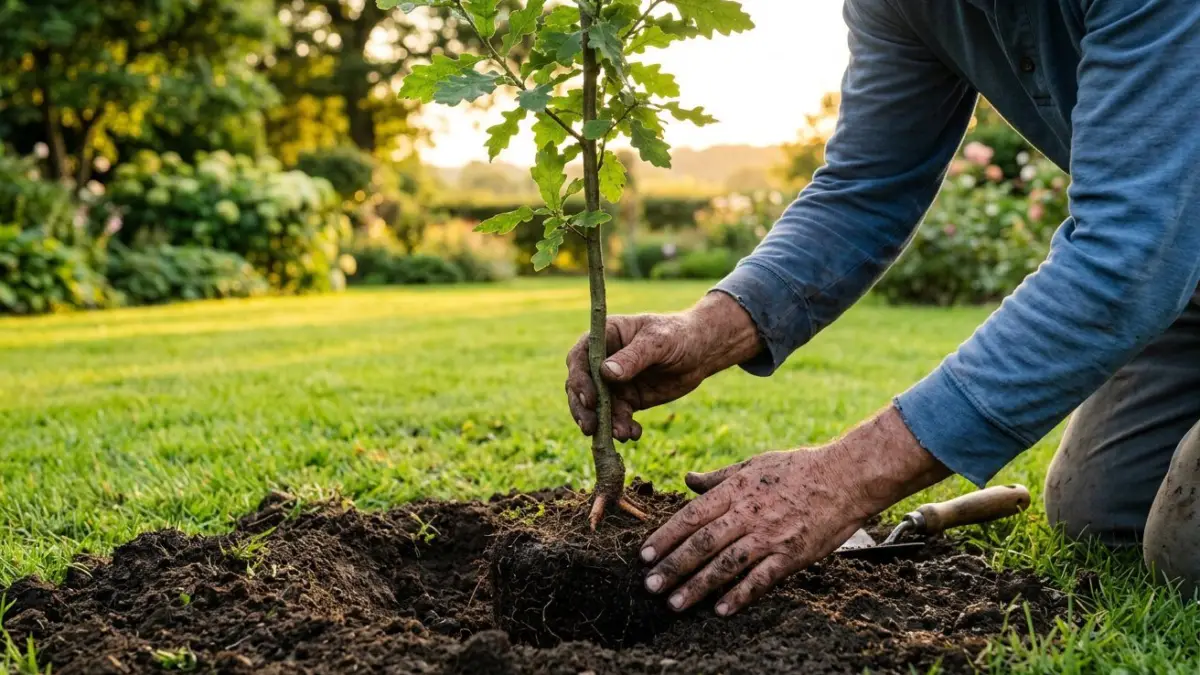
How to plant a tree properly takes about ten minutes of professional method: dig the right hole, set the root flare at ground level and water deeply so the roots can settle.
Plant a tree in a wide, shallow hole, with the root flare (where the trunk widens into roots) just above the soil surface, backfilled with the soil you dug out and watered slowly. That is the whole method, and it takes about ten minutes of real work. Most trees that fail in their first three years were planted too deep, in a narrow hole, with roots still circling the shape of the pot.
This guide is for anyone planting a container, bare-root or balled tree in a home garden. It sits in the Trees guides and leads on to Tree Watering and Mulching and How to Prune Trees Safely.
Planting at a glance
| Question | Answer |
|---|---|
| Hole width | 2 to 3 times the width of the root ball |
| Hole depth | Equal to the height of the root ball, minus 2 to 5 cm so the flare sits above grade |
| Hole walls | Sloping, with rough (not glazed) sides |
| Backfill | The native soil you removed; no fertilizer, little or no compost |
| First watering | 20 to 40 litres, slowly, straight after planting |
| Stakes | Only if the trunk cannot stand alone; loose ties; remove at 12 months |
| Mulch | 5 to 8 cm deep, a ring about 1 m across, 10 cm clear of the bark |
Choose the site before you buy the tree
A tree is planted once, so the site decides more than technique does. Look up for wires and eaves, then down for pipes and drains. A useful rule is to keep a large tree at least half its mature canopy width from walls, and further from drains if the species is thirsty. Full sun suits most fruit and flowering trees, while many woodland natives tolerate part shade. If rain leaves water standing in the spot for more than a day, choose a tree that tolerates wet feet (alder, swamp cypress, some willows) or plant on a low mound.
For size and habit, check Best Shade Trees for Home Gardens, and if fruit is the goal, Fruit Trees for Beginners.
When to plant, by climate
| Climate | Best window | Why | Avoid |
|---|---|---|---|
| Cool temperate | Autumn to early winter, or late winter to early spring | Roots grow in soil above about 5 to 7°C even when the top is dormant | Frozen or waterlogged ground |
| Hot dry (Mediterranean, arid) | Autumn, so winter rain does the watering | A full cool season to root before the first summer | Late spring, when heat arrives before roots do |
| Humid tropical | Start of the rainy season | Rain waters in, and heat and humidity push fast root growth | Peak monsoon waterlogging, and the dry months |
| Subtropical | Autumn, and early spring after frost danger | Mild soil temperatures in both | Midsummer |
Bare-root trees must go in while dormant and ideally within days of purchase. Container trees are more forgiving, but the same logic holds: a tree planted into warm soil and cool air is the aim.
Read the root ball before you dig
Nursery trees are often potted or balled too deep. Scrape away the top soil or burlap until you find the first main lateral roots and the trunk flare. Measure from there to the bottom of the ball: that, not the pot depth, is your digging depth. If the flare is buried 5 to 10 cm, take the extra soil off before planting.
- Container trees: slide the tree out and check for circling roots. Cut or tease out any that wrap the ball, and slice vertically through a solid root mat in three or four places. Roots left circling often become girdling roots that strangle the trunk 10 to 20 years later.
- Bare-root trees: soak the roots for a few hours (not days) before planting. Trim only damaged or broken roots, and spread the rest in a natural fan.
- Balled and burlapped trees: set the ball in the hole first, then cut and remove the wire basket and any plastic or synthetic twine. Fold natural burlap down around the ball or remove it, so it can’t wick moisture away from the roots.
The planting method, step by step
- Mark the circle. Outline a circle 2 to 3 times the ball width. Remove turf and weeds inside it, as grass competes fiercely with young roots.
- Dig a saucer. Make the sides slope outward, with the bottom flat and firm. Roughen any smooth, glazed clay walls with a fork so roots can cross them.
- Check the depth. Lay a spade handle across the hole. The root flare should sit 2 to 5 cm above the handle line, or higher in heavy clay.
- Lift by the ball. Never carry a tree by the trunk. Set it on the undisturbed hole floor, then turn it so the best side faces the view.
- Backfill in layers. Return the native soil, breaking big lumps, and water as you go to settle air pockets. Don’t stamp heavily, which compacts the soil.
- Build a water basin. Form a low ridge of soil about 5 cm high around the outer edge of the planting hole to hold water.
- Water slowly. Give 20 to 40 litres, slowly enough that none runs off. Top up soil that sinks.
- Mulch. Spread 5 to 8 cm of wood chips or bark and keep it 10 cm from the trunk.
Stakes, guards and the first pruning
A trunk that sways grows thicker and stronger, so stake only when the tree can’t hold itself up, such as a tall, thin tree on a windy site or a heavy-headed standard. Use one or two stakes, set outside the root ball, with wide soft ties placed about a third of the way up the trunk. Check them each season and remove them at 12 months. Stakes left on become strangling ties.
A guard of mesh protects bark from rabbits, mowers and strimmers. Leave the top few centimetres open for air. As for pruning, take off only broken or crossing wood now. Structural pruning waits for year two or three.
Special situations
- Heavy clay: the hole can act as a sump. Plant 5 to 10 cm high with the flare well proud, and slope soil up to it. Don’t fill the hole with sand or compost, which holds water in a bowl.
- Sandy soil: water drains past roots quickly, so build a bigger basin and plan on watering twice as often in year one. A 8 cm mulch ring helps most here.
- Slopes: cut a level shelf and plant on it, with the basin ridge on the downhill side.
- In lawn: keep a mulch circle at least 1 m across. Mower damage to the trunk base is one of the commonest causes of death in young trees.
- Windy coasts: choose tough species, keep trees short and stake low so the crown can flex.
The first year after planting
A new tree has lost much of its root system in the nursery, so the first growing season is about rebuilding it. Expect modest top growth: a tree that adds only a little shoot length in year one is often putting its energy underground, which is exactly right. Water the root ball directly two or three times a week in warm weather for the first month, then taper to weekly. Probe 15 to 20 cm down beside the ball before each watering, and skip it if the soil is still damp.
Hold off on fertilizer until the second spring, and then use a light, balanced feed spread under the canopy rather than against the trunk. Pull weeds by hand inside the mulch ring, and refresh the mulch each spring as it breaks down. By the end of year two, most trees will have rooted out well past the planting hole, and the water basin can be levelled. A tree is usually considered established after two or three growing seasons, when it can ride out a normal dry spell without help.
Troubleshooting a new tree
| Symptom | Likely cause | Fix |
|---|---|---|
| Wilting with wet soil | Hole is holding water, or planted too deep | Check at 20 cm; lift the tree, improve drainage or replant higher |
| Wilting with dry root ball | Water is missing the ball | Water directly onto the ball; use a slow trickle |
| Leaves small and pale in the first summer | Root loss, slow establishment | Steady watering, mulch, no fertilizer |
| Bare twigs after leafing out | Dormant buds not yet pushing, or dead branches | Scratch the bark with a thumbnail: green means alive, so wait a full season |
| Trunk leaning | Loose ball, wind, or heavy crown | Re-firm soil; add a low stake |
What a tree needs when you plant it
A hole as deep as the root ball and two to three times as wide lets roots spread through loose topsoil, while a deep hole causes the tree to settle and rot. The root flare should sit at or just above ground level, because buried bark encourages canker and root rot. Loosening circling roots with your hands prevents them from girdling the trunk years later.
Backfilling with the soil you dug out encourages roots to leave the hole, while rich compost can hold water and keep them inside it. A stake supports the trunk in wind for a year, but a tight tie damages the bark, so you should check it each spring. Mulch in a ring cools the soil and reduces weeds, though piling it against the trunk hosts rodents and fungus. How often should you water? A deep soak once or twice a week through the first summer supports establishment better than light daily sprinkling. Your local extension service or an arborist can advise on species and spacing.
What happens in the ground after you plant a tree
A hole three times as wide as the root ball lets roots spread through loose topsoil, while compacted clay at the sides blocks them and holds water that causes root rot. The root flare should sit 2 to 3 cm above ground, because buried bark encourages canker and fungus on oak, maple and cherry. Loosening circling roots with your hands prevents girdling that kills a birch or maple after 5 or 10 years.
Backfilling with the soil you dug out encourages roots to leave the hole, but rich compost and manure hold water and keep roots inside it. A stake supports the trunk in wind for a year, and a tight tie damages the bark and blocks the sap of apple and pear. A ring of mulch 5 to 8 cm deep cools the topsoil and reduces weeds, though mulch against the trunk hosts rodent and fungus. A slow soak of 20 to 40 litres each week controls drought stress and encourages deep roots in the first summer. Spring and autumn suit most species because soil temperature supports root growth without heatwave stress. An arborist or your extension service can advise on species, and tree watering and mulching improves survival.
Bare-root maple, apple and cherry establish fastest when you plant them between November and March, because cool soil temperature protects the roots while the buds stay dormant. Soaking the roots for 30 minutes holds moisture and prevents drying before planting. Mycorrhiza powder supports root growth on poor sand, and a drip line or soaker hose delivers water to the right zone. Clay needs a hole with sloping sides so water drains away from the roots, and a fork improves drainage at the base. You’ll find that a tree watered deeply in its first two summers tolerates drought for decades.
Staking suits bare-root apple and cherry in exposed gardens, but a stake that stays on for years weakens the trunk, so you should remove it after 12 months. Fertiliser in the hole burns roots, and compost on the surface feeds earthworm activity without harm. Netting protects a young plum from rabbit and deer, and a guard of 60 cm stops the chewing that kills bark.
Common mistakes and what causes them
- Burying the flare. Cause: digging to the pot depth, or mulch piled on later. Fix: expose the flare and keep mulch off the bark. A buried flare rots bark and sends out girdling roots.
- A narrow, deep hole. Cause: digging with a post-hole digger. Fix: dig wide and shallow, because roots spread sideways in the top 30 to 60 cm.
- Enriched backfill. Cause: wanting to give the tree a head start. Fix: use native soil; the tree needs to adapt to the soil it will live in.
- Daily sprinkling. Cause: fear of drying out. Fix: soak deeply and less often, as set out in the tree watering guide.
- Leaving plastic or wire on. Cause: assuming it will rot. Fix: remove everything synthetic from the ball.
Most trees need little support, and this guide shows when to stake and how to protect young bark: Staking and Protecting Young Trees.
What to read next
Set up the first-year routine in Tree Watering and Mulching, shape the tree later with How to Prune Trees Safely, and check soil pH explained if leaves stay pale. Back to the Trees guides.
Frequently asked questions
How do I find the root flare on a potted tree?
Scrape away the top soil until you see the first main lateral roots and the point where the trunk widens. Nursery trees are often potted too deep, sometimes by 5 to 10 cm. Measure your hole depth from that point, not from the pot rim.
Should I remove the pot, burlap and wire basket?
Remove the pot, any plastic, the wire basket and synthetic twine. Natural burlap should be cut away or folded down so it cannot wick moisture from the roots. Set a balled tree in the hole before cutting the basket, and never carry a tree by its trunk.
What do I do with circling roots on a container tree?
Tease out or cut roots that wrap the ball, and slice vertically through a solid root mat in three or four places. Roots left circling can become girdling roots that strangle the trunk 10 to 20 years later.
How should I plant a tree in heavy clay?
Plant 5 to 10 cm high, with the flare well above the surrounding soil, and slope soil up to it. Do not fill the hole with sand or compost, which turns it into a sump. Roughen glazed hole walls with a fork so roots can cross.
How much water does a new tree need straight after planting?
Give 20 to 40 litres, poured slowly enough that none runs off, and top up any soil that sinks. Keep the soil moist but not soggy in the first month. Probe 15 to 20 cm down beside the ball before each later watering.
Can I plant a tree on a slope?
Yes. Cut a level shelf and plant on it, with the water basin ridge on the downhill side. That stops water running away from the root ball and keeps the trunk upright. Mulch the ring afterwards, keeping it clear of the bark.
How long does a new tree take to establish?
Most trees count as established after two or three growing seasons, when roots reach well past the planting hole. Keep watering through dry spells until the third summer. Modest top growth in year one is normal, because the tree is rebuilding its roots.
Why are the leaves on my new tree small and pale?
Root loss at transplanting is the usual cause, and it should improve as roots establish. Keep watering steady, mulch, and skip fertilizer. If leaves wilt while the soil is wet, the hole may be holding water or the tree may be planted too deep.
How can I tell if a bare twig on a new tree is alive?
Scratch the bark with a thumbnail. Green underneath means it is alive, so wait a full season before deciding. Brown and dry means that twig is dead. Buds can be slow to open in a year of transplant stress.
Is it a mistake to plant a tree close to the house?
Often, yes. Keep a large tree at least half its mature canopy width from walls, and further from drains if the species is thirsty. Check for buried services and overhead wires before digging. Best Shade Trees for Home Gardens lists mature sizes.
More in Trees
Best Shade Trees for Home Gardens (Fast, Clean, Beautiful)
Choose a shade tree by mature size, root habit, litter and climate, then place it where its shadow cools your wall or seat. Includes spacing rules…
Fruit Trees for Beginners: 7 That Almost Grow Themselves
Pick fruit trees by chill hours, pollination group and rootstock, and set honest expectations for years to first harvest, from fig in 2 years to pear…

How to Prune Trees Safely: Cuts, Timing and Tools
Where to make the cut, how much to remove, the right season by tree type, and the ladder, chainsaw and power-line limits that tell you when…