Quick answers
- Where do I start when designing a garden?
- Start with analysis, not plants. Understand your site: sun, soil, wind, views, privacy needs, and how you want to use the space.
- What is the most important design principle?
- Unity: the sense that everything belongs together. Unity comes from repetition, a limited palette, and a clear concept.
- How do I make a small garden look bigger?
- Create depth with layered planting, use curved paths to hide the full extent, frame views, and keep the planting simple.
- What garden style is right for me?
- The right style is the one that reflects your taste and suits your site. Let your instinct guide you.
Key takeaways
- Start with analysis, not plants. Understand your site before choosing a single plant.
- Unity is the most important principle. Repetition, limited palette, and clear concept create a garden that feels intentional.
- Scale matters more than you think. Plants grow. Paths need to be wide enough for two people.
- Create mystery and movement. A garden that reveals itself in stages feels larger and more interesting.
- Choose a style that reflects you and suits your site. Your garden, your rules.
- Structure before flowers. Paths, fences, walls, and large plants create the framework.
- Invest in quality hardscape. A well-built path lasts decades and defines the garden.
- Maintain what you build. A garden too complex for your maintenance capacity will decline.
Table of contents29 sections
- The design sequence
- The principles that do the most work
- Choosing a style
- Small spaces, balconies and terraces
- Paths and hardscaping
- Colour and planting
- Lawn: how much and how to keep it
- Water and light as the final layer
- Troubleshooting a design that feels off
- How garden design choices shape planting, paths and landscaping
- What questions does this guide answer?
- What does each guide cover?
- Principles: Garden design principles
- Styles: Garden styles explained
- Small spaces: Small garden design ideas
- Balconies: Balcony and terrace gardens
- Hardscape: Garden paths and hardscaping
- Colour: Garden colour theory
- Lawn: Lawn care basics
- Evening layer: Water features and garden lighting
- Privacy: Privacy Screens and Hedges: Plants, Fences and Layout
- Edging: Best Garden Edging Materials
- What size should paths, steps and seating areas be?
- Which colours create which effect?
- How do you care for a lawn through the year?
- How do the design choices affect each other?
- Key terms
- Common mistakes in garden design
- Where to go next
Garden design and landscaping start with how you want to use the space, so this guide takes you from a first sketch to planting, paths, lawn, water and light.
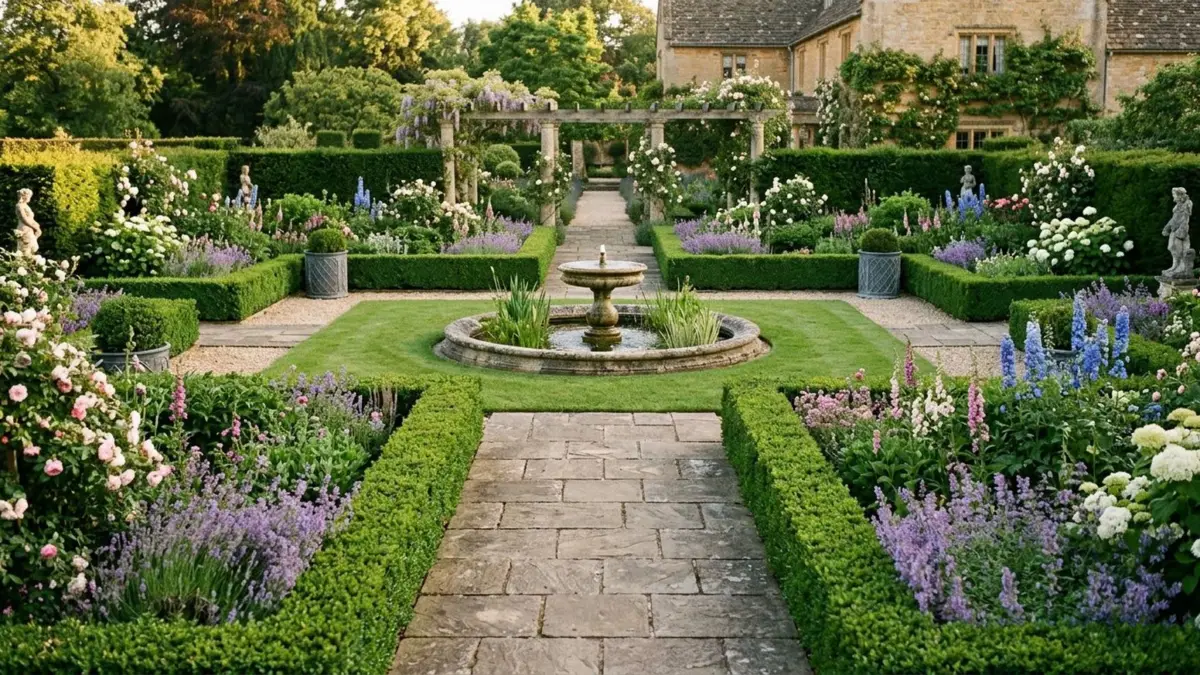
Garden design is the process of arranging paths, structure, planting and features so a garden is balanced, easy to use and good to look at in every season, using four working principles: balance, scale, rhythm and unity.
A good garden design rests on a few principles that work at any size: a clear structure of paths and boundaries, a restrained palette, repeated plants and materials, and a sense of scale that fits the space. This guide links the design guides so you can plan from the hard surfaces outward, then add colour, planting, lawn and light.
Quick answer: plan the layout before planting: decide where you’ll walk and sit, build paths and edges first, limit your palette to two or three colours plus green, and repeat a few plants to create rhythm.
Design is easiest in the order a garden is built. Decide how you’ll move through the space and where you’ll sit, lay the hardscape, plan planting for colour and rhythm, and add finishing layers such as water and lighting. Planting choices connect to the flower gardening guides, and evening effects are in the water features and lighting guides.
The design sequence
| Step | Question to answer | Guide |
|---|---|---|
| Principles | What makes a layout feel balanced and calm? | Garden design principles |
| Style | Formal, cottage, modern, wild or Mediterranean? | Garden styles explained |
| Small space | How do I make a compact plot feel larger? | Small garden design ideas |
| Balcony or terrace | What works above ground? | Balcony and terrace gardens |
| Bones | Paths, edges, patios and steps | Paths and hardscaping |
| Colour | Which combinations work together? | Garden colour theory |
| Lawn | How much lawn, and how to keep it | Lawn care basics |
| Evening layer | Water and light | Water features and garden lighting |
The principles that do the most work
Four ideas account for most of what makes a garden feel designed. Balance spreads visual weight, either symmetrically or by offsetting a large element with several smaller ones. Scale relates objects to each other and to the space, so a huge feature crowds a small plot. Rhythm comes from repeating shapes, colours or plants, which gives the eye a pattern to follow. Unity comes from a limited palette of materials and plants, so the garden reads as one place. When a design feels wrong, one of these four is usually the cause. See garden design principles for worked examples.
Choosing a style
| Style | Defining features | Upkeep |
|---|---|---|
| Formal | Symmetry, clipped hedges, geometric beds | High, regular clipping |
| Cottage | Dense, mixed, informal planting | Moderate, staking and deadheading |
| Modern | Clean lines, few materials, bold foliage | Low to moderate |
| Naturalistic | Drifts of grasses and perennials | Moderate, seasonal cut-back |
| Mediterranean | Gravel, drought-tolerant silver and herb plants | Low once established |
The style should suit your climate and your time, not only your taste. The comparison in garden styles explained includes how each one performs in different conditions.
Small spaces, balconies and terraces
In a small garden, the usual tools are vertical growing, a clear focal point, curved or diagonal lines that lengthen the view, and a limited plant palette so the space isn’t busy. Containers and trellis make use of walls and corners. On balconies and terraces, weight limits, wind and heat are the practical constraints, so check what the structure can carry and choose lighter pots and tough plants. See small garden design ideas and balcony and terrace gardens.
Paths and hardscaping
Hard surfaces set the layout for decades, so they come before planting. Paths should follow the way people actually walk, and a main path is comfortable at about 90 cm wide for two people to pass. Foundations matter more than the surface: a compacted sub-base prevents sinking and puddles, and a gentle slope away from buildings sends water away. Permeable surfaces such as gravel or open-jointed paving reduce runoff. The construction details are in garden paths and hardscaping.
Colour and planting
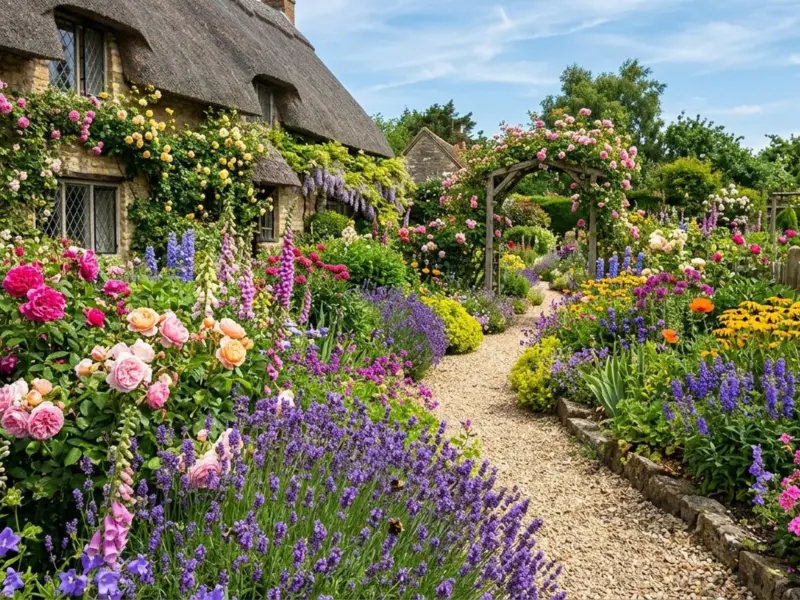
Colour works best with a plan. A limited palette, for example two or three main colours plus green, reads as calm, while using many colours can read as busy. Warm colours such as red and orange advance and make a space feel closer, and cool colours such as blue and purple recede and make a space feel larger. White and silver stand out in low light, which is why they suit evening gardens. Foliage colour and texture carry the garden when flowers fade, as covered in garden colour theory.
Lawn: how much and how to keep it
Lawn is a design decision with a maintenance bill, since it needs mowing, feeding and watering. A smaller lawn with a clear shape is easier to keep than a large irregular one, and shaded or dry areas often do better with ground cover or planting. If you keep lawn, the main practices are mowing at the right height (taller grass roots deeper and shades out weeds), feeding at the right time of year for your grass type, and watering deeply but rarely. See lawn care basics.
Water and light as the final layer
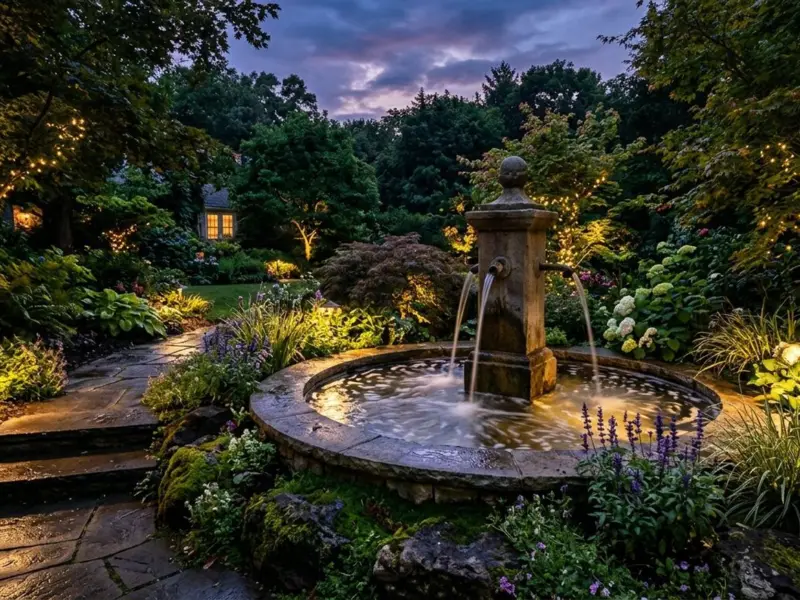
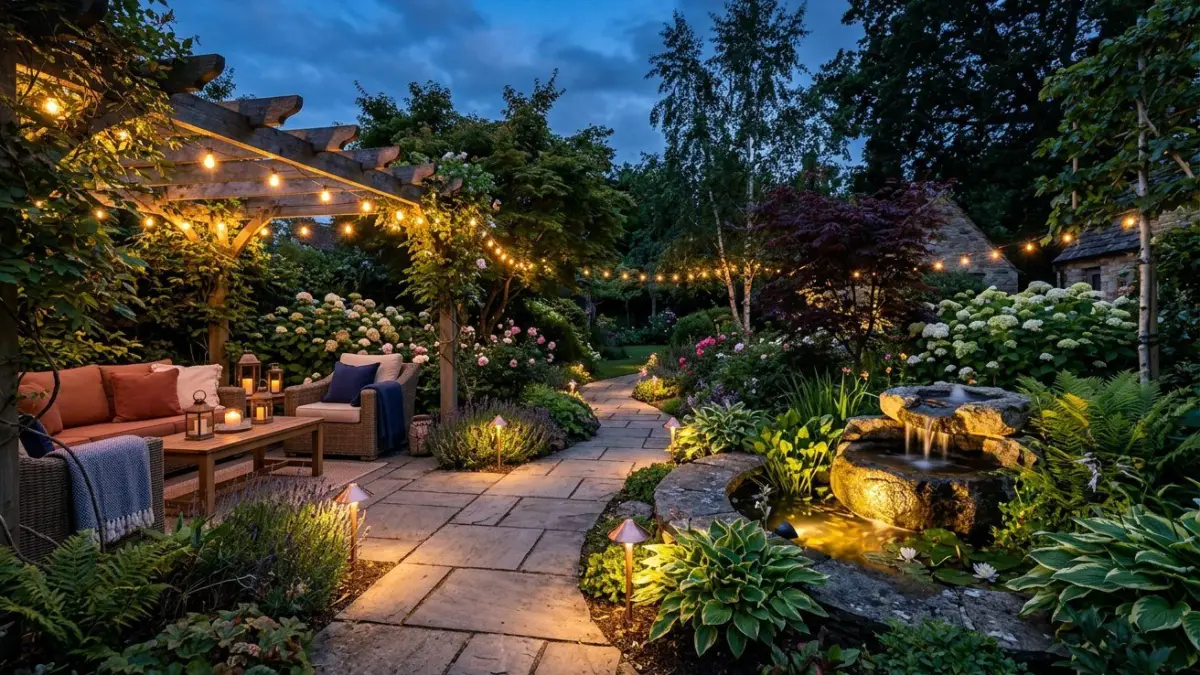
Water adds sound, movement and wildlife, and lighting extends the use of the garden into the evening. Both add safety considerations, because mains electricity near water and open water near children need careful planning. The planning approach is in water features and garden lighting, with detail in the water features and lighting guides.
Water and mains electricity are a dangerous combination. Use low-voltage or solar lighting where possible, protect any mains circuit with an RCD (GFCI), and have fixed outdoor wiring installed by a qualified electrician. Open water is a drowning risk for small children.
Troubleshooting a design that feels off
| Symptom | Likely cause | Fix |
|---|---|---|
| Garden feels cluttered | Too many materials, colours or plant types | Reduce the palette and repeat key plants |
| Garden feels flat | No variation in height | Add structure: shrubs, climbers, containers |
| Space feels small | Boundaries too visible, straight view | Soften edges, add curved paths and layers |
| Nothing looks good out of season | All planting peaks at once | Add evergreens, bulbs and late perennials |
| Puddles on the path | Poor sub-base or no fall | Rebuild the base with a slight slope |
How garden design choices shape planting, paths and landscaping
Yew blocks wind and protects rose, lavender attracts bee and suits gravel, and hydrangea needs shade where hosta tolerates it and birch shades fern. Box holds a clipped edge and blocks wandering grass, ivy covers a fence and supports wildlife, and clematis needs cool roots that rose shades.
Mulch reduces weeds and protects peony roots, compost feeds rose and improves clay and loam, sand drains clay and protects a paver base, and gravel drains water and suits lavender edges. Clover tolerates feet and holds soil, thyme tolerates paving and suits sunny gaps, catmint tolerates drought and suits gravel, and sage needs sun while fern needs shade. A path of 1.2 m suits two people, a bed 2 m deep holds three layers, and repeating each plant 3 or 5 times gives rhythm. Keep lawn grass at 5 cm in summer, sketch the layout first and you’ll see gaps before you buy, and your extension service or the rhs lists plants for your climate.
What questions does this guide answer?
Quick answers to the questions people ask most, each linked to the guide that answers it in full.
| Type | Question | Short answer | Full answer |
|---|---|---|---|
| What | What are the main design principles? | Balance, scale, rhythm and unity. Most designs that feel wrong break one of the four. | Design principles |
| How | How do I make a small garden feel bigger? | Use curved or diagonal lines, vertical growing, a focal point and a limited palette. | Small garden ideas |
| How | How wide should a path be? | About 90 cm for a main path two people can share, and 45 to 60 cm for secondary paths. | Paths and hardscaping |
| When | When is the best time to design a garden? | Before planting, and ideally after a full year of watching sun, shade and drainage. | Design principles |
| Why | Why does my garden look messy? | Too many plant types, colours or materials. Repeat fewer plants and simplify the palette. | Colour theory |
| Which | Which garden style suits me? | The one that fits your climate, time and house. Formal needs clipping, naturalistic needs a seasonal cut-back. | Garden styles |
| How | How tall should I mow my lawn? | Most lawns do best at about 5 to 7.5 cm for cool-season grasses, never removing more than a third at once. | Lawn care |
| Which | What works on a balcony? | Light containers, wind-tolerant plants and a check on the weight the structure can carry. | Balcony gardens |
What does each guide cover?
Principles: Garden design principles
Balance, scale, rhythm and unity, with worked examples of how each one changes how a garden feels.
Styles: Garden styles explained
A comparison of formal, cottage, modern, naturalistic and Mediterranean styles by look, upkeep and climate.
Small spaces: Small garden design ideas
Ten techniques for compact plots, from vertical planting to mirrors and diagonal lines.
Balconies: Balcony and terrace gardens
Weight limits, wind, heat and watering for above-ground gardens, with plant lists.
Hardscape: Garden paths and hardscaping
Path widths, sub-bases, materials and drainage, with a step-by-step build method.
Colour: Garden colour theory
How warm, cool and neutral colours change perceived space and mood, with combinations that work.
Lawn: Lawn care basics
Mowing, feeding, watering and repairing a lawn through the year.
Evening layer: Water features and garden lighting
How to plan sound, reflection and light for evening use, with safety rules.
Privacy: Privacy Screens and Hedges: Plants, Fences and Layout
The guide compares hedges, fences and trellis, gives heights and spacing, and shows how to plant and trim a hedge.
Edging: Best Garden Edging Materials
The guide compares metal, timber, brick, stone and plastic for curves, cost and life, and shows how to cut the trench and fit an edge.
What size should paths, steps and seating areas be?
| Element | Comfortable size | Why |
|---|---|---|
| Main path | About 90 to 120 cm wide | Two people can pass, wheelbarrow fits |
| Secondary path | About 45 to 60 cm wide | One person, narrow beds |
| Step riser | About 10 to 15 cm high | Comfortable to climb and safe in wet weather |
| Step tread | At least about 30 cm deep | Space for the whole foot |
| Seating area for a small table | About 2.5 by 2.5 m | Room for chairs to be pulled out |
Which colours create which effect?
| Colour group | Effect in a garden | Best for |
|---|---|---|
| Red, orange, yellow | Energetic, appears closer | Focal points, large spaces |
| Blue, purple | Calm, appears further away | Making small gardens feel deeper |
| White, silver | Glows in low light | Evening gardens, dark corners |
| Green foliage | Neutral background, unifies | Linking different plantings |
How do you care for a lawn through the year?
| Season | Main jobs |
|---|---|
| Spring | First mows high, rake out thatch, feed as growth starts, repair bare patches |
| Summer | Mow regularly at a higher setting, water deeply and rarely |
| Autumn | Overseed and feed, clear leaves promptly |
| Winter | Keep off frozen or waterlogged grass, service the mower |
How do the design choices affect each other?
Many plant types and materials cause a cluttered look, which a limited palette removes. A weak sub-base causes sunken paths and puddles, which makes repairs more expensive than building it right. Bright lighting causes glare, which makes the dark beyond feel darker. A large lawn causes more mowing, feeding and watering, which is why a smaller, well-shaped lawn is easier to keep. Design decisions chain together in the same way, so fix the structure first and the planting second.
Key terms
- Focal point: a feature that draws the eye, such as a tree, bench or sculpture.
- Hardscaping: the non-living structure of a garden, such as paths, walls and patios.
- Sub-base: compacted stone layer beneath paving that prevents settling.
- Drift: a group of the same plant, planted in an irregular, flowing shape.
- Borrowed landscape: using views beyond the garden as part of the design.
Common mistakes in garden design
- Planting before planning the layout. Beds and paths end up in the wrong places, so draw a plan first.
- Using too many plant types. The garden looks busy, so repeat fewer plants.
- Ignoring mature size. Plants crowd each other, so space for the final size.
- Cheap foundations. Paths sink, so invest in the base.
- Forgetting winter. The garden empties, so include evergreen structure.
Where to go next
For plant selection see the flower gardening guides and the trees guides, for the ground itself see the soil, water and fertilizer guides, and for the evening layer see the water features and lighting guides.
Frequently asked questions
What is hardscaping in a garden?
Hardscaping is the non-living structure of a garden, such as paths, patios, walls, steps and edging. It sets the layout for years, so it goes in before planting. Softscaping is the planting that sits within that framework, and the two should share a limited set of materials.
How do I start designing a garden from scratch?
Start with a scale sketch of the plot, marking the house, boundaries, sun, shade, drainage and any trees. Then decide where you will sit and walk, add paths and structure, and choose plants last. This order stops you buying plants that have nowhere sensible to go.
How long should I observe my garden before redesigning it?
Ideally watch it for a full year. You will see where sun and shade fall in each season, where water collects after rain and which areas stay frosty. If you cannot wait, at least note the light at three times of day and the wettest spots.
What is a focal point in garden design?
A focal point is the one feature the eye lands on, such as a specimen tree, bench, urn or water bowl. It works best at the end of a main sightline and in plain surroundings. One strong focal point per view looks calmer than several competing ones.
Why does my garden look flat even with lots of plants?
A flat garden usually has everything at the same height. Add structure with shrubs, climbers on trellis, a small tree or tall containers so the eye moves up and down. Three tiers in a border, low at the front and tallest at the back, give depth.
How much lawn should a garden have?
There is no fixed figure, but a smaller lawn with a clear shape is easier to keep than a large irregular one. Lawn needs mowing, feeding and watering, so keep it where it is used and replace dry or shaded areas with planting or ground cover.
Should I build paths before planting?
Yes. Hard surfaces set the layout and need heavy digging and compacting that would damage new plants. Build paths, edges and patios first, then plant around them. Paths that follow the way people actually walk also stop worn shortcuts across beds and lawn.
How much space do I need for a patio dining area?
A table for two needs about 1.8 to 2.4 m square, and a table for four to six needs about 3 by 3 m or more. Allow room to pull chairs out and about 90 cm of clear walkway around the table.
How do I choose a garden style for my climate?
Match the style to your site first. Mediterranean planting needs sun and sharp drainage, Japanese-inspired schemes want shelter and some shade, and cottage gardens like moist, fertile soil. Forcing plants into the wrong conditions is the costliest design mistake, so check what thrives locally.
Is it safe to put lights and pumps near a garden pond?
It can be, but only with the right precautions. Use low-voltage or solar lighting where possible, protect any mains circuit with an RCD (GFCI), and have fixed outdoor wiring installed by a qualified electrician. Open water is also a drowning risk for small children.
All Garden Design guides
Small Garden Design Ideas: 10 Tricks That Double Your Space
Diagonal lines, hidden views, walls as planting space and right-sized pots, with the measurements that make a small garden feel larger and work harder.
Lawn Care Basics: A Season-by-Season System
Mowing heights by grass type, how deep to water, cool-season versus warm-season timing, and how to read yellow or bare patches before spending money on products.
Garden Paths & Hardscaping: Build the Bones of Your Garden
Plan path width, sub-base depth, a 1 to 2% drainage fall, permeable surfaces and edging so paths and patios stay level, drain well and survive frost.
Balcony & Terrace Gardens: The Complete Setup Guide
Check weight limits first, then handle wind, drainage and sun. A practical setup for balconies and terraces, with pot weights, screens and layout rules.
Garden Color Theory: Paint Your Beds Like an Artist
Use the color wheel, plant value and the light you actually garden in to build beds with a clear palette, strong repetition and color that holds…
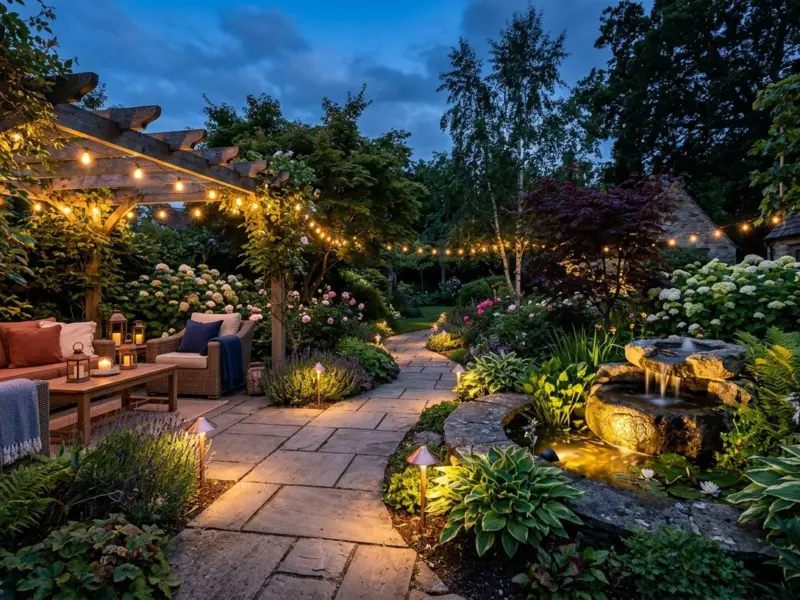
Water Features & Garden Lighting: The Evening Transformation
How to site a water feature and light layer, choose between options, and weigh budget against upkeep, with links to the detailed guides for each build.
Garden Design Principles: Balance, Scale, Rhythm, Unity
Unity, balance, rhythm, focal points and scale turned into measurable rules, plus a worked layout for a 12 m by 8 m plot you can copy…
Garden Styles Explained
Compare cottage, formal, Mediterranean, modern, wildlife and Japanese-inspired gardens by plants, upkeep and cost, then pick one that fits your house, soil and time.
Privacy Screens and Hedges: Plants, Fences and Layout
How to plan a garden privacy screen with hedges, trellis, fences and tall plants: heights, spacing, fast and evergreen choices, and how to plant and trim…
Best Garden Edging Materials
How to choose garden edging: metal, timber, brick, stone and plastic compared for cost, life and curves, plus depth, installation steps and how to edge lawns…