Quick answers
- How wide should a low-maintenance border be?
- Aim for 1.2 to 1.5 m (4 to 5 ft) so you can plant three layers and still reach the middle from either side. Narrower than 60 cm and plants lean out over the lawn or path, which means more edging and trimming.
- How many plants do I need per square metre?
- Plant medium perennials at 5 to 7 per square metre, large ones at 2 to 3, and small edgers at 9 to 12. Planting to final spread rather than leaving gaps is what shades out weeds by the second summer.
- How much work does a border like this really need?
- In year one expect weekly weeding and watering through dry spells. From year two, a 4.5 square metre border typically needs one big cut-back and mulch session in late winter, a light tidy in summer and dividing every 3 to 5 years. Our mulching guide covers the annual top-up.
- Should I use landscape fabric under the plants?
- Generally no. Perennials cannot spread through it, and weed seeds root in the mulch that settles on top, so the fabric just hides the problem. A 5 cm (2 in) layer of bark or compost mulch, kept off the plant crowns, suppresses weeds better over the long run.
Key takeaways
- Plant to final spread: 5 to 7 medium perennials per square metre closes the canopy by year two
- Pick plants that never need staking, such as catmint, hardy geranium, salvia, echinacea and sedum
- Use 5 cm of mulch each late winter, kept clear of crowns, instead of landscape fabric
- Cut back once a year and divide clumps every 3 to 5 years; do not deadhead what you can leave
Table of contents13 sections
- Low-maintenance borders at a glance
- Start with the site for a low maintenance flower border
- A simple planting formula for flower borders
- A sample plan for 3 m by 1.5 m
- Flower border plants that skip the chores
- Planting day and the first season
- Edges of a flower border and the lawn boundary
- The yearly work calendar for a low maintenance border
- When the border misbehaves
- What keeps a low maintenance flower border easy
- What keeps a low-maintenance flower border looking professionally designed
- Common mistakes
- Next steps
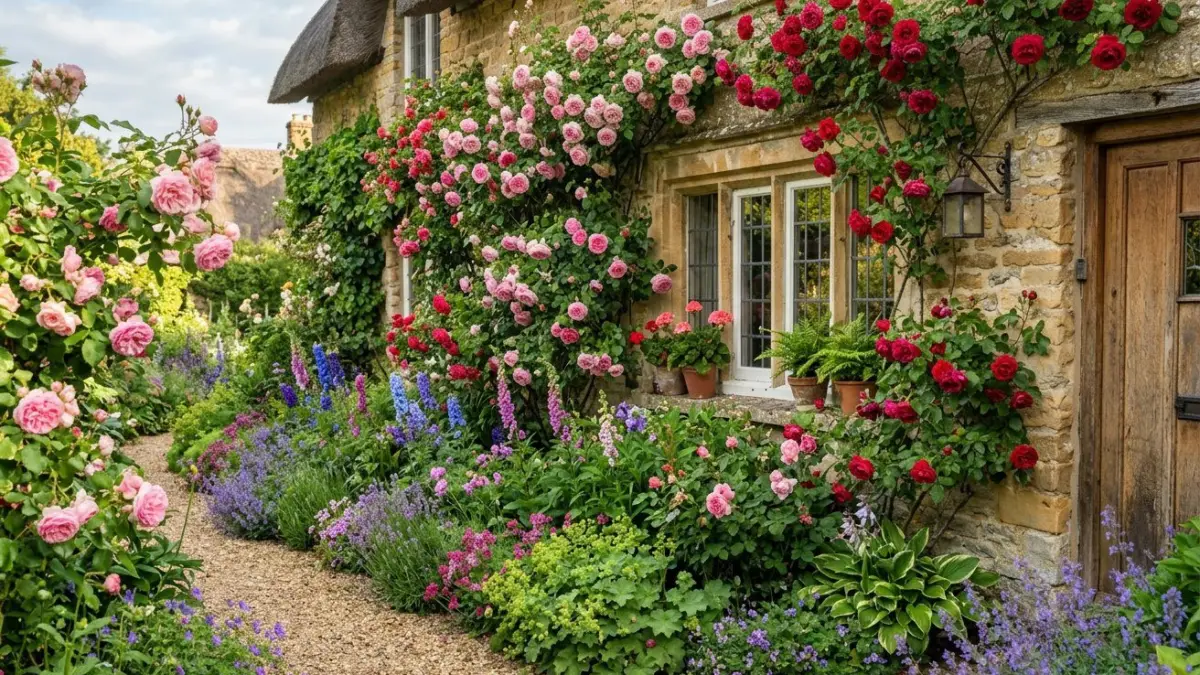
Low-maintenance flower borders that look professionally designed rely on tough perennials, dense planting and a thick mulch that cuts weeding to almost nothing.
A low-maintenance border is one where the plants are matched to your soil and light, planted dense enough to close over bare ground by the second summer, and chosen so they never need staking or constant deadheading. Do that and a 4.5 square metre (about 48 sq ft) border typically needs roughly an hour a month in season. This guide gives the width, spacing and counts, a sample plan, the plants that earn their place, and a year of work in order.
It belongs to the Flower Gardening guides. For the choice between short-lived and long-lived plants read Annuals vs Perennials, and for sun-baked sites start with Flowering Plants for Full Sun.
Low-maintenance borders at a glance
| Factor | Guideline |
|---|---|
| Best width | 1.2 to 1.5 m (4 to 5 ft); minimum 60 cm for a single path edge |
| Large perennials or grasses | 2 to 3 per square metre |
| Medium perennials | 5 to 7 per square metre |
| Small edgers and groundcover | 9 to 12 per square metre |
| Mulch depth | 5 cm (2 in), refreshed each late winter |
| Watering after planting | One deep soak a week for the first season; rarely after year two |
| Dividing | Every 3 to 5 years, in early spring or early autumn |
| Time to look “full” | Usually the second summer |
Start with the site for a low maintenance flower border
Most maintenance comes from fighting the site. A plant that wants sharp drainage will rot in clay, and a plant that wants moisture will sulk against a south wall. Before you buy anything, spend a day noting how many hours of direct sun the bed gets (6 or more is full sun, 3 to 6 is part shade) and squeeze a handful of damp soil: if it holds a shiny, sticky ball it’s clay, and if it won’t hold together it’s sandy. Understanding Your Soil Type walks through the jar test.
Then match the plant to what you found. In clay with full sun, daylilies, rudbeckia, echinacea and sedum cope well. In sandy, dry ground, catmint, lavender, Russian sage and feather reed grass are better bets. In part shade, hardy geraniums and Japanese anemones cope, and the heavier shade options are in Shade-Loving Flowers. Hardiness varies by cultivar, so check the zone label on the plant against your own winter minimum.
A simple planting formula for flower borders
Designers repeat plants because repetition looks calm and reads as intentional. A workable rule of thumb is roughly 50 to 60 percent structure (shrubs and grasses that hold shape most of the year), 30 to 40 percent perennials for seasonal colour and a small share of annuals or bulbs for gaps. It’s a guide rather than a standard, so shrink the shrub share in a narrow bed.
- Plant in odd numbers. Groups of 3 or 5 of one plant, set in a loose triangle rather than a straight line, look natural and fill faster.
- Repeat two or three plants along the length so the eye has a rhythm. Colour pairing ideas follow in the next steps.
- Stagger bloom time. Choose at least one star for spring, summer and autumn, and add bulbs from Flower Bulbs 101 to cover the gap before perennials wake up.
- Put tall plants at the back or centre, but let a few see-through types such as verbena or calamint drift forward to break the ranks.
A sample plan for 3 m by 1.5 m
This plan suits full sun and average, free-draining soil. It uses about 30 plants and avoids anything that flops.
| Layer | Plant | Count | Mature size |
|---|---|---|---|
| Back | Feather reed grass (Calamagrostis x acutiflora) | 3 | 1.2 to 1.5 m tall |
| Back to middle | Purple coneflower (Echinacea purpurea) | 5 | 70 to 90 cm tall |
| Middle | Salvia nemorosa | 6 | 45 to 60 cm tall |
| Middle | Sedum (Hylotelephium) in the spectabile group | 5 | 45 to 60 cm tall |
| Front | Catmint (Nepeta x faassenii) | 6 | 30 to 45 cm tall |
| Edge | Hardy geranium such as Rozanne | 5 | 40 to 50 cm, spreading |
Space plants at roughly half their mature width plus a little, so the bed looks sparse for the first season. Fill the gaps with annuals, not extra perennials, or you’ll be dividing and removing plants by year three.
Flower border plants that skip the chores
The chores people dislike are staking, deadheading, frequent watering and replacing short-lived plants. Choose accordingly.
- No staking: catmint, hardy geranium, salvia, sedum, daylily and most grasses hold themselves up. Tall delphiniums and dahlias don’t, so leave them for a cutting bed (see Cutting Garden).
- No deadheading needed: echinacea, rudbeckia and sedum seedheads feed birds and look good in frost, so cut them in late winter. Shear catmint and salvia hard after the first flush if you want a second.
- Long-lived: peonies, daylilies and hardy geraniums can sit for a decade or more without dividing.
- Pollinator value: most of the plants above attract bees and butterflies, and Flowers That Attract Pollinators expands the list.
Rich soil and extra feeding make perennials taller and floppier, which creates the staking job you were avoiding. On average soil, skip fertiliser and top up with 2 to 3 cm of compost each late winter instead.
Planting day and the first season
Low maintenance later depends on a careful start. Plant in early autumn or spring, when the soil is workable and the weather is mild, and tease out any circling roots at the pot edge before planting. Set each plant at the depth it grew in the pot, with the crown level with the soil surface, then firm gently and soak well.
Water slowly and deeply instead of sprinkling. A weekly soak that wets the soil to about 20 cm (8 in) pushes roots down, and those deep roots are what let the plant ride out dry spells in year two. Pull seedling weeds while they are small, since a few minutes with a hoe in spring saves hours later. Leave the plant labels in place for the first year so you know which clump is which when you divide or move them.
Edges of a flower border and the lawn boundary
A border looks tidy or untidy mainly at its edge. A clean spade-cut edge about 5 to 8 cm (2 to 3 in) deep, re-cut once or twice a year, keeps lawn grass out without any hardware. A mowing strip of brick or stone set level with the soil lets the mower run along it and removes the trimming job. Allow edging plants such as catmint to flop gently over the line, but don’t let them smother the grass.
The yearly work calendar for a low maintenance border
- Late winter: cut grasses to 10 to 15 cm and perennial stems to just above the crowns before new growth starts. Pull out winter weeds and spread 2 to 3 cm of compost.
- Early spring: mulch with 5 cm of bark or leaf mould once the soil is damp, keeping it 5 cm away from crowns so they don’t rot. Divide any clump that has died out in the centre.
- Late spring: for tall, late-flowering perennials such as sedum, asters and helenium, cutting stems back by a third to a half in late May (the “Chelsea chop”) gives sturdier, later bloom.
- Summer: soak new plants once a week, and established plants only in drought. Shear catmint and hardy geraniums after flowering.
- Autumn: leave seedheads and stems standing for wildlife, and plant bulbs and new perennials while the soil is still warm.
When the border misbehaves
| Symptom | Likely cause | Fix |
|---|---|---|
| Plants flop open in the middle | Too much shade or fertiliser, or a tall cultivar | Cut back by a third in late spring; move to a sunnier spot; skip feed |
| Bare patches in year two | Planted too far apart or a short-lived plant died | Fill with annuals this year; add perennials at 5 to 7 per square metre |
| Weeds keep returning | Thin mulch, or perennial weeds left in roots | Dig out roots before planting; top up mulch to 5 cm |
| Clump dead in the centre | Plant has outgrown its space | Lift, discard the middle and replant young outer sections |
| Crowns rotting over winter | Heavy soil or mulch piled on crowns | Improve drainage with grit and compost; keep mulch off crowns |
| Mildew on leaves in late summer | Crowding and dry roots | Water deeply at the base; thin stems; cut back badly affected foliage |
What keeps a low maintenance flower border easy
Mulch reduces weeds and holds moisture, so a 5 cm layer of compost or leaf mould cuts your watering and hoe work. Perennial salvia, catmint and echinacea tolerate drought and return each year, while annual cosmos fills gaps without much care. Dense planting shades the soil and blocks weeds, which means you’ll weed far less by midsummer.
A drip line or soaker hose delivers water to the roots and reduces blight and mildew. Native and tough varieties such as geranium and sedum resist pests, and lavender repels deer and rabbit. Staking suits tall dahlia and delphinium, but shorter plants support each other. Is a border ever truly no-work? No, but cutting back once in spring and dividing every few years keeps vigour high. Your extension service can recommend hardy varieties for your area.
What keeps a low-maintenance flower border looking professionally designed
Mulch reduces weeds and holds moisture, so a 5 cm layer of compost or leaf mould cuts your watering and hoe work by half. Perennial salvia, catmint and echinacea tolerate drought and return each year, while annual cosmos fills gaps without much care. Dense planting shades the soil and blocks weeds, which means you’ll weed far less by midsummer.
A drip line or soaker hose delivers water to the roots and reduces blight and mildew on delphinium and phlox. Tough varieties such as geranium and sedum resist aphid and slug, and lavender repels deer and rabbit. Staking suits tall dahlia and delphinium, but shorter plants hold each other up in groups of 5 to 7. Repeating the same three plants every 2 m gives a border its professional rhythm, and a clipped box edge or stone kerb keeps the lines crisp. Cutting back once in spring and dividing every 3 years keeps vigour high, and a feed of potash supports flowers without encouraging soft growth. Clay holds moisture for catmint and hosta, while sand and grit suit lavender and thyme. Your extension service can recommend hardy varieties for your area, and the full sun flower guide lists plants for hot borders.
Mulch reduces weeds and protects peony and hosta. Catmint tolerates drought and suits gravel. Salvia attracts bee and needs little feed.
Common mistakes
- Buying one of everything. Singletons look like a collection, not a design, and they leave more bare soil for weeds. Buy fewer varieties in larger groups of three or five.
- Planting too far apart to save money. Sparse planting leaves gaps that weeds colonise. Fill space with annuals in the first year, then let the perennials close the canopy.
- Using landscape fabric. It stops perennials spreading and weeds root in the debris on top. Use a thick mulch instead.
- Choosing by flower photo alone. A plant that wants dry soil in a damp bed fails. Match the plant to sun and drainage first, and flower colour second.
- Mulching up to the stems. Wet mulch against crowns invites rot. Keep a 5 cm gap around each plant.
A hedge makes a good backdrop for a border, as shown in Privacy Screens and Hedges.
Next steps
Pick your colour scheme with Garden Color Theory, plan the spring show with Flower Bulbs 101, and set up the yearly mulch routine from Mulching Mastery. For the full set of flower guides go back to the Flower Gardening guides.
Frequently asked questions
Which border plants never need staking?
Catmint, hardy geranium, salvia, sedum, daylily and most grasses hold themselves up. Tall delphiniums and dahlias do not, so keep them for a cutting bed. Rich soil makes perennials taller and floppier, so skip fertiliser on average soil and add 2 to 3 cm of compost instead.
How do I make a border look professionally designed?
Plant in odd numbers, groups of 3 or 5 set in a loose triangle, and repeat two or three plants along the length for rhythm. Stagger bloom so spring, summer and autumn each have a star. Put tall plants at the back or centre.
When should I cut back perennials in a low-maintenance border?
Once a year in late winter: cut grasses to 10 to 15 cm and perennial stems to just above the crowns before new growth starts. Leaving seed heads standing through autumn feeds birds and looks good in frost, so there is no need for tidying earlier.
What is the Chelsea chop?
It means cutting tall, late-flowering perennials such as sedum, asters and helenium back by a third to a half in late May. They flower a little later but with sturdier stems that need less support. Do not use it on plants that bloom in spring.
How far should mulch stay from plant crowns?
About 5 cm. Mulch piled against crowns holds moisture and invites rot, especially in heavy soil. Apply 5 cm of bark or leaf mould once the soil is damp in early spring, and top it up each late winter.
How do I keep the edge of a border tidy?
Cut a spade edge 5 to 8 cm (2 to 3 in) deep and re-cut it once or twice a year. Or set a brick or stone mowing strip level with the soil so the mower runs along it. Let edging plants flop gently, but not smother the grass.
Why is my border full of bare patches in year two?
Plants were probably spaced too far apart, or a short-lived plant died. Fill the gaps with annuals this year and add perennials at 5 to 7 per square metre. Bare soil lets weeds in, so keep the mulch at 5 cm.
Which plants suit a sunny border in clay soil?
Daylilies, rudbeckia, echinacea and sedum cope well in clay. In sandy, dry ground, choose catmint, lavender, Russian sage and feather reed grass. Match the plant to sun and drainage first and flower colour second, or the plant will struggle.
How much should I water a new flower border?
Give one deep soak a week through the first season, wetting the soil to about 20 cm (8 in), instead of sprinkling. Deep roots help plants ride out dry spells in year two. After that, water established plants only in drought.
Is it better to plant a border in spring or autumn?
Both work, so choose whichever has mild weather and workable soil. Early autumn gives roots time to settle before the next summer, while spring suits cold or wet sites. Tease out circling roots, set the crown level with the soil and soak well.
More in Flower Gardening
Annuals vs Perennials: What to Plant Where
Annuals, biennials and perennials differ in cost, labour and hardiness. Use these decision rules to choose what goes in beds, pots, gaps and cutting rows.
Cutting Garden: Growing Flowers for Bouquets
Plan a production bed that gives bouquets from spring to frost: close row spacing, pinching, the right cutting stage, succession sowing and conditioning for vase life.
How to Grow Dahlias: Planting Tubers, Staking, Pinching and Winter Storage
A practical guide to growing dahlias from tubers: when to plant, how to stake and pinch for more blooms, how to feed, and how to lift…