Quick answers
- How do I make a small garden look bigger?
- Hide part of the view so the eye has to travel, lay paving on the diagonal, use pale surfaces and cool colors at the far end, and cover the boundaries with plants. Fewer, larger elements always read as more spacious than many small ones.
- What should I plant in a very small garden?
- Choose plants that earn their place twice: climbers on walls, multi-stem trees, herbs and compact shrubs with both flowers and good foliage. Skip anything wider than about 1.5 m unless it is the single feature. The herb garden guide has useful picks.
- How much space do I need for seating?
- A bistro table with two chairs needs about 2 x 2 m including room to pull chairs out. Allow 60 to 90 cm of clear walkway around furniture, or the seating area becomes an obstacle instead of a destination.
- Should a small garden have a lawn?
- Usually not under about 15 square meters. A tiny lawn wears out, needs a mower and chops the space into leftover strips. Paving, gravel or low groundcover with planting beds gives more usable area. See lawn care basics if you keep one.
Key takeaways
- Hide one corner so the eye must travel: depth beats actual area
- Use walls and fences as planting space, with wires 30 to 45 cm apart
- Few large pots and slabs read calm; many small ones read cluttered
- Keep 60 to 90 cm of clear path around any furniture
- Cap the palette at three hues plus green and repeat them
Table of contents12 sections
- Measure first: what kind of small are you?
- Create depth with lines and hidden views
- Grow upward: walls as planting space
- Right-size everything
- A weekend method for planning a small garden
- Privacy without losing light
- Let each element do two jobs
- Light the small garden once
- How small garden design ideas double your space
- Mistakes and what causes them
- Climate and site variants
- What to read next
Small garden design ideas include 10 tricks that double your space by using height, light, paths and carefully chosen plants.
A small garden feels bigger when the eye can’t take it in at one glance and when every surface does two jobs. Hide a corner, run lines on the diagonal, grow upward on walls, and replace many small items with a few large ones. These changes cost far less than any attempt to add real area.
This guide is for courtyards, narrow terrace gardens and town plots from roughly 6 to 40 square meters. It belongs to the Garden Design & Landscaping guides, and the rules here apply the garden design principles to tight space. If you have no ground at all, go to balcony and terrace gardens.
Measure first: what kind of small are you?
Small gardens fail in different ways depending on their shape, so the fix differs too. Pace out the plot, mark the sun on a sketch at 9am, noon and 5pm, and note which walls are in shade for more than half the day.
| Shape | Main problem | Best move |
|---|---|---|
| Long and narrow (under 4 m wide) | Reads like a corridor | Divide into 2 or 3 rooms with a screen or a gap in a hedge; zigzag the path |
| Square courtyard (3 to 5 m) | Everything is visible at once | Lay paving on the diagonal and place a focal point in the far corner |
| Deep shade (north-facing walls in the Northern Hemisphere) | Dark, damp, mossy | Pale paving, white-flowered shade plants, a mirror or a painted wall |
| Front garden or strip | Used only in passing | One bold layer: a small tree, a hedge and a repeated edging plant |
| Overlooked on two or more sides | No privacy, so nobody sits out | Screen the sitting spot, not the whole boundary (see the privacy section below) |
Create depth with lines and hidden views
In a square plot, paving laid on the diagonal makes the longest visible line the corner-to-corner distance, about 40 percent longer than a side. A path that bends behind a shrub or trellis hides its destination, and a hidden destination makes the garden feel as though it continues. Even in 5 meters, an offset path with one visible turn adds perceived distance.
Choose large-format paving, for example slabs of 60 x 60 cm or bigger, because fewer joints mean less visual busyness. Pale paving reflects light into shaded corners, while dark paving makes a space read smaller and hotter in summer.
Mirrors outdoors work when treated like a window. Use an exterior-grade mirror, frame it, tilt it slightly downward, and partly hide the edges with climbers so birds don’t mistake it for open sky. Place it where it reflects planting, not the back door, and keep it out of direct afternoon sun, which can focus reflected light onto nearby plants and furniture.
Perspective helps too. Make the far end of the garden slightly narrower, put the smaller pots and finer-textured plants there, and keep the bold, large-leaved plants close to the house. The eye reads fine detail as distance.
Grow upward: walls as planting space
A 2 m high wall that’s 5 m long is 10 square meters of planting surface, which may exceed the floor area of the beds. The aim is to cover it without damaging it or overloading it.
| Method | Suits | Details that matter |
|---|---|---|
| Wires on wall eyes | Roses, clematis, jasmine, fruit trained flat | Horizontal wires about 30 to 45 cm apart, held 5 to 8 cm off the wall for airflow |
| Timber trellis panel | Sweet peas, beans, honeysuckle | Fix to battens, not directly to the wall, so the wall can breathe and the panel can be replaced |
| Freestanding obelisk in a pot | Climbing annuals, a single clematis | Pot at least 40 cm across; heavy base so it does not blow over |
| Pocket or felt wall planters | Herbs, strawberries, trailing plants | Dry out fast: give them drip watering or water twice daily in summer |
Pick climbers for the aspect. Clematis and honeysuckle manage part shade, while star jasmine and passionflower want warm, sheltered sun and are best in mild or subtropical regions. In hot dry climates, bougainvillea on a west wall gives shade as well as color. Self-clinging climbers such as ivy and Virginia creeper can mark soft render or loosen weak mortar, so use wires on old or crumbling walls. For edible vertical ideas, borrow the pot and feeding rules from container vegetable gardening.
Right-size everything
Scale works against instinct in tight spaces. Small pots create a cluttered, fussy look and dry out in a day. Three or four large containers, 40 to 60 cm across, hold moisture, look deliberate and can carry a shrub or small tree.
| Plant | Minimum pot | Watering rhythm in summer |
|---|---|---|
| Annuals and herbs | 20 to 30 cm wide, about 10 liters | Daily in heat |
| Compact shrub or large climber | 40 cm wide and deep, 30 to 40 liters | Every 1 to 2 days |
| Small tree (multi-stem, dwarf) | 50 to 60 cm wide and deep, 60 liters or more | Every 1 to 3 days, with a deep soak |
For trees, choose multi-stem or slender forms that stay under about 4 to 5 m, such as serviceberry, crab apple on dwarfing stock, or Japanese maple in a large pot. Check the shade and size notes in best shade trees for home gardens before buying, and expect to refresh the top 5 cm of potting mix yearly and root-prune or repot every 3 to 5 years.
Limit the plant palette to around 8 to 12 kinds in a 20 square meter garden and repeat each one. A drift of 3 to 5 of the same plant looks calmer than one each of 10 different plants. Color follows the same logic: three hues plus green, with cooler tones at the far end, as explained in garden color theory.
A weekend method for planning a small garden
- Sketch the plot to scale. Use graph paper at 1 square per 50 cm. Mark doors, windows, drains, taps and any tree or wall that casts shade.
- List what you want. Seating for how many, a place for bins and storage, any growing space, and whether children or pets need room.
- Cut the list. If it needs more than about 70 percent of the floor area, drop the least-used item. Floor space is the scarcest resource.
- Place seating where the sun lands. Choose where the evening light falls and the view is best, then build the planting toward that chair.
- Draw the paths and hide the end. Make the main route at least 80 to 90 cm wide, with one visible bend or screen.
- Lay it out with string and a hose. Live with it for a few days before buying paving or plants.
- Plant the vertical layer first. Walls and fences take longest to fill, so get climbers in before beds.
Privacy without losing light
Most people over-screen. A solid 2 m fence along every edge turns a small garden into a box and casts shade across a third of it. What you usually need is a sheltered sitting spot, which takes far less.
- Screen the angle, not the edge. Sit down, look toward the window that overlooks you, and place a screen or tall pot on that line of sight. A screen 1.8 m high placed 2 to 3 m from your chair blocks more than a fence 10 m away.
- Use open screens. Slatted panels with gaps of 1 to 2 cm slow wind and break sightlines while letting light through. Solid panels create turbulence on the lee side.
- Go overhead for upper windows. A light pergola with a deciduous climber blocks views from above and gives summer shade, then lets winter light in.
- Check height rules. Local rules often limit fence and screen heights, so check before building anything over about 2 m.
Let each element do two jobs
In small gardens, single-purpose objects cost too much floor area. A bench with a hinged lid stores cushions and tools. A raised bed 45 cm high is also a seat edge. A row of herbs along a path edge is both planting and kitchen supply, so see the picks in herb garden essentials. A trellis can hide the bins and support beans at once. A small bird bath or bubbler adds sound that masks street noise, and the water features for small gardens guide shows what fits in a few square meters. If an item has only one job, ask whether a different shape could give it two.
Light the small garden once
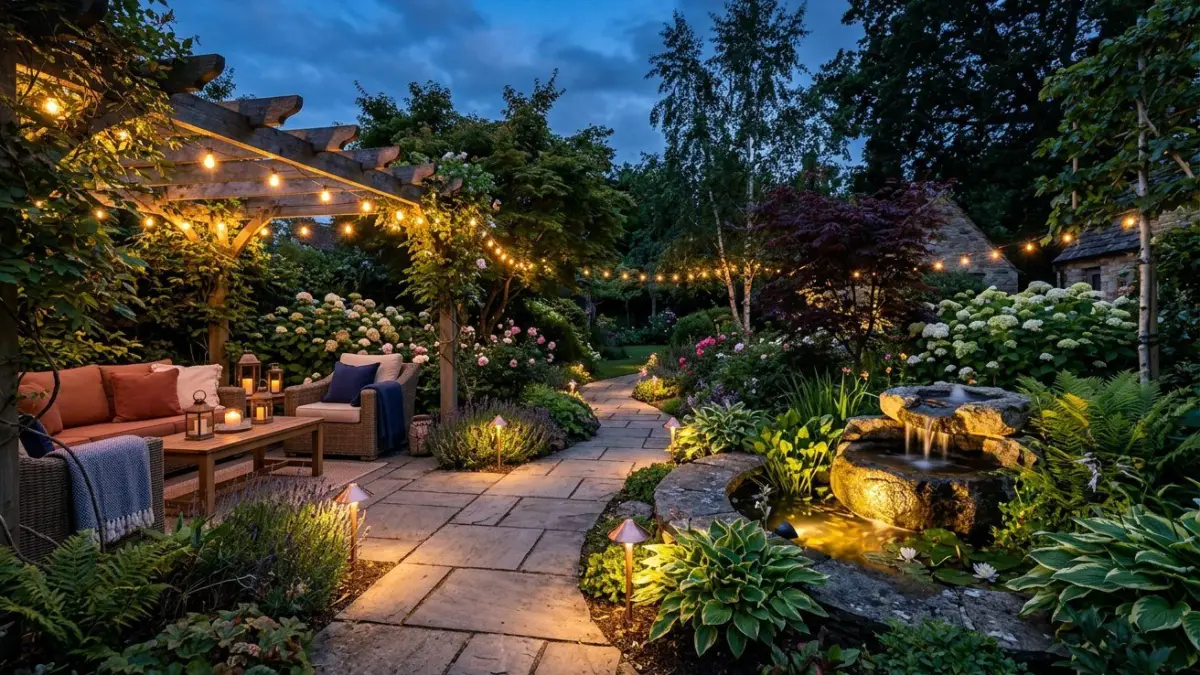
A small garden is often seen from inside at night, through a window. Two or three low, warm lights aimed at one tree or wall and one at the step do more than a string of ten. Keep the fittings out of the line of sight from the window so you see the plants, not the bulbs. The placement rules are in garden lighting design.
How small garden design ideas double your space
Vertical space holds climbing clematis, jasmine and bean on a trellis, and it frees the ground for seating. A diagonal path or a mirror lengthens the view, while pale paving and white hydrangea reflect light and open the space. Raised beds and containers improve drainage and keep soil warm, so you’ll plant earlier.
Fewer plant types in bigger groups reduce clutter and suit a small plot, and repeating lavender or box creates calm. Dwarf apple and pear on a trellis or espalier supply fruit without taking floor space, and a trained fig tolerates a pot of 40 cm. Shade from a fence suits fern and hosta, and sun suits herbs and tomato. A large lawn needs mowing and holds little interest, so a patch of grass and a bed of echinacea and salvia often feeds bee better. Containers on wheels let you rearrange, and a drip line on a timer protects them when you travel. A pond of 1 m or a pot fountain attracts frog and bird, and a pump needs a gfci and an electrician. Mulch of 5 cm reduces weeds in every bed, and compost feeds a dense planting. Soil in tiny plots compacts under foot, so a stepping stone path protects the beds. The RHS offers small garden plant lists, and the container vegetable guide suits patios.
Mistakes and what causes them
| Mistake | Cause | Fix |
|---|---|---|
| Garden still feels boxed in after planting | Boundaries are bare and all the planting is in the center | Cover fences with climbers and move beds to the edges, leaving the middle open |
| Plants crammed together within two years | Planted for instant fullness, not mature size | Plant at mature spacing and fill gaps with annuals or pots for the first two summers |
| Tiny lawn that never looks good | Too little light, too much foot traffic, strip too narrow to mow | Replace with paving, gravel or a short groundcover such as thyme in sun |
| Paving puddles and grows algae | Laid flat with no fall | Re-lay with a fall of about 1 in 80 (roughly 1 to 1.5 cm per meter) away from walls |
| Space feels messy despite few plants | Too many materials: several paving types, fence colors and pot styles | Reduce to two hard materials and one pot color family |
Climate and site variants
In cool temperate gardens, use evergreen structure such as yew, holly or hebe so the space doesn’t collapse in winter. In hot dry climates, including the plains of Punjab and Sindh, the small garden’s best asset is shade: a pergola or a single tree over the seating, light paving underfoot and a small water bowl for cooling. Most pots need water twice a day in peak summer there, so group them where one tap or drip line reaches. In humid tropical or subtropical areas, allow airflow and avoid dense low hedges that trap moisture, and choose large-leaved plants such as cannas or ginger relatives for a lush effect. Sloped small plots gain from a single step change that creates two levels without losing area.
When not to add a feature: skip a pond if the plot is under about 8 square meters and in deep shade. A bubbler pot or bird bath gives more benefit for far less space and maintenance.
If neighbours overlook your space, see Privacy Screens and Hedges.
To choose a look that suits your space, see Garden Styles Explained.
What to read next
For paving, edging and path widths, read garden paths and hardscaping. If a lawn is staying, lawn care basics covers mowing and watering. Return to the Garden Design & Landscaping guides or browse the Garden Design guides.
Frequently asked questions
Can I use a mirror in a small garden?
Yes, if you treat it like a window. Use an exterior-grade mirror, frame it, tilt it slightly downward and partly hide the edges with climbers so birds do not mistake it for open sky. Keep it out of strong afternoon sun, which can focus light onto nearby plants.
What are the best climbers for a small garden wall?
Clematis and honeysuckle suit part shade, while star jasmine and passionflower want warm, sheltered sun in mild climates. Roses and sweet peas work on sunny walls. Use wires or trellis on battens, especially on old or crumbling walls, rather than fixing plants directly.
Which trees suit a very small garden?
Choose multi-stem or slender trees that stay under about 4 to 5 m, such as serviceberry, crab apple on dwarfing stock or Japanese maple in a large pot. Check the mature size on the label, and plant away from walls and drains.
How many plant types should a small garden have?
About 8 to 12 kinds in a 20 square meter garden, with each repeated in groups of three to five. Fewer plant types in bigger groups look calmer than one of each. Choose plants that earn their place twice, with flowers and foliage or fruit.
Is gravel a good alternative to lawn in a small garden?
Often, yes. A tiny lawn wears out and is hard to mow. Gravel drains well, needs little upkeep and can be combined with planting beds, but use angular gravel and an edge to keep it in place. Keep paths firm underfoot.
How do I hide bins in a small garden?
Use a trellis or slatted screen with a climber, or build a storage bench with a hinged lid. Place it where it is convenient but out of the main view. Leave ventilation and access, and keep the screen away from the bin lids.
Should small garden paving be light or dark?
Light paving usually works better. Pale surfaces reflect light into shaded corners and make a space feel larger, while dark paving can make it feel smaller and hotter in summer. Large slabs with few joints also look calmer, so choose fewer, bigger pieces.
How do I stop neighbors overlooking my seating area?
Screen the angle rather than the whole boundary. Sit down, find the line of sight from the overlooking window, and place a screen or tall pot on that line, about 2 to 3 m from your chair. A light pergola can block views from above.
How do I design a long narrow garden?
Divide it into two or three rooms with a screen or a gap in a hedge, and zigzag the path to break up the corridor effect. Put the focal point off center and use wide borders in places. Fine-textured plants at the far end add depth.
How often should I water pots in a small garden?
In hot summer weather, small pots may need water daily, and larger pots every one to two days. Check by pushing a finger 2 to 3 cm into the mix. Larger containers hold moisture longer, and grouping pots near a tap makes the job easier.
More in Garden Design
Lawn Care Basics: A Season-by-Season System
Mowing heights by grass type, how deep to water, cool-season versus warm-season timing, and how to read yellow or bare patches before spending money on products.
Garden Paths & Hardscaping: Build the Bones of Your Garden
Plan path width, sub-base depth, a 1 to 2% drainage fall, permeable surfaces and edging so paths and patios stay level, drain well and survive frost.
Balcony & Terrace Gardens: The Complete Setup Guide
Check weight limits first, then handle wind, drainage and sun. A practical setup for balconies and terraces, with pot weights, screens and layout rules.