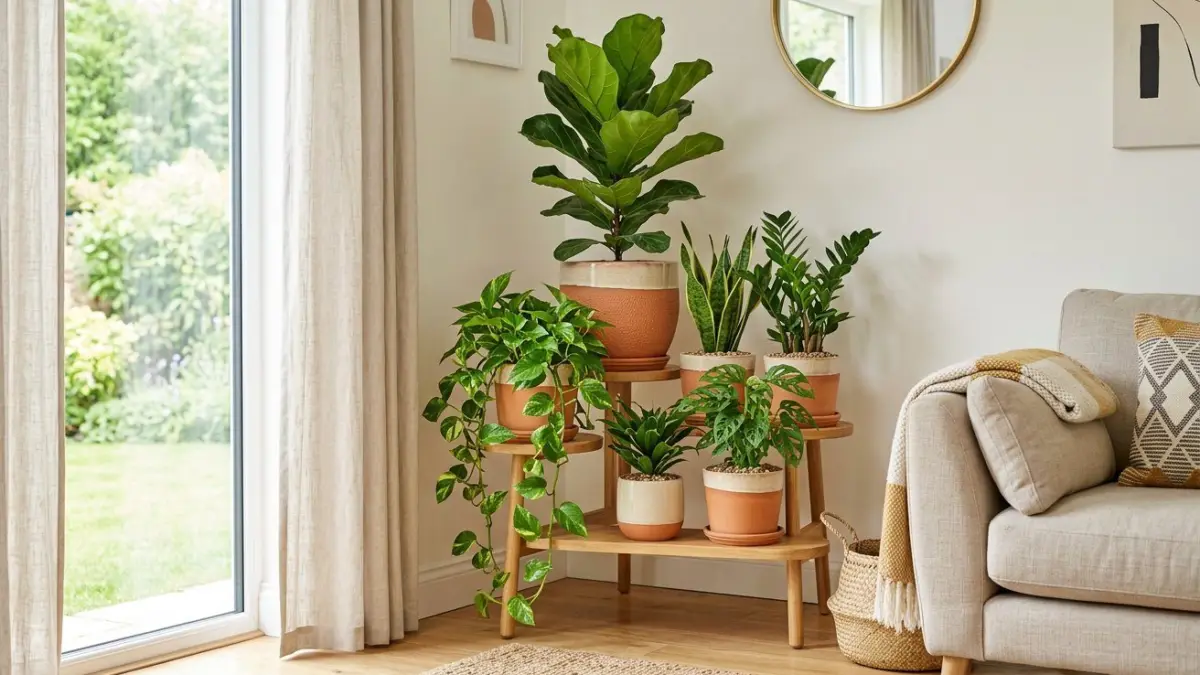
Quick answers
- How do I know my houseplant needs repotting?
- Look for roots circling the inside of the pot or pushing out of the drainage holes, water running straight through without soaking in, and stalled growth during the growing season. A plant that merely looks top-heavy or has one aerial root does not need a bigger pot.
- How much bigger should the new pot be?
- Go up by 2 to 5 cm in diameter, roughly one size. A much larger pot holds a wet mass of mix that the roots cannot drink, which is the usual route to root rot. Slow growers and succulents suit the smaller end of that range.
- Should I fertilize right after repotting?
- No, wait 4 to 6 weeks. Fresh potting mix has some nutrients, and cut or bruised roots are easily burned by fertilizer salts. Start feeding once you see new leaves, using the routine in our watering guide.
- Why is my plant drooping after repotting?
- Mild drooping for a week or two is transplant shock, caused by roots that were damaged or are not yet in contact with the new mix. Keep it out of direct sun and water only when the mix dries. If stems turn soft, check for rot using our problem guide.
Key takeaways
- Repot for evidence (circling roots, fast drain-through, stalled growth), not because a year has passed
- Go up only 2 to 5 cm in pot diameter; oversized pots stay wet and rot roots
- Repot in the active growing season; avoid peak heat, deep winter and flowering peaks
- Skip the gravel layer; drainage comes from the mix and the hole, not from stones
- Water once after repotting, hold fertilizer for 4 to 6 weeks, and keep out of harsh sun
Table of contents13 sections
- Repotting at a glance
- Signs it really needs repotting
- Timing, by climate
- Choosing the pot and the mix
- Step by step: repotting a medium plant
- When the roots are the problem
- Large plants and top-dressing
- The first month afterward
- Transplant shock or something else?
- What happens when you repot a houseplant
- What happens to roots when repotting houseplants
- Mistakes that cost plants
- Where to go next
Repotting houseplants without stress, yours or theirs, means choosing the right season, pot size and mix so the roots recover quickly.
Repot when the roots have run out of room, not when the calendar says so. Most houseplants are happiest slightly snug, and a repot done at the wrong time or into too large a pot does more harm than leaving the plant alone. This guide shows how to read the evidence, pick a pot size, handle the roots and look after the plant during the awkward weeks that follow.
It sits inside the Indoor Plants guides and pairs well with How to Water Houseplants Correctly, Houseplant Problems & Fixes and Humidity for Houseplants.
Repotting at a glance
| Question | Answer |
|---|---|
| Best season | Spring to early summer, when roots are actively growing |
| Pot size jump | 2 to 5 cm wider; for pots over 30 cm, 5 to 8 cm is fine |
| Root trimming | Remove dead or mushy roots; healthy cuts up to about a quarter of the mass on tough plants |
| First watering | Once, thoroughly, right after potting |
| Fertilizer | Wait 4 to 6 weeks |
| Recovery time | 1 to 4 weeks of slower growth is normal |
| Time needed | 10 to 20 minutes for a medium plant |
Signs it really needs repotting
Roots don’t announce themselves, so you look for indirect evidence. Pull the plant gently from its pot once, in the growing season, and inspect the root ball. A healthy, slightly crowded root ball is white to tan, firm and holds the shape of the pot.
| What you see | Does it mean repot? | Why |
|---|---|---|
| Thick roots circling the outside of the root ball | Yes | Circling roots keep growing in loops and can girdle the plant |
| Roots coming out of the drainage holes | Usually yes | The pot is full; but a few roots in a big pot are normal for some species |
| Water runs out of the bottom within seconds | Often | There is more root than mix, or the mix has shrunk away from the pot |
| Pot needs watering every 2 to 3 days in the growing season | Likely | Roots are using up the little mix there is |
| Growth has stopped but light and feeding are fine | Check the roots | Could also be light, season or a compacted mix |
| Plant tips over | Not necessarily | Tall plants may need a heavier pot, not a larger root space |
| Aerial roots on the stem | No | Normal in monstera, philodendron and pothos |
| Yellowing with wet, smelly mix | Yes, but for rot | Repot into fresh mix and trim; see below |
Many slow plants, such as snake plant, ZZ plant, hoya and most succulents, flower and grow better when slightly root-bound. For those, repot every 3 to 5 years or when a pot starts to split. Fast growers such as pothos, philodendron and ficus may need a new pot every 1 to 2 years.
Timing, by climate
Roots heal fastest when the plant is already growing. In the Northern Hemisphere that usually means March to June; in the Southern Hemisphere, September to December. Check local advice for exact dates.
- Cool temperate: wait until days lengthen and new growth appears. Repotting in November to January leaves roots sitting in cold, wet mix with little water uptake.
- Hot, dry subtropical (for example the plains of Punjab and Sindh): spring is short, so use February to March and again September to October. Avoid repotting when indoor temperatures sit near 35°C or higher, because freshly disturbed roots can’t keep up with water loss.
- Humid tropical: growth never fully stops, so repotting is workable most of the year. Avoid the heaviest monsoon weeks, when mix stays soggy.
- Emergencies: rot, a cracked pot or a pest in the mix can be repotted at any time. Accept slower recovery.
Avoid repotting a plant at the peak of flowering. Wait until blooms fade, unless the plant is clearly failing.
Choosing the pot and the mix
The pot decides how long the mix stays wet. Roots only drink from mix they have reached, so a large pot around a small root ball leaves a damp core that can stay saturated for weeks. That is why the rule is one size up, not a size that “gives it room to grow”.
| Plant type | Pot choice | Mix idea |
|---|---|---|
| Cacti and succulents | Terracotta, only 2 to 3 cm wider | Gritty mix, about half mineral grit by volume |
| Snake plant, ZZ, rubber plant | Heavy pot, drainage holes, 3 to 5 cm wider | Standard indoor mix with 20 to 30% perlite or bark |
| Pothos, philodendron, monstera | Any pot with holes, 3 to 5 cm wider | Indoor mix with 20 to 30% bark or perlite |
| Calathea, ferns, peace lily | Plastic or glazed pot, 3 to 5 cm wider | Moisture-retentive mix, still with 15 to 20% perlite |
| Moth orchids | Clear slotted pot, same size or 1 size up | Orchid bark, not regular mix |
Drainage holes matter more than the material. A decorative pot without holes is best used as a sleeve: keep the plant in a plastic nursery pot and lift it out to water. Don’t put a layer of gravel at the bottom of the pot. It doesn’t improve drainage; water pools at the boundary between fine mix and coarse stone, raising the wet zone nearer to the roots. Details on mixes are in Choosing Pots and Potting Mix.
Step by step: repotting a medium plant
- Water lightly the day before. Slightly damp mix holds together; bone-dry mix crumbles and tears roots.
- Prepare the new pot. Wash it, soak terracotta in water for 10 minutes so it doesn’t wick moisture from fresh mix, and cover the drainage hole with a piece of mesh if the mix is fine.
- Loosen and lift. Squeeze the pot or run a knife around the inside edge, tip the plant sideways and slide it out, holding the base of the stems. Don’t pull on the foliage.
- Inspect and tease. Shake off loose mix. Loosen circling roots with your fingers, or make 3 or 4 vertical cuts in a tightly wound root ball with clean scissors.
- Trim only what is dead. Cut off black, brown or mushy roots (healthy ones are firm and pale). Clean blades with 70% rubbing alcohol between plants.
- Set the depth. Add mix so the top of the root ball sits 2 to 3 cm below the pot rim and at the same depth it grew before.
- Fill and settle. Add mix around the sides, tapping the pot on the table. Press gently rather than packing, because compacted mix drains badly.
- Water once, thoroughly, until it runs from the holes. Empty the saucer after 20 minutes.
When the roots are the problem
Sometimes the reason to repot is rot, not size. Wet mix, yellowing lower leaves, a sour smell and a soft stem base all point to roots that have lost their oxygen. Remove the plant, wash off the old mix and cut away every soft root until you reach firm tissue. If more than about two thirds of the root system is gone, go down a pot size, because fewer roots can only support a smaller volume of damp mix.
Use fresh mix, never the old stuff. Hold off watering for several days, then resume only when the top third of the mix dries. If the stem base is also soft, take cuttings from healthy growth as insurance (see Propagation by Cuttings).
Large plants and top-dressing
Plants in pots over 35 cm are heavy and awkward. You don’t have to repot them every time. Instead, scrape off the top 3 to 5 cm of exhausted mix each spring and replace it with fresh compost-rich indoor mix. Every 3 to 4 years, tip the pot, slice off the bottom third of the root ball and slide the plant back in with fresh mix around it. This keeps size constant and refreshes the nutrient supply. Get a second person to help and protect your back.
The first month afterward
- Place it in the same light as before, not brighter. Wounded roots can’t supply leaves that are working harder.
- Water only when the mix dries, not on a fixed schedule. New mix is looser and dries differently; see How to Water Houseplants Correctly.
- Skip fertilizer for 4 to 6 weeks, then feed at half strength.
- Expect some leaf loss. A few older leaves may yellow as the plant redirects energy to roots.
- Don’t move it again for at least a fortnight.
- Watch for stability. Tall plants may need a stake until roots anchor in the new mix.
Transplant shock or something else?
| Symptom after repotting | Likely cause | What to check or do |
|---|---|---|
| Slight droop for 1 to 2 weeks, mix drying normally | Transplant shock | Shade from strong sun; wait |
| Droop with wet mix and yellow leaves | Overwatering in a larger pot | Stop watering until the top third is dry; consider a smaller pot |
| Crispy leaf edges | Dry air or fertilizer burn | Flush with plenty of water; see Humidity for Houseplants |
| Water runs round the edge and out of the pot | Mix not in contact with roots, or hydrophobic dry mix | Bottom water for 20 to 30 minutes |
| Fungus gnats appear | Fresh, wet organic mix | Let the top 2 to 3 cm dry; see Houseplant Problems & Fixes |
What happens when you repot a houseplant
Roots circling the pot or pushing from the drainage hole show the plant needs more room, and fresh potting mix feeds it and improves drainage. A pot only 2 to 5 cm wider suits most plants, because a much bigger container holds wet mix that encourages root rot. Perlite and coir keep the new mix airy, while garden clay blocks air.
Loosening tight roots with your fingers encourages them to spread, and clean secateurs remove rotten roots that spread fungus. Watering a day before repotting holds the root ball together and reduces stress. Spring suits most plants because light and warmth support recovery, though you shouldn’t repot a flowering orchid until blooms fade. How soon should you feed afterwards? Wait about six weeks, since fresh mix already holds nutrients and fertiliser can burn tender roots. Terracotta suits succulent and cactus, and you’ll find it forgives mistakes.
What happens to roots when repotting houseplants
Roots circling the pot or pushing from the drainage hole show the plant needs more room, and fresh potting mix feeds it and improves drainage. A pot only 2 to 5 cm wider suits most plants, because a much bigger container holds wet mix that encourages root rot. Perlite and coir keep the new mix airy, while garden clay blocks air and holds water.
Loosening tight roots with your fingers encourages them to spread, and clean secateurs remove rotten roots that spread fungus. Watering a day before repotting holds the root ball together and reduces stress on pothos and monstera. Spring suits most plants because light and warmth support recovery, though you shouldn’t repot a flowering orchid until the blooms fade. Fresh mix already holds nutrients, so fertiliser can burn tender roots if you add it within 6 weeks. Terracotta suits succulent and cactus and dries within 3 days, while glazed pots hold water for fern and calathea. Snake plant and zz plant tolerate being root bound for years, but peace lily and fern need repotting every 12 to 18 months. A saucer holds standing water that encourages fungus gnat, so empty it after 30 minutes. Mealybug hides in old mix, so you should check the roots with a hand lens and rinse them if you see white fluff. The houseplant problem guide covers rot and pests that repotting reveals.
A vet or your local extension service can advise on toxic species before you handle roots with bare hands. Fresh perlite mix improves drainage for pothos and monstera, and a terracotta pot holds less water than plastic. Slow-release fertiliser feeds a repotted fern after 6 weeks, and a grow light supports weak growth after the move.
Orchid needs bark, and cactus needs sand. Monstera tolerates tight pots, but pothos needs room. Perlite drains water and prevents root rot.
Mistakes that cost plants
- Doubling the pot size because the plant looks small in it
- Reusing old mix full of salts, gnat larvae or rot fungi
- Burying the stem deeper than it grew before, which invites stem rot (tomatoes are the exception, not houseplants)
- Packing mix down hard, which squeezes out the air roots need
- Repotting a sick plant that’s actually suffering from low light or pests, which adds stress without fixing the cause
Gritty mixes for cactus and succulent are covered in Succulents and Cacti Indoors.
Where to go next
Sort out the right mix with Choosing Pots and Potting Mix, learn to interpret symptoms in Reading Plant Signals and pick forgiving plants from 15 Best Low-Light Houseplants. Back to Indoor Plants.
Frequently asked questions
What is the best time of year to repot houseplants?
Spring to early summer, when roots are actively growing, in most climates. In the Northern Hemisphere that usually means March to June, and in the Southern Hemisphere September to December. Avoid deep winter, peak heat and the height of flowering unless the plant is failing.
Can I repot a plant while it is flowering?
It is best to wait. Repotting at peak bloom stresses the plant and can cut the flowers short, so wait until blooms fade, especially with orchids. The exception is an emergency such as rot, a cracked pot or pests in the mix, which you can fix at any time.
What kind of potting mix should I use when repotting?
Choose one that suits the plant. Most foliage plants like indoor mix with 20 to 30% perlite or bark, cacti and succulents need a gritty mix with about half mineral grit, and moth orchids need orchid bark. Always use fresh mix, never old mix that may hold salts or pests.
Do I need a layer of gravel at the bottom of the pot?
No. Gravel does not improve drainage, and water pools at the boundary between fine mix and coarse stone, which raises the wet zone nearer the roots. Drainage comes from the mix and the hole. Cover the hole with mesh if the mix is fine.
How often should I repot houseplants?
It depends on the plant. Fast growers such as pothos, philodendron and ficus may need a new pot every 1 to 2 years. Slow plants such as snake plant, ZZ plant and most succulents prefer being snug and need repotting every 3 to 5 years.
Is it OK to cut roots when repotting?
Yes, but trim only what is dead. Cut off black, brown or mushy roots with clean scissors wiped in alcohol. Tough plants can lose up to about a quarter of healthy root mass. Loosen circling roots with your fingers or make 3 or 4 vertical cuts.
Should I water the plant before repotting?
Yes, lightly the day before. Slightly damp mix holds together and protects the roots, while bone-dry mix crumbles and tears them. Soak a terracotta pot in water for 10 minutes before use so it does not pull moisture from the fresh mix.
How do I repot a large, heavy plant without lifting it?
Top-dress it instead. Each spring, scrape off the top 3 to 5 cm of tired mix and replace it with fresh indoor mix. Every 3 to 4 years, tip the pot, slice off the bottom third of the root ball and refill. Get a second person to help.
Can I repot a plant into the same pot?
Yes. Remove the plant, trim dead roots, refresh the mix and replant in the cleaned pot. This keeps the plant at the same size and renews the nutrients. It suits large plants and any plant you want to keep compact.
How deep should I plant a houseplant when repotting?
Plant it at the same depth it grew before, with the top of the root ball 2 to 3 cm below the pot rim. Burying the stem deeper invites stem rot. Fill around the sides, tap the pot on the table and press gently, because packed mix drains badly.
More in Indoor Plants
Houseplant Problems & Fixes: A Visual Diagnostic Guide
Work out why a houseplant is yellowing, browning, dropping leaves or infested: a fixed diagnostic order, a symptom table, pest treatments and a root rot rescue.
Air-Purifying Indoor Plants: What the Science Actually Says
The 1989 NASA study tested sealed chambers, not living rooms. Here is why a few plants will not clean your air, and what they genuinely do…
Styling with Indoor Plants: A Light-First Design Guide
Place plants by light first, then use height, grouping, pots and negative space to make a room look composed instead of crowded.