Quick answers
- What single change most improves beginner success rates?
- Sowing by soil temperature with a thermometer instead of by calendar date. It fixes germination speed and reduces rot in one stroke.
- How do I know if my seed is still viable?
- Place ten seeds on a damp paper towel in a warm spot for a week. Eight sprouting means ~80% viability: sow thickly or buy fresh accordingly.
- Is bottom watering always better?
- It is best for trays and dense foliage, keeping leaves dry and damping-off risk low. Established pots water normally from the top until drainage.
- Why do my seedlings stretch even on a bright windowsill?
- Glass filters light; add a LED grow light 10-15 cm above the tray for 14-16 hours. The stretch is the plant chasing light.
Key takeaways
- Learn the fundamentals first. Tools and gadgets depend on six basic skills that compound over years.
- Sow by soil temperature, not the calendar. A thermometer outperforms a heat mat for germination reliability.
- Water by soil feel, not by schedule. The finger test integrates everything a calendar misses.
- Match pot and mix to plant strategy. Succulents need different drainage than moisture-lovers.
- Propagate by species timing, not by hype. Species timing matters more than any additive.
- Use the calendar as a starting point, not a rule. Your garden microclimate shifts the dates.
- Keep a garden log from day one. Your own records beat any guide by year two.
- Build skill, not inventory. A well-used trowel beats a garage full of half-used gadgets.
Table of contents29 sections
- How plant growing skills depend on soil, water and timing
- What questions does this guide answer?
- What does each growing guide cover?
- Sowing seed: How to plant seeds step by step
- Moving plants: How to transplant seedlings
- Water management: Watering plants the right way
- Containers and growing media: Choosing pots and potting mix
- Making new plants: Propagation by cuttings
- Timing: The seasonal planting calendar
- Reading and planning: Reading plant signals and The first garden plan
- Lights: Grow Lights for Seedlings: Choosing, Hanging and Timing the Light
- Tools: Best Gardening Tools for Beginners
- How do you answer the most common sowing questions?
- What is a good hardening-off schedule?
- How often should each type of plant be watered?
- Which potting mix suits which plant?
- How long do cuttings take to root?
- How do you count back from planting day to sowing day?
- How do the six skills affect each other?
- Which guide helps when something goes wrong?
- What soil temperature does each crop need?
- How do you choose between pot materials?
- What do you do in each season?
- What do the key terms mean?
- What are the most common growing mistakes?
- Where should you go next?
Plant growing guides begin with six skills, so this page shows you how seed, sowing, watering and potting mix work together to grow a healthy plant.
Plant growing is the set of six skills that decide whether a seed becomes a healthy plant: sowing at the right depth and soil temperature, transplanting without root damage, watering by soil moisture, choosing a pot and mix that drain, propagating from cuttings, and timing every job to frost and soil warmth.
This guide is your map to every step. Each section below gives you the short answer, the reason behind it, and the guide that goes deep. If you’re new, read in the order shown, because the skills follow a plant’s life from seed to pot to garden to season’s end. If you already grow well, use the symptom table near the end to find your one weak link, because a single poorly handled stage, usually watering or timing, causes most failures. After the basics, you’ll move naturally to trees, vegetables and herbs and soil, water and fertilizer.
If you only do one thing: check the soil with your finger before every watering, and sow warm-season seed only when the soil has reached about 15 degrees C. These two habits prevent more losses than any product.
How plant growing skills depend on soil, water and timing
Tomato and pepper seed need warmth of 21°C to germinate, while lettuce and spinach prefer cool soil, so sow the two groups at different times. Compost feeds seedlings and improves loam, and perlite drains water and prevents damping-off. Bean and pea need 3 to 5 cm of cover, whereas carrot and radish need only 1 cm, and gravel around the rows blocks the slugs that damage lettuce and bean.
Basil needs light and warmth, mint tolerates shade, and rose needs 6 hours of sun while hosta tolerates shade. Sand drains clay and mulch protects roots and reduces weeds, but overwatering kills succulent and cactus and clay holds water and causes root rot, so loam is the safer middle for most pots. Cuttings of rosemary and lavender need sharp drainage, and pothos roots in water. Harden off seedlings for 7 to 10 days so tomato and pepper avoid shock, sow lettuce every 2 weeks and you’ll harvest for months, and check your extension service or the rhs for local sowing dates.
What questions does this guide answer?
People search this topic in six different ways: what something is, how to do it, when to do it, why it failed, which option is better, and what to do next. The table gives a short answer to each common question and the guide that answers it fully.
| Question type | Common question | Short answer | Full answer |
|---|---|---|---|
| What | What is hardening off? | Gradually exposing indoor-raised seedlings to outdoor sun, wind and cooler nights over 7 to 10 days, so leaves thicken and lose less water after planting. | Transplant seedlings |
| How | How deep do I plant seeds? | As a rule, about two to three times the seed’s width. Tiny seeds such as lettuce are pressed onto the surface and barely covered. | Plant seeds step by step |
| How | How do I tell when a plant needs water? | Push a finger into the soil. Water when the top few centimetres are dry for most plants, then soak until water drains out of the bottom. | Watering the right way |
| When | When can I plant tender crops outside? | After the average last frost date and when soil at sowing depth has warmed, usually 15 to 18 degrees C for tomatoes, beans and squash. | Seasonal planting calendar |
| Why | Why are my seedlings tall and thin? | They are stretching for light. Move them closer to the window or add a grow light a few centimetres above the leaves. | Reading plant signals |
| Why | Why do plants wilt when the soil is wet? | Waterlogged soil has no air, so roots rot and stop taking up water. The plant droops exactly as it does in drought. | Watering the right way |
| Which | Which pot material is best? | It depends on the plant. Terracotta dries fast and suits succulents, glazed and plastic pots hold moisture longer and suit thirsty plants. | Pots and potting mix |
| Which | Water or soil for cuttings? | Many soft-stemmed plants root in either. Soil-rooted cuttings usually form stronger roots, water is easier to watch. | Propagation by cuttings |
| Start | What should a beginner plant first? | Fast, forgiving crops such as lettuce, radish, beans and herbs, in a small bed or a few pots near a tap. | The first garden plan |
What does each growing guide cover?
Sowing seed: How to plant seeds step by step
Seed holds a fixed energy store and germinates only when moisture, warmth and air are right. Sown too deep, it exhausts its reserves before reaching light. Sown into cold, wet soil, it rots. The guide sets out depth, spacing and temperature for common crops, how to test old seed on damp paper, and how to avoid damping off. It’s the starting point for everything that follows.
Moving plants: How to transplant seedlings
A seedling’s fine root hairs do most of its water uptake and are the first thing lost in moving. Handle by the leaves, never the stem, keep the root ball intact, plant at the same depth as before and water straight away. Hardening off for 7 to 10 days and moving in the evening or on a cloudy day reduce the shock. The guide also covers spacing and aftercare.
Water management: Watering plants the right way
Roots need oxygen as much as water, so the aim is moist soil with air spaces, not constantly wet soil. Deep watering encourages roots to grow downward, while frequent light watering keeps them near the surface where they dry out. The guide covers the finger test, how amounts scale with pot size, soil type and weather, and when to water in the day.
Containers and growing media: Choosing pots and potting mix
Drainage holes matter more than pot material. Garden soil compacts in containers, so potting mixes use bark, coir, perlite and compost to keep air in the mix. Succulents need a gritty, fast-draining blend and moisture-loving plants a richer mix. The guide compares pot materials, sizes and mixes, and explains why a layer of gravel at the bottom doesn’t improve drainage.
Making new plants: Propagation by cuttings
New roots form from tissue at and just below a node. Soft-stemmed houseplants often root in two to eight weeks, while woody shrubs take longer and depend on the type of cutting and the season. Keeping cuttings humid but not wet, with a clean cut and no submerged leaves, prevents most rot. The guide includes species timing and rooting media.
Timing: The seasonal planting calendar
Two numbers drive planting dates: average last spring frost and soil temperature. Cool-season crops such as peas and spinach go out 2 to 6 weeks before the last frost, while warm-season crops wait until 1 to 2 weeks after it. The guide shows how to count back from transplant day to sowing day and how to build your own calendar.
Reading and planning: Reading plant signals and The first garden plan
Leaf colour, posture and growth tell you what a plant lacks, and the guide on plant signals teaches you to tell water, light, feed and pest problems apart before acting. The first garden plan then turns the skills into a layout: what to plant where, how much space, and which crops suit a first season.
Lights: Grow Lights for Seedlings: Choosing, Hanging and Timing the Light
The guide compares LED and fluorescent lights, gives hanging heights and hours for each crop, and shows how to read pale, leggy or scorched seedlings.
Tools: Best Gardening Tools for Beginners
The guide lists the six tools to buy first, explains how to judge steel, handles and weight, and shows which tools to skip until a real job calls for them.
How do you answer the most common sowing questions?
How do you test whether old seed is still alive?
Place ten seeds on a damp paper towel, slide it into a bag, keep it warm and check after the usual germination time for that crop. If eight sprout, viability is about 80 per cent, so sow a little thicker. If fewer than five sprout, buy fresh seed. Most vegetable seed stays usable for two to five years when kept cool and dry, but onion, parsnip and parsley seed lose viability faster.
Why do seedlings grow tall and thin?
Seedlings stretch toward light when the light is too weak. A windowsill behind glass gives less light than it looks, so add an LED grow light 10 to 15 cm above the leaves for 14 to 16 hours a day, and raise it as the seedlings grow. Cooler temperatures also slow stretching.
How do you stop damping off?
Damping off is a group of fungus-like organisms that rot seedling stems at soil level in cool, wet, stagnant conditions. Use clean trays, fresh seed compost, water from below, give the tray airflow, and sow thinly. Once a seedling has collapsed it won’t recover, so remove it and let the surface dry slightly.
What is a good hardening-off schedule?
Hardening off takes 7 to 10 days. Start in a sheltered, shaded spot and increase exposure each day. Protect tender plants from cold nights and strong wind throughout.
| Days | Outdoor exposure | What it prepares the plant for |
|---|---|---|
| 1 to 2 | 1 to 2 hours in sheltered shade | Air movement and cooler temperature |
| 3 to 4 | 3 to 4 hours, morning sun only | Brighter light without scorch |
| 5 to 6 | Half a day in sun, in a sheltered spot | Stronger sun and wind |
| 7 to 8 | Full day outdoors, bring in at night | Full sun and drying wind |
| 9 to 10 | Outdoors day and night if nights stay above about 8 to 10 degrees C for tender crops | Cool nights |
How often should each type of plant be watered?
No plant should be watered on a fixed schedule, but the soil condition you aim for differs by type. Use this as a guide to what to check, not a calendar.
| Plant type | Aim to keep the soil | Check before watering |
|---|---|---|
| Seedlings | Evenly damp at the surface | Surface colour and tray weight |
| Succulents and cacti | Dry fully between waterings | Dry all the way down |
| Mediterranean herbs (rosemary, thyme, sage) | Dry in the top few centimetres | Top 2 to 3 cm |
| Leafy vegetables | Evenly moist | Top 2 to 3 cm, daily in heat |
| Tomatoes and other fruiting crops | Steadily moist, not swinging wet to dry | Top 5 cm |
| Established shrubs | Deeply watered in dry spells | Soil at 10 cm depth |
Which potting mix suits which plant?
These blends are typical starting points. Always use a bagged potting mix, not garden soil, and adjust to how fast your pots dry.
| Use | Typical blend | Why it works |
|---|---|---|
| Seed sowing | Fine seed compost, or equal parts sieved compost or coir and perlite or vermiculite | Fine, low in nutrients, holds even moisture |
| General houseplants | 2 parts potting mix to 1 part perlite | Holds water but keeps air in the mix |
| Succulents and cacti | About equal parts potting mix and coarse grit or perlite | Drains fast so roots dry between waterings |
| Tomatoes and vegetables in pots | Quality potting mix, with some compost mixed in | Holds more nutrient and water for hungry crops |
How long do cuttings take to root?
| Type of cutting | Examples | Typical time to root | Best season |
|---|---|---|---|
| Soft-stemmed, in water | Pothos, tradescantia, coleus | 1 to 3 weeks | Spring to summer |
| Softwood, in a light mix | Rosemary, lavender, pelargonium | 3 to 8 weeks | Late spring to early summer |
| Semi-ripe | Many evergreen shrubs | Several weeks to months | Late summer |
| Hardwood | Currants, willow, dogwood | Several months | Autumn to winter |
| Succulent leaf or stem | Echeveria, jade plant | 3 to 6 weeks after callusing | Warm months |
Cut just below a node, remove the leaves that would sit under water or mix, and keep the cutting in bright indirect light. Direct sun cooks a cutting before it has roots to replace lost water.
How do you count back from planting day to sowing day?
Many crops are sown indoors so seedlings are the right size on planting day. Count backward from your transplant date, which is usually around or after your last frost date, depending on the crop.
| Crop | Sow indoors this long before planting out |
|---|---|
| Peppers and aubergines | 8 to 10 weeks |
| Tomatoes | 6 to 8 weeks |
| Cabbage family | 4 to 6 weeks |
| Lettuce | 3 to 4 weeks |
| Cucumbers, squash, melons | 3 to 4 weeks |
Example: if your last frost is around 15 May and you plant tomatoes out a week later, sow them about 6 to 8 weeks before that, in late March to early April. Build the full list for your own site using the seasonal planting calendar.
How do the six skills affect each other?
These skills are linked by cause and effect. Poor drainage in the mix causes root rot, which causes wilting that looks like thirst, which leads to more watering and worse rot. Cold soil slows germination, which keeps seed in the ground longer, which raises the risk of rot. A thin root ball causes transplant shock, which stalls growth for days. Understanding these chains is faster than memorising rules.
- Mix drainage controls whether roots get air, so it comes before watering technique.
- Watering depth controls root depth, which controls drought tolerance later.
- Hardening off controls leaf thickness, which controls water loss after transplanting.
- Frost date and soil warmth control when every other skill matters.
- Propagation repeats all of these on a cutting that has no roots yet.
Which guide helps when something goes wrong?
| Symptom | Most likely cause | Go to |
|---|---|---|
| Seeds never came up | Cold soil, too deep, or dried out after sowing | Plant seeds |
| Seedlings collapse at soil level | Damping off in wet, cool conditions | Plant seeds |
| Wilting after planting out | Root damage or no hardening off | Transplant seedlings |
| Yellow lower leaves | Overwatering, low nitrogen or ageing | Reading plant signals |
| Water runs straight through the pot | Root bound or dry hydrophobic mix | Pots and mix |
| Cuttings turn black | Rot from too much water or a dirty cut | Propagation |
| Frost killed new plants | Planted before the last frost date | Planting calendar |
What soil temperature does each crop need?
Soil temperature, not the calendar, decides when seed germinates. Use a soil thermometer pushed 5 cm deep in the morning. These are typical minimums for germination, and many gardeners sow a few degrees above them for faster, safer results.
| Crop group | Typical minimum soil temperature | Frost tolerance | When to sow |
|---|---|---|---|
| Peas, spinach, broad beans | About 5 to 10 degrees C | Hardy | 2 to 6 weeks before last frost |
| Lettuce, radish, carrots | About 7 to 10 degrees C | Light frost | Around last frost, repeat every 2 to 3 weeks |
| Beans, squash, sweetcorn | About 15 to 18 degrees C | Tender | 1 to 2 weeks after last frost |
| Tomatoes, peppers (transplants) | At least 15 to 18 degrees C, nights above 10 degrees C | Tender | Sow indoors 6 to 10 weeks before planting out |
How do you choose between pot materials?
| Material | Dries out | Best for | Watch out for |
|---|---|---|---|
| Terracotta | Fast, through the walls | Succulents, herbs, plants that dislike wet roots | Dries quickly in summer, cracks in hard frost |
| Plastic | Slowly | Thirsty plants, large pots, lightweight use | Easy to overwater |
| Glazed ceramic | Slowly | Decorative indoor pots | Often has no drainage hole, so check first |
| Fabric grow bags | Fast, with air pruning of roots | Vegetables, potatoes, tomatoes | Needs more frequent watering |
A pot without a drainage hole holds a layer of saturated mix at the bottom whatever you put in it. Use a pot with holes, or keep the plant in a plain pot that drains and set that inside the decorative one.
What do you do in each season?
| Season | Growing focus | Skills you use most | Guide |
|---|---|---|---|
| Late winter | Plan and sow slow crops indoors | Sowing, pots and mix | Plant seeds |
| Spring | Harden off, then plant out after last frost | Transplanting, timing | Transplant seedlings |
| Summer | Water deeply, take softwood cuttings | Watering, propagation | Watering |
| Autumn | Plant perennials, sow hardy crops, review notes | Timing, transplanting | Planting calendar |
What do the key terms mean?
- Germination: the point at which a seed breaks dormancy and a root emerges.
- Damping off: a fungal and water mould disease that rots seedling stems at soil level.
- Hardening off: gradual exposure of indoor-raised plants to outdoor conditions.
- Node: the stem joint where leaves and roots form, and where cuttings are cut.
- Last frost date: the average date after which frost becomes unlikely in your area.
- Potting mix: a soil-free blend designed for drainage and aeration in containers.
What are the most common growing mistakes?
- Following the calendar, not the soil. Cold soil rots seed whatever the date says, so check soil temperature before you sow warm-season crops.
- Watering on a schedule. Plants use different amounts of water as weather and growth change, so test the soil instead of watering every Tuesday.
- Skipping hardening off. Seedlings moved straight outdoors scorch and stall, so allow a week or more.
- Using garden soil in pots. It compacts and drains poorly in a container, so use a potting mix.
- Burying stems and crowns. Planting too deep suffocates the crown of many plants, so match the depth they grew at before.
Where should you go next?
When the six skills feel routine, pick the plant group you care about: trees for long-lived structure, vegetables and herbs for food, flowers for colour and pollinators, or soil, water and fertilizer to improve the ground everything grows in. A written log of sowing dates, weather and results turns each season into data you can use the next year.
Frequently asked questions
What are the basic skills every new gardener needs to learn?
There are six: sowing seed, transplanting, watering by soil moisture, choosing pots and potting mix, taking cuttings, and timing jobs to frost and soil warmth. Each skill covers one stage of a plant's life. Learn them in that order, because later steps depend on earlier ones.
Is it better to grow from seed or buy young plants?
Both work, and the best choice depends on the crop. Seed is cheaper and offers more varieties, and it suits radish, beans and lettuce. Young plants save weeks for slow, warm-season crops such as peppers and aubergines, especially in short summers or where you have no bright, warm place to start seed.
How long does a small beginner garden take to look after?
A single bed of about 1.2 by 2.4 m usually needs 20 to 30 minutes a day in the growing season, plus an hour or two of preparation in spring. Time rises with the number of containers, because pots dry quickly. Watering is the biggest regular job.
What is the most common reason beginners lose plants?
Watering mistakes cause most losses, either too much, too little or on a fixed schedule. Planting warm-season crops before the soil has warmed comes second. Checking the soil with a finger before watering, and sowing by soil temperature rather than the calendar, prevents a large share of failures.
Do I need a greenhouse to start seeds early?
No. A bright windowsill, a cool room and a small LED grow light are enough for most home gardeners. A greenhouse or cold frame adds space and warmth, but it is a convenience, not a requirement. Start with one tray and expand once you know how many seedlings you really use.
How do I know when my soil is warm enough to sow?
Push a soil thermometer 5 cm deep in the morning and compare the reading with the crop's minimum. Peas and spinach germinate from roughly 5 to 10°C (41 to 50°F), while beans and squash need about 15 to 18°C (59 to 64°F). A cheap probe thermometer is reliable enough.
Can I grow plants without a garden?
Yes. Pots, grow bags and window boxes on a balcony, patio or doorstep can grow herbs, salad leaves, cherry tomatoes and flowers. Choose containers with drainage holes, use potting mix rather than garden soil, and expect to water more often, since small pots dry out fast.
Why do experienced gardeners keep a growing journal?
A journal records sowing dates, varieties, weather and results, so you can repeat what worked and change what did not. Three lines a week is enough. After two or three seasons it shows your own frost dates and best sowing windows more accurately than any printed chart.
Which basic gardening skill should I fix first if plants keep failing?
Fix watering first, because it causes more problems than any other skill and often looks like disease or hunger. Check the soil 5 cm down, water deeply when the top few centimetres are dry, and make sure every pot drains. Then look at timing and light.
How many plants should a first-time gardener start with?
Six to eight easy plants is plenty for a first bed or a few large pots. Mix a fast crop such as radish, a cut-and-come-again lettuce, bush beans and a few herbs. Starting small lets you give each plant proper attention and learn from mistakes before you expand.
All Plant Growing Guides guides
How to Plant Seeds Step by Step (Complete Beginner Guide)
Learn exact seed-sowing depth, spacing, timing and aftercare so more of your seeds actually grow, a foolproof step-by-step method for beginners.
How to Transplant Seedlings Without Killing Them
Harden off, timing, root handling and aftercare, everything you need to move seedlings from tray to garden with zero transplant shock.
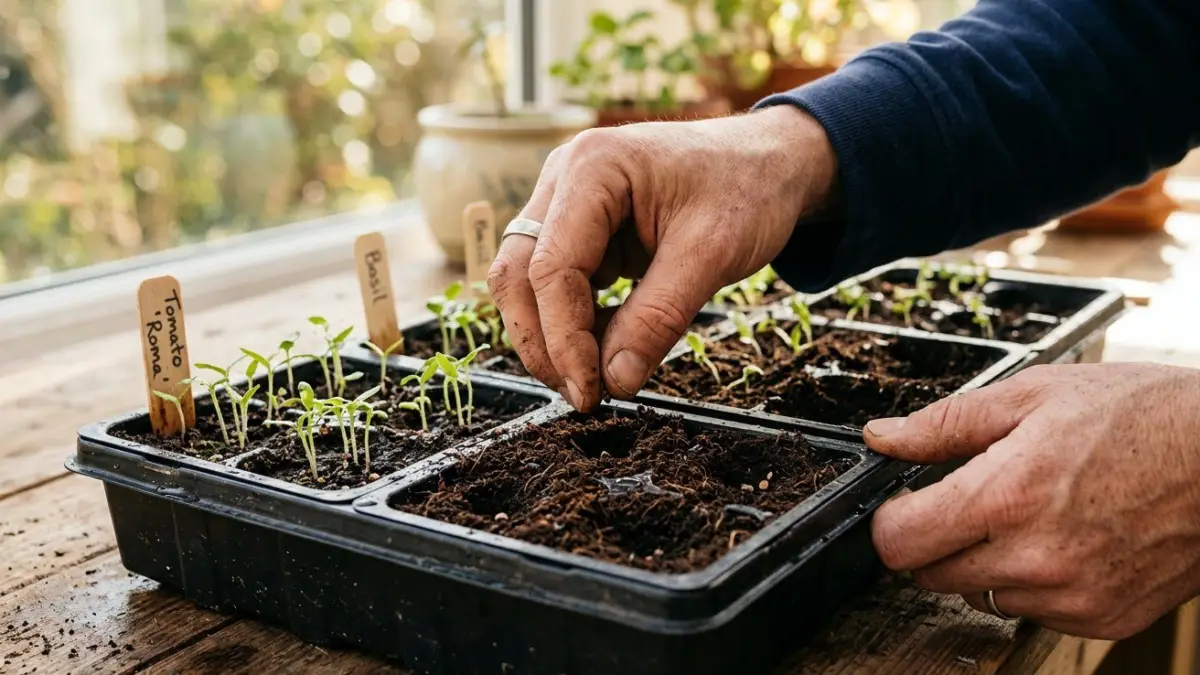
Watering Plants the Right Way: How, When and How Much
Deep-and-rare beats little-and-often. Learn to read your plants, check soil moisture properly, and build a watering rhythm that prevents 90% of garden problems.
Choosing Pots and Potting Mix: A Practical Guide
Terracotta or plastic? Potting soil or garden soil? Size and drainage decoded, pick containers and mixes your plants will genuinely thrive in.
Propagation by Cuttings: Multiply Your Plants for Free
Learn which cutting type suits which plant, when to take it, how to root it in water or mix, and why most failures happen at potting…
The Seasonal Planting Calendar: What to Plant and When
Work out what to sow and plant each season using frost dates, soil temperature and your climate type, with timing tables for cool and warm season…
Grow Lights for Seedlings: Choosing, Hanging and Timing the Light
How to pick a grow light for seedlings, how high to hang it, how many hours to run it and how to fix leggy, pale or…
Reading Plant Signals: What Your Plants Are Trying to Tell You
Decode yellow, brown, curled, purple and leggy plants by leaf age, pattern and soil check, so you fix the real cause instead of guessing.
The First Garden Plan: What to Plant Where, for Beginners
Plan a first garden that works: pick a site with 6 hours of sun, size one bed to reach across, choose forgiving plants and follow a…
Best Gardening Tools for Beginners
Which gardening tools a beginner really needs: the first six to buy, how to judge steel, handles and weight, what to skip, and how to care…