Quick answers
- How many lights does a garden need?
- Far fewer than most people expect. Light three to five anchors, such as one tree, the main path, the seating area and one wall, and leave the rest dark. Contrast between lit and unlit areas is what creates depth, so over-lighting flattens the garden.
- What colour temperature is best for garden lighting?
- Warm white, 2700K to 3000K, suits almost every garden. It flatters green foliage, timber and brick, and disturbs insects less than cool white or blue-rich light. Keep every fitting in one scheme at the same colour temperature so the garden looks coherent.
- What is the difference between uplighting and moonlighting?
- Uplighting sits at ground level and aims upward to show a trunk, canopy or wall. Moonlighting is fixed high in a mature tree and aims down, so light filters through leaves and throws soft shadows on the ground below. Both can be combined on one large tree.
- Should I use low-voltage or mains garden lights?
- Low-voltage 12V LED systems suit most gardens because they are flexible, cheap to run and easy to reposition. Mains fittings suit fixed floodlights and wall lights but must be installed to local regulations by a licensed electrician. See Outdoor Electrical Safety.
Key takeaways
- Design in three layers: functional light for movement, accent light for features and a low ambient glow for mood.
- Leave most of the garden dark. Shadow is what makes the lit parts look three-dimensional.
- Use one colour temperature, 2700K to 3000K, across the whole scheme.
- Hide the fitting and show the effect. Glare from a visible bulb ruins night vision.
- Mock up with a torch at dusk before you fix or bury anything.
Table of contents11 sections
- Lighting design at a glance
- Think in three layers
- Choosing the right technique for each feature
- Colour temperature, brightness and glare
- Plan the scheme in seven steps
- Low-voltage, mains or solar
- Lighting and wildlife
- How garden lighting design shapes types, placement and mood at night
- Common mistakes and look-alike problems
- Climate and region
- Where to go next
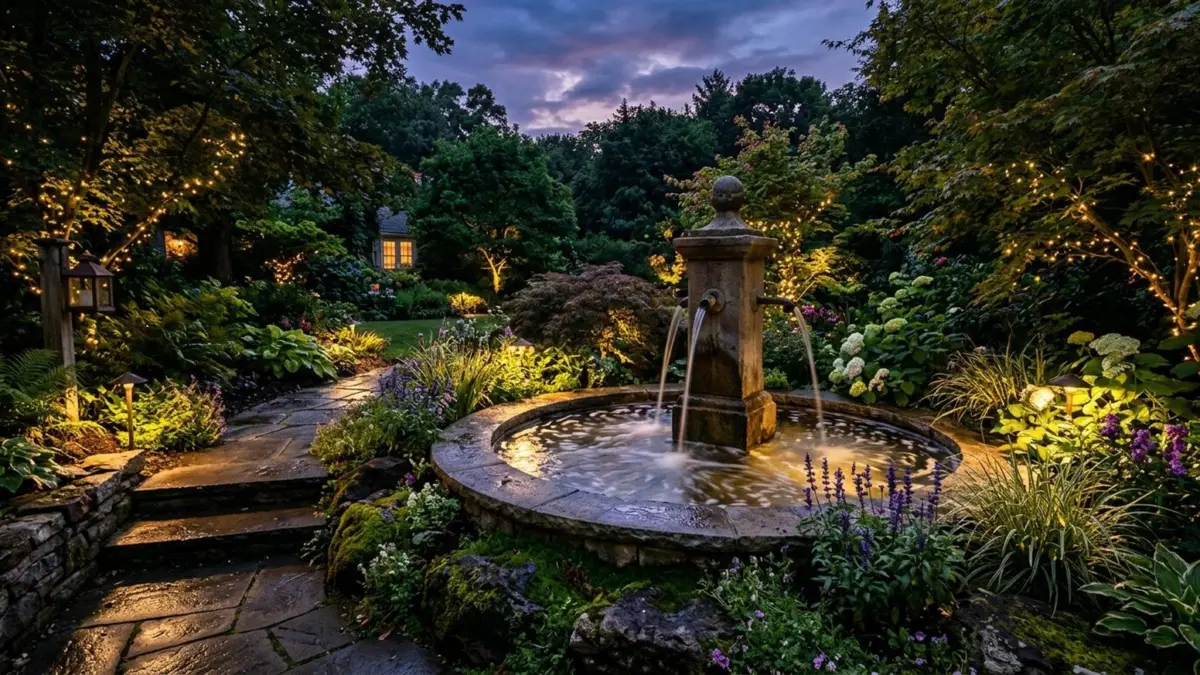
Garden lighting design covers types, placement and mood, so each light has a job and the garden never looks floodlit.
Good garden lighting is mostly about restraint. Pick the three or four things you want to see at night, light each with a technique that suits its shape, keep the colour warm and let everything else fall into shadow. Most disappointing schemes fail because they light too much, from the wrong angle, with fittings that glare.
This guide covers planning and technique. It belongs to the Water Features and Garden Lighting guides and pairs with Lighting for Safety and Security for steps and entrances, and Installing Solar Garden Lights for cable-free options.
Lighting design at a glance
| Question | Practical answer |
|---|---|
| Colour temperature | 2700K to 3000K warm white; 2200K to 2400K for a candle-like feel |
| Layers | Functional, accent, ambient (in that order of priority) |
| Path light height | Fixtures 30 to 45 cm tall, shielded from above |
| Path light spacing | Roughly 2 to 3 m apart so pools of light overlap slightly |
| Accent fixture output | Typically 100 to 400 lumens per tree or wall feature |
| Moonlighting height | Fixed 4 to 8 m up in a mature tree, aimed down |
| Eye adjustment time | 20 to 30 minutes to reach full night vision |
| Typical cut-off | Timer or dimmer so lights drop or stop by late evening |
Think in three layers
Every scheme works better if you decide the layers before you buy a single fitting.
- Functional light lets people move safely: steps, door, gate, path edges. It’s low, shielded and dim, usually 50 to 150 lumens per point.
- Accent light picks out features: a multi-stemmed tree, a sculptural shrub, a textured wall, a water feature. It’s where most of your budget and thought should go.
- Ambient light is the faint background glow that stops the garden looking like a black hole beyond the terrace. It can come from spill off accent lights, a few candles or string lights at low output.
Start with function, add one or two accents, then judge whether ambient light is needed at all. Often the spill from the first two layers is enough.
Choosing the right technique for each feature
The same tree looks quite different depending on where the light sits. The table matches common features to techniques.
| Technique | How it works | Best for | Watch out for |
|---|---|---|---|
| Uplighting | Ground fitting aimed up into canopy or trunk | Trees with clear stems, tall grasses, architectural shrubs | Glare into eyes; light escaping into the sky |
| Grazing | Fitting 10 to 20 cm from a surface, light skims across it | Brick, stone, bark, rendered walls | Exposes every flaw in the wall |
| Washing | Fitting 1 to 2 m back, wider beam covers the whole surface | Hedges, smooth fences, plain walls | Looks flat; use sparingly |
| Silhouetting | Light behind the plant, aimed at a wall behind it | Sculptural shapes: agave, phormium, bamboo, Japanese maples | Needs a pale background wall and a gap behind the plant |
| Shadowing | Light in front of the plant throws its shadow on a wall | Spiky or finely cut foliage | The shadow moves with wind, which is part of the charm |
| Downlighting | Fitting mounted above, aimed down | Seating, steps, tabletops, paths | Harsh pools if the fixture is bare and bright |
| Moonlighting | Downlight fixed high in a tree, light filtering through leaves | Terraces and lawns under large trees | Needs safe access to install; see How to Prune Trees Safely for working at height |
Uplighting is the technique most often misused. Aim the beam into the canopy or along the trunk, not at the viewer, and set the fixture 30 to 60 cm back from the trunk so the light spreads rather than making a hot spot on the bark. Use a narrow beam (15 to 25 degrees) for tall slim trees and a wide beam (40 to 60 degrees) for broad canopies.
Colour temperature, brightness and glare
Colour temperature is measured in kelvin. Lower numbers are warmer. At 2700K to 3000K, greens look natural and brick and timber glow. At 4000K and above, the same garden looks clinical and the light carries more blue, which is the part of the spectrum insects and many night animals respond to most.
Brightness matters less than most buyers assume. After 20 to 30 minutes in the dark your eyes become far more sensitive, so a garden lit at a fraction of daytime levels still looks clear. A bright fitting in your direct line of sight does the opposite: it makes your pupils close and the rest of the garden look black. That is glare, and it’s the real enemy of night lighting.
- Choose fittings with a hood, louvre or recessed lamp so you see the light on the plant, not the bulb.
- Aim every fitting from the side or from behind the viewing position.
- Prefer several low-output sources over one strong one.
- Look for a dimmer, or choose a system that can take one. Being able to turn the whole scheme down by half is the cheapest upgrade there’s.
Plan the scheme in seven steps
- Decide where you’ll view from. Most gardens are seen through a window or from a terrace. Light for that view first.
- List your anchors. Choose three to five: a key tree, a path, a seating area, a wall, a water feature.
- Assign a technique to each. Use the table above.
- Sketch the circuit. Decide where the power source and cable runs will go, keeping cable away from digging zones such as vegetable beds.
- Mock up at dusk. Hold a torch where each fitting will go and walk the garden. Move it until the effect looks right and the bulb is hidden.
- Install the main anchors only, then live with them for a week before adding more.
- Re-aim in summer and winter. Plants grow, deciduous trees drop leaves, and the effect changes.
Low-voltage, mains or solar
The type of power determines flexibility, safety and effort. For most domestic schemes, low-voltage is the practical middle ground.
| System | Strengths | Limits | Who should install |
|---|---|---|---|
| Low-voltage (12V) LED | Flexible, fittings can be moved as plants grow, cable is easier to handle, low running cost | Voltage drop on long runs; still needs a mains-powered transformer | Careful DIY for the low-voltage side; a licensed electrician for any mains supply point |
| Mains (line voltage) | Powerful floodlights, wall lights, fixed post lights | Fixed wiring, protection and regulations apply | Licensed electrician |
| Solar | No cable at all, instant to set up | Output depends on sun; unreliable for critical lighting | Anyone; see Installing Solar Garden Lights |
On a low-voltage system, add up the wattage of all fittings and choose a transformer rated well above that total, with a margin of at least 20 to 25 percent. Voltage drops along a cable, so the last fitting on a long, thin run looks dimmer than the first. Split long layouts into two or more shorter runs, or follow the maker’s maximum run lengths. Remember that the transformer plugs into mains, so it needs a protected, outdoor-rated supply, and the rules for that are in Outdoor Electrical Safety. Local regulations differ, so confirm what you may do yourself before you start.
Lighting and wildlife
Artificial light at night affects insects, bats, birds and hedgehogs. You don’t need to give up lighting, but a few habits reduce the harm.
- Use warm white and avoid blue-rich light.
- Shield fixtures so light falls on the target, not the sky or the boundary hedge.
- Put lights on a timer or sensor so they are off late at night and in the hours just before dawn.
- Leave one corner or a boundary dark as a movement corridor.
- Keep light off ponds and nest boxes, and away from bat flight lines along hedges.
For a planting style that works with night visitors rather than against them, see Creating a Moon Garden and Flowers That Attract Pollinators.
How garden lighting design shapes types, placement and mood at night
Uplighting a tree highlights bark and canopy, while a path light guides footsteps and prevents trips. Warm white at about 2700 kelvin flatters foliage and stone, and cool light makes plants look pale. A led fixture lasts for years and reduces your energy bill.
A transformer steps mains down to 12 V for safe garden circuits, and an electrician should fit a gfci or rcd on the supply. Lumen output matters, and 50 to 150 lumens per path light is enough, because glare blocks night vision. Shielded fittings protect neighbours and wildlife from light spill, which controls moth and bat disturbance. Layer a few well placed lights and leave shadows, and a photocell turns lights on at dusk while a timer controls off time. Moonlighting from a high branch mimics natural light and softens a lawn, and a spotlight of 200 lumens on a focal fern or maple boosts its texture. An ip rating of ip65 or higher protects fittings from rain and a conduit protects cable from a spade. Solar panel lights suit remote beds but need sun for 6 hours. A motion sensor security light reduces false alarms when you aim it low. Mulch hides cable runs and compost feeds nearby planting, and a path of loam and gravel suits low bollards. A pond or fountain doubles a spotlight’s effect, and a pump needs its own rcd. The lighting for safety guide covers steps and doors.
Uplighting a birch or maple shows bark that rose and lavender hide by day, and shielded fittings protect the moth that feed on jasmine at night from glare. Fern and hosta tolerate shade, so a spotlight suits them better than a floodlight, while cedar and yew absorb light and need a stronger beam. Frog and hedgehog avoid bright beds, so dim lights protect them, and a layer of mulch hides cable and reduces weeds near each fixture.
Common mistakes and look-alike problems
| What you see | Likely cause | Fix |
|---|---|---|
| Garden looks flat and washed out | Too many lights, or all at the same brightness | Remove a third of them; dim the rest; leave dark gaps |
| You can see the bulb from the terrace | Fitting aimed toward the viewer | Rotate it, add a hood or move it behind the plant |
| Light looks blue and harsh | Cool white lamps, or mixed temperatures | Swap to 2700K to 3000K lamps throughout |
| Last lights on a run look dim | Voltage drop over a long, thin cable | Shorten runs, split the circuit, or use heavier cable if the maker allows |
| Lights work for months, then flicker | Water in a connector or fitting | Replace with correctly rated waterproof connectors; check the fitting rating |
| Plants look bleached close to a spotlight | Old hot lamps right against foliage | LEDs stay cool, but still keep fittings a few centimetres from leaves and re-aim as plants grow |
Climate and region
In cool temperate gardens, deciduous trees change the design over the year. A canopy that diffuses moonlighting in summer becomes a bare structure in winter, so the same fixture can look stark. Plan for winter shapes, not only summer leaf.
In hot, dry subtropical regions such as the plains of Punjab and Sindh, evenings are when the garden is actually used from late spring to early autumn, so lighting the seating area and water matters more than lighting the planting. Dust coats fixtures quickly, so choose lenses that wipe clean, and check that plug-in transformers sit in shade because heat shortens their life. In humid tropical gardens, moisture and insects are the problem: choose fittings with a higher ingress rating and warm light to reduce the swarm of bugs around the lamp. Check local advice for specific rules and product standards.
For festive and winter schemes, see Seasonal Lighting Displays.
For what decides how well solar lights perform, see Best Solar Garden Lights.
Where to go next
For the full picture, return to the Water Features and Garden Lighting guides. Once your lighting plan is clear, check Lighting for Safety and Security for the practical layer, and Outdoor Electrical Safety before installing anything powered. For the design thinking behind layout and focal points, see Garden Design Principles. To add reflected light and sound, read Water Features for Small Gardens. The other guides on this topic are collected in the Water Features and Lighting guides.
Frequently asked questions
What is the difference between lumens and watts in garden lighting?
Lumens measure how much light a lamp gives, while watts measure the power it uses. LEDs give far more lumens per watt than old bulbs, so compare lumens when you buy. A single garden fitting often needs only 1 to 5 watts.
How do I avoid glare from garden lights?
Hide the bulb and show only the effect. Use shielded or recessed fittings, aim them away from your eyes and windows, and keep brightness low. Place path lights below eye level, and use a dimmer so you can fine-tune the glow after dark.
Should garden lights stay on all night?
Usually not. Put them on a timer or dusk sensor so they switch off or dim by late evening. This saves energy, reduces glare for neighbours and lessens disturbance for bats, moths and birds. Keep only a low safety light on steps if needed.
Do garden lights harm bats, moths and other wildlife?
Bright, cool-coloured and all-night lighting can disturb bats, moths, hedgehogs and nesting birds. Use warm white, low output, shielded fittings and timers, and leave parts of the garden dark. Keep lights away from hedgerows, ponds and bat roosts. Check local guidance if bats are known to roost nearby.
Can I light a garden without digging up the lawn?
Yes. Solar lights, battery lights and plug-in low-voltage sets need no trenching. For low-voltage cable, you can lay it along borders and under edging, or tuck it just below the lawn edge. Avoid running it where mowers or spades will cut it.
How much electricity do LED garden lights use?
Very little. Ten 3 W fittings use about 30 W together, so six hours a night is roughly 0.18 kWh. Your cost depends on local rates. Using a timer and shutting lights off late reduces this even further. Solar lights use no mains power at all.
Where should I put the transformer for low-voltage garden lights?
Put it indoors, in a garage or in a weatherproof outdoor-rated enclosure, near a protected socket. It must stay dry and ventilated. Keep the total load to about 80 percent of its rating, and let a qualified electrician fit any mains supply.
Which plants look best when uplit?
Plants with strong shape and texture stand out best: ornamental grasses, multi-stem birch, Japanese maple, architectural evergreens and shrubs with peeling bark. Avoid flat, low or very dark plants, which absorb light. Place the fitting 30 to 60 cm from the base.
What are the most common garden lighting mistakes?
The usual mistakes are lighting everything, using bare bulbs that glare, mixing cool and warm colours, and placing lights too high. Another is skipping a night-time test. Mock up positions with a torch first, then add fixings once you like the result.
Is LED better than halogen for garden lighting?
Yes, in nearly every case. LEDs use much less power, run cooler, last far longer and are available in warm white. Halogen bulbs run hot and waste energy. LED fixtures cost more up front but need fewer replacements over their working life.
More in Water Features & Lighting
Installing Solar Garden Lights: Where, How and When They Work
Panel placement, sun hours, battery types, lumens versus lux and winter performance: how to site and maintain solar garden lights so they last the whole evening.
Water Features for Small Gardens: Fountains, Bubblers and Bird Baths
Choose a container pond, wall fountain or pebble pool, size the pump in litres per hour, plan for evaporation top-ups, keep children safe and protect it…
Pond and Water Garden Basics: Planning, Plants and Maintenance
Plan a pond that is safe around children, clear without constant work and mosquito-free: depth zones, covers, fish load, circulation and algae control explained with numbers.