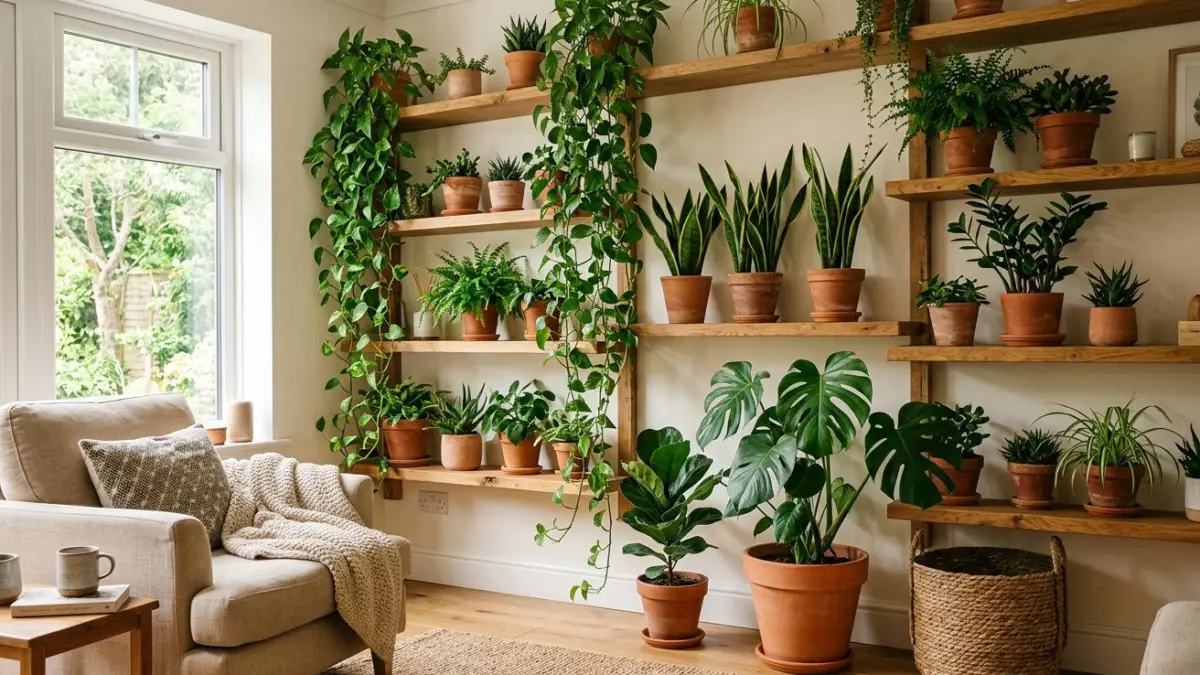
Quick answers
- Which low-light houseplant is toughest?
- Snake plant, ZZ plant and cast iron plant. All three survive weeks of dry neglect and low light, store water in thick leaves or rhizomes, and mostly die from overwatering rather than dimness. Water them far less than you think.
- Can any houseplant live in a windowless room?
- No. Plants need light to make food. A windowless room works only with a grow light running 10 to 14 hours a day. Without one, even the toughest plant slowly weakens over several months.
- How do I know if a spot is too dark?
- Hold your hand a hand-width above the plant at midday. A sharp shadow means medium light or better. A faint, fuzzy shadow means low light. No visible shadow means too dark for most plants without a lamp.
- Why is my pothos losing its variegation?
- The plant is making more green chlorophyll to catch scarce light. Move it nearer a window. New leaves usually show more marbling again, though leaves already turned green will not change back.
Key takeaways
- Low light means a faint, fuzzy hand shadow at midday, not a dark room
- Light falls sharply with distance: 3 m from a window is often a tenth of the sill
- Water low-light plants roughly half as often as sunny-window plants
- Snake plant, ZZ, cast iron and pothos tolerate the dimmest spots
- Add a grow light for 10 to 14 hours if the room has no window
Table of contents8 sections
The 15 best low-light houseplants actually thrive in dim rooms because their leaves and slow growth suit weak light.
The best low-light houseplants are snake plant, ZZ plant, cast iron plant, pothos, heartleaf philodendron and peace lily, followed by parlor palm, Chinese evergreen and a few dracaenas. They tolerate light that would make most plants stretch and sulk, but none of them grows in the dark. “Low light” means a bright room’s far corner or a north window, not a cupboard.
This guide is for anyone with a dim flat, hallway, office or north-facing room who wants plants that last. It sits inside the Indoor Plants guides, and it covers how to measure your light, which fifteen plants earn their place, and how to care for them differently from sunny-window plants.
What low light actually means
Plants respond to light intensity, not to how bright a room feels to your eyes, because your pupils adjust and plants can’t. Rough figures help. Low light is about 50 to 250 foot-candles (roughly 500 to 2,500 lux), medium is 250 to 1,000 foot-candles, and a sunny sill can exceed 5,000. A phone light-meter app gives a usable estimate.
You can also test with your hand. At midday, hold your hand about 30 cm above the plant’s spot. A crisp, dark shadow means medium or bright light. A soft, blurry shadow means low light. If you can barely see a shadow, the spot is too dim for any plant to grow, and you’re only asking it to survive on stored reserves.
Distance matters more than most people expect. Light falls off quickly as you move away from glass, so a plant 3 m inside a room can receive only a tenth of what the windowsill gets. Direction matters too. In the northern hemisphere a north window gives soft, steady light all year, while in the southern hemisphere the same description applies to a south window. Trees outside, balconies, window film and net curtains can each take away a third or more.
The 15 plants compared
These are ranked loosely from most to least tolerant of dim conditions. Watering notes assume low light, where mix stays wet for much longer than in a bright room.
| Plant | Lowest light it tolerates | Water in low light | Notes and pet safety |
|---|---|---|---|
| Snake plant (Dracaena trifasciata) | Very low, slow growth | Every 3 to 5 weeks | Rot-prone if wet; toxic to pets if chewed |
| ZZ plant (Zamioculcas zamiifolia) | Very low | Every 3 to 4 weeks | Stores water in thick rhizomes; toxic to pets |
| Cast iron plant (Aspidistra elatior) | Very low | Every 2 to 3 weeks | Very slow; non-toxic to cats and dogs |
| Pothos (Epipremnum aureum) | Low | When top 3 to 4 cm is dry | Variegation fades; toxic to pets |
| Heartleaf philodendron | Low | When top 3 to 4 cm is dry | Trails well; toxic to pets |
| Peace lily (Spathiphyllum) | Low, may not flower | When leaves just begin to soften | Droops clearly when thirsty; toxic to pets |
| Parlor palm (Chamaedorea elegans) | Low to medium | When top 3 cm is dry | Compact; non-toxic to pets |
| Kentia palm (Howea forsteriana) | Low to medium | Every 10 to 14 days | Slow, elegant floor plant; non-toxic |
| Chinese evergreen (Aglaonema) | Low (green types) | When top 4 cm is dry | Silver and pink types need more light; toxic to pets |
| Corn plant (Dracaena fragrans) | Low to medium | When top 5 cm is dry | Tall and sculptural; toxic to cats and dogs |
| Dragon tree (Dracaena marginata) | Low to medium | When top 5 cm is dry | Narrow leaves; toxic to cats and dogs |
| Spider plant (Chlorophytum) | Low to medium | When top 2 to 3 cm is dry | Plain green forms cope best; non-toxic |
| Bird’s nest fern (Asplenium nidus) | Low to medium | Keep lightly moist | Needs humidity; non-toxic |
| Prayer plant (Maranta) | Medium-low | Keep lightly moist | Folds leaves at night; non-toxic |
| Lucky bamboo (Dracaena sanderiana) | Low | Change water every 1 to 2 weeks | Grows in water; toxic to cats and dogs |
Plain green or dark-leaved forms tolerate shade better than white, cream or pink variegation. Variegated tissue contains little chlorophyll, so a plant with half its leaf area pale needs more light to make the same food.
Choosing by room
| Situation | Rough light | Best choices | Avoid |
|---|---|---|---|
| North window, within 1 m | Low to medium | Pothos, philodendron, prayer plant, peace lily | Succulents, which stretch |
| Hallway, 3 m or more from glass | Very low | Cast iron plant, ZZ, snake plant | Anything flowering or variegated |
| Bathroom with frosted window | Low, humid | Bird’s nest fern, pothos, peace lily | Snake plant, which dislikes constant damp |
| Office under fluorescent tubes | Low, long hours | ZZ, pothos, spider plant | Weekend-only lighting for tropicals |
| Bedroom, east or north window | Low to medium | Parlor palm, Chinese evergreen, snake plant | Large pots that stay wet |
The decision rule is simple. If the plant would be happy with what you can measure, buy it. If your spot is darker than the table suggests, choose the most tolerant plant in the row and plan to move it nearer a window for a few weeks each season, because a plant that’s rotated into better light holds its leaves far longer.
How care changes in low light
Low light slows everything. Photosynthesis, growth and water use all drop, and the usual advice needs adjusting.
- Water less, and check deeper. Wait until the top third to half of the mix is dry, and use the lift test: a light pot is ready. Plants in dim rooms often need a third to half as much water as the same plant on a bright sill. The full routine is in how to water houseplants correctly.
- Feed rarely. Use a balanced liquid feed at half strength, about once every 6 to 8 weeks in spring and summer, and skip it in winter. Unused fertiliser salts build up in slow-growing plants and brown the leaf tips.
- Wipe the leaves. A layer of dust can cut the light a leaf receives noticeably. Wipe broad leaves with a damp cloth every month or two.
- Rotate. Turn the pot a quarter turn every week or two so the plant doesn’t lean, and swap pairs between a dim spot and a brighter one every few weeks.
- Resist upsizing. A snug pot dries sooner and suits most of these plants. Repot only when roots circle the pot or push out of the holes, as explained in repotting houseplants without stress.
When a grow light is the honest answer
If your spot reads below about 50 foot-candles, or the room has no window, choose a lamp over a tougher plant. A full-spectrum LED bulb or panel placed 30 to 60 cm above the foliage, run 10 to 14 hours a day on a timer, is enough for most plants in this list. Shade-tolerant foliage plants need far less output than tomatoes or orchids. Warm-white household LEDs do help, but they are weak, and the plant must sit within about 30 cm of the bulb to benefit.
Low light also means cooler, darker winters in many climates, so plants that tolerate dimness in summer may still drop leaves in midwinter. In subtropical and tropical homes with deep verandas, the same plants do well on shaded porches, but keep them out of direct afternoon sun, which scorches shade-grown leaves within days.
Common mistakes and what causes them
| Mistake | Cause | Fix |
|---|---|---|
| Yellow, soft lower leaves | Mix stays wet for weeks because the plant uses little water | Stop watering, check roots, water by weight instead of by date |
| Long gaps between leaves | The plant is stretching toward light (etiolation) | Move closer to the window or add a lamp; trim the stretched growth |
| Pale or all-green variegated leaves | Plant is producing more chlorophyll to compensate | Brighten the spot; accept some loss on old leaves |
| Brown leaf tips | Salt build-up or dry air, not low light itself | Flush with plenty of water; feed less; see humidity for houseplants |
| Fungus gnats | Constantly damp top layer | Let the top 3 cm dry fully and use sticky traps |
| Plant declines after purchase | Moved from a bright greenhouse to a dim room, losing leaves while it adjusts | Keep care steady for 4 to 6 weeks; some leaf loss is normal |
If a plant looks unwell and none of these fit, work through the checks in houseplant problems and fixes.
Choosing safely with pets and children
Many classic low-light plants, including pothos, philodendron, peace lily, ZZ, snake plant and Chinese evergreen, contain irritants that cause mouth pain or stomach upset if chewed. The non-toxic names in the table are parlor palm, kentia palm, cast iron plant, spider plant, bird’s nest fern and prayer plant. Species and cultivar names matter, so check the botanical name on the label. A fuller list is in pet-safe houseplants.
If you have a bright sill instead, see Succulents and Cacti Indoors.
For how to choose a light for dim rooms, see Best Grow Lights for Houseplants.
What to read next
Match your watering to the dim conditions with how to water houseplants correctly, then use houseplant problems and fixes if leaves change colour. If you have a cat or dog, read pet-safe houseplants before buying. For the wider picture, go back to the Indoor Plants guides.
Frequently asked questions
Do low-light houseplants need fertiliser?
Only a little. Feed at half strength about once every 6 to 8 weeks in spring and summer, and skip winter. Slow growth means unused fertiliser salts build up in the mix and brown the leaf tips.
Can I put a succulent in a north-facing window?
It will survive for a while, but it will stretch and weaken. Most succulents and cacti want 4 to 6 hours of bright light. In the northern hemisphere, a north window suits pothos or ZZ plant better. Haworthia tolerates lower light than most succulents.
Which low-light houseplants are safe for cats and dogs?
Parlor palm, kentia palm, cast iron plant, spider plant, bird's nest fern and prayer plant are listed as non-toxic. Pothos, philodendron, peace lily, ZZ and snake plant are not. Check the botanical name against the ASPCA database before you buy, as common names overlap.
How often should I water a snake plant in low light?
Roughly every 3 to 5 weeks, but check the mix first. In dim rooms the mix stays wet for a long time, and wet roots rot. Water only when the pot feels light and the mix is dry well down, then let it drain fully.
Can low-light plants live under fluorescent office lighting?
Often yes. ZZ plant, pothos and spider plant can cope under office tubes if the lights are on long hours. They struggle when lights stay off for whole weekends or holidays. A desk lamp with an LED grow bulb on a timer helps.
Why is my low-light plant dropping leaves in winter?
Shorter, darker days can push a plant below the light it needs, so it sheds older leaves. Move it to the brightest spot you have, or add a grow light for 10 to 14 hours a day. Water less as well, since a plant in dim light uses little.
Do low-light plants need to be rotated?
Yes, turn the pot a quarter turn every week or two so growth stays even. Swapping a dim-spot plant with one from a brighter room every few weeks also helps it keep its leaves. Plants that lean toward the window need this most.
How far from a window can a low-light plant sit?
Most manage within 2 to 3 m of a window, but light drops sharply with distance. A spot 3 m from glass can get around a tenth of the light on the sill. Only ZZ plant, snake plant and cast iron plant cope with the dimmest spots.
Can lucky bamboo live in water only?
Yes, lucky bamboo grows in water if you change the water every 1 to 2 weeks. Use filtered or rainwater if leaf tips brown. It tolerates low light but is toxic to cats and dogs, so keep it out of reach.
Should I wipe the leaves of my low-light plants?
Yes, wipe broad leaves with a damp cloth every month or two. Dust cuts the light reaching a leaf, which matters in a dim room where every bit counts. Use a soft dry brush on small or fuzzy leaves instead.
More in Indoor Plants
How to Water Houseplants Correctly (The Complete Guide)
Soak-and-drain watering, bottom watering, judging pot weight, water quality and how seasons change the interval, so you water by the plant and not the calendar.
Repotting Houseplants Without Stress (Yours or Theirs)
How to tell a plant truly needs a bigger pot, how much bigger to go, what to do with the roots, and how to handle the…
Houseplant Problems & Fixes: A Visual Diagnostic Guide
Work out why a houseplant is yellowing, browning, dropping leaves or infested: a fixed diagnostic order, a symptom table, pest treatments and a root rot rescue.