Quick answers
- How many colors should one flower bed have?
- Plan on two or three flower colors plus green, with a repeating foliage color such as silver or purple. Repeat each color in drifts of 3 to 5 plants at least twice along the bed. More colors work only in cottage styles, and only when repetition outnumbers variety.
- What is the safest palette for a beginner?
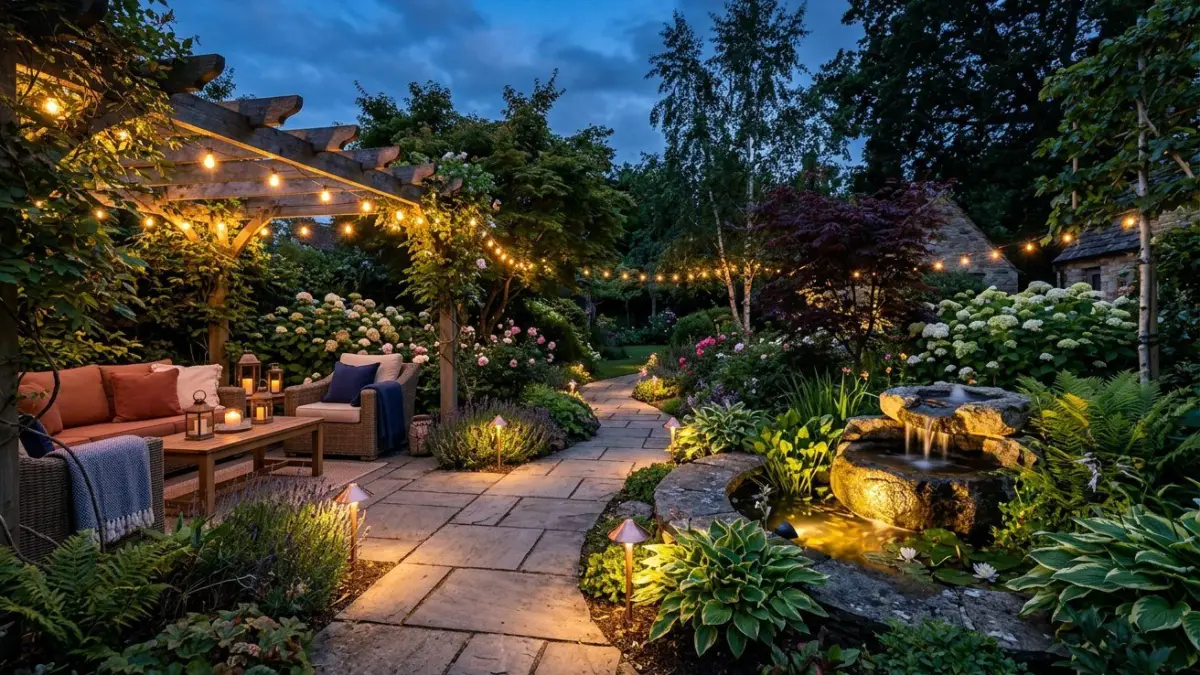
- Blue-violet with white and silver. Lavender, salvia, alyssum and dusty miller all fit it, and neighboring tints rarely clash. It also glows at dusk, which suits a garden you mostly see after work. See the moon garden guide for the evening version.
- Why do my colors look dull or washed out?
- Usually the cause is light and value, not hue. Pale pastels bleach in strong midday sun, while dark reds and deep purples vanish in shade and at dusk. Check the bed at the hours you use it, and add silver, white or chartreuse foliage to separate dark flowers.
- Do warm or cool colors suit a small garden?
- Cool colors (blue, violet, soft pink) tend to recede and make a short space feel longer when planted at the far end. Warm colors (red, orange, yellow) advance, so use them near seating. More tricks are in our small garden ideas guide.
Key takeaways
- Limit each view to 2 or 3 flower colors plus green, repeated in drifts of 3 to 5
- Value (light versus dark) matters more than hue once the sun drops
- Warm colors advance and cool colors recede, so place them to shape space
- Map bloom time by month so the palette changes key instead of fading out
Table of contents10 sections
- Garden color theory rules at a glance
- Color wheel schemes and the garden plants that deliver them
- Value beats hue in a garden after sunset
- How light and climate change what you see
- Build a garden color palette in five steps
- Keep the garden color palette alive all season
- Fixing a garden color palette that is not working
- How colour changes the way your garden feels
- Common mistakes
- Next steps
Garden color theory helps you paint your beds like an artist, using contrast, repetition and foliage to build a scheme that holds together.
A good garden palette uses two or three flower colors plus green, repeats them in drifts, and is tested in the light you actually see the bed in. Hue (the position on the color wheel) gets most of the attention, but value (how light or dark a color is) decides whether a combination reads from the patio at 7 pm. This guide covers the wheel schemes, named plant combinations, how light changes color, and how to keep a palette alive from spring to autumn.
Color is one of the principles covered in Garden Design Principles, and it pays off most when you apply it to the shapes and sightlines from Small Garden Design Ideas and the structure in Garden Paths & Hardscaping.
Garden color theory rules at a glance
| Question | Working rule |
|---|---|
| Flower colors per view | 2 to 3, plus green and one foliage accent |
| Proportions | About 60% dominant color (often green or one hue), 30% second, 10% accent |
| Drift size | 3 to 5 plants of one kind (7 or more in a border longer than 6 m (20 ft)) |
| Repeats | Each key color appears at least twice, ideally 3 times, along the bed |
| Warm colors | Red, orange, yellow: advance, feel closer, energize |
| Cool colors | Blue, violet, soft pink: recede, feel calmer |
| Dusk visibility | White, cream, pale yellow and silver stay visible; deep red, navy and dark purple fade |
| Bloom check | Something in color in every month you are outside |
Color wheel schemes and the garden plants that deliver them
The wheel gives you four reliable starting points. Each one fails in a predictable way, so the table includes the weak spot to watch.
| Scheme | Example plants | Mood | Weak spot |
|---|---|---|---|
| Monochrome (one hue, many tints) | Pale to deep pink: Echinacea purpurea, phlox, Sedum ‘Autumn Joy’ | Elegant, restful | Flat without texture contrast; vary leaf shape |
| Analogous (neighbors on the wheel) | Blue to violet to pink: catmint, salvia, verbena, cranesbill | Harmonious, soft | Can lack a focal note; add one white or silver plant |
| Complementary (opposites) | Purple and yellow: salvia with coreopsis; iris with Achillea | Vivid, high energy | Tiring if equal quantities; use roughly 2 parts to 1 |
| Hot palette | Canna, nasturtium, lantana, rudbeckia | Tropical, bold | Needs full sun and green breaks; clashes with pink |
For hot palettes, the best performers are in our list of flowering plants for full sun. Planting complementary colors in unequal amounts is the quickest fix for a bed that feels loud: let one color be the field and the other the sparkle.
Value beats hue in a garden after sunset
In dim light the eye loses color sensitivity and leans toward blue-green, so reds look near black while pale flowers seem to glow. This is why a bed of deep burgundy and navy can look rich at noon and vanish by evening, and why white and silver gardens have a following with people who are home only after work. The famous white garden at Sissinghurst in England works on the same principle, though it also relies on green and grey foliage to give the whites somewhere to rest.
Value also solves separation. Dark flowers need a light neighbor, and pale flowers need something darker nearby to stand out. A practical test: take a photo of the bed and convert it to grayscale on your phone. If the image turns into a single gray mass, the colors may differ but the values don’t, and the planting will look muddy from a distance. It’s also a cheap check for color vision differences, since roughly 1 in 12 men have some red-green deficiency and see pink and green or red and green as similar.
Foliage is the connector. Silver (dusty miller, lamb’s ear, Artemisia) calms hot colors and lifts dark ones. Chartreuse (Hakonechloa, some heuchera and hosta) brightens shade. Dark purple foliage (smoke bush, dark-leaved heuchera) makes pale flowers pop. Use one of these three repeatedly rather than all at once.
White is also the best peacemaker. A block of white or cream flowers between two clashing colors, such as orange and magenta, resets the eye and lets both stay. Keep in mind that colors shift with age: pale blue and pink petals fade in strong sun within days, and some flowers change color as they open, so judge a plant by its mature flower, not its bud.
How light and climate change what you see
- Bright, high sun (low latitudes, summer noon) bleaches pastels and flatters saturated colors. Pale pink and lavender can look washed out, while red, orange and deep blue hold up.
- Soft, grey or northern light usually favors pastels and cool tones, while deep colors can look heavy.
- Shade reads cooler. White, yellow-green and pale blue show up best, so choose them for the darkest corners.
- Behind a wall or fence, a pale painted backdrop reflects light and lifts a palette, and a dark one makes bright flowers pop. Treat the wall as part of the color scheme.
- Surrounding materials count. Warm brick and terracotta clash with cool pinks and magenta. Grey stone and slate suit blues, whites and silvers.
View the bed at three times (late morning, mid-afternoon, early evening) before you commit to a palette. Nursery pots under sales-yard light tell you very little.
Build a garden color palette in five steps
- Look at what is fixed. Note house brick or render, paving, fence color and any large evergreen. Your flowers have to agree with these.
- Choose the mood and the viewing hour. Calm and evening use points to cool and pale. Lively daytime use points to warm.
- Pick two flower colors and one accent. Aim for roughly 60:30:10 by area, counting foliage in the 60.
- Choose plants by bloom month, then lay out drifts of 3 to 5 on paper or with potted plants set on the bed. Repeat each color at least twice.
- Review at dusk, photograph in grayscale, and swap any plant that disappears or dominates.
Keep the garden color palette alive all season
Most beds peak in one month and then sag. Instead of one palette, plan a sequence: early bulbs in white and pale yellow, early summer in blue and pink, late summer in gold and orange, autumn in rust, burgundy and seed-head brown. A spring-bulb layer is the cheapest way to extend the show, and the timing is explained in Flower Bulbs 101. If you rely on annuals for filler, match their color to the perennial scheme before buying and sow them to peak in the gaps between perennial waves.
Texture and form do some of the work color usually gets credit for. Fine, feathery foliage (fennel, Stipa) makes a color feel softer and further away, while large, glossy leaves make the same color feel heavier and closer. If a bed feels flat even though the colors are right, change the shapes before you change the colors.
Leave seed heads and grasses standing into winter. Tan, bronze and silver tones are a legitimate part of the palette, and frost on them is free color.
Fixing a garden color palette that is not working
| Symptom | Likely cause | Fix |
|---|---|---|
| Bed looks busy or chaotic | Too many colors, singles instead of drifts | Remove to 2 or 3 colors; regroup plants into 3 to 5 of a kind |
| Bed looks flat and washed out at noon | All pale pastels in strong sun | Add one deeper accent and silver or dark foliage |
| Flowers vanish at dusk | Dark reds, navy and purple with no light partner | Add white, cream or silver within 1 m (3 ft) |
| Orange and pink fight each other | Adjacent hues with competing temperature | Separate with a block of green, silver or white |
| Beautiful in June, empty by August | Single-season palette | Add late perennials and grasses in the same colors |
| Bright bed looks too close to the house | Warm colors dominate the far end | Move blues and silvers to the far end, warm colors to the front |
How colour changes the way your garden feels
Blue salvia and lavender cool a border and make a small space seem larger, while red dahlia and orange marigold warm it and shorten the distance. Yellow rudbeckia and sunflower boost brightness in shade, and white cosmos and hydrangea catch light at dusk. Green foliage from hosta and fern calms a bed and holds the scheme together.
Complementary pairs such as purple salvia with yellow echinacea create contrast, and a single colour suits a modern garden. Silver foliage from lavender and sage softens hot colours and tolerates drought. Repeating one colour in three places guides the eye and reduces clutter in a bed of 3 m. Morning light flatters pastel tulip and peony, while strong midday sun washes them out, so you’ll want deeper tones such as dahlia and rudbeckia in a sunny spot. Foliage lasts for 6 months where flowers last for 6 weeks, so hosta, heuchera and fern protect the scheme between blooms. Mulch in a dark colour makes bright flowers stand out, and compost feeds the bed so that colour stays strong. White and pale yellow reflect light in shade, and hydrangea and astilbe tolerate it. Your local garden centre or the RHS gallery helps you see combinations before you buy, and the garden design principles guide shows how colour supports balance.
White cosmos and hydrangea reflect dusk light and brighten shade. Lavender and sage cool a hot border and tolerate drought. Dahlia and marigold warm a bed and attract bee and hoverfly, and mulch makes their colours stand out.
Common mistakes
- Buying one of everything. Single plants of many colors read as noise. Buy fewer varieties in larger groups and repeat them.
- Choosing color at the nursery. Tags and sales-yard light distort color and say nothing about your site. Test with potted plants in place, at the right time of day.
- Forgetting green. Foliage fills most of the season and most of the bed. Pick leaf color and texture on purpose, not by default.
- Ignoring bloom time. Two plants that look great together on a label may never flower at the same time. Check bloom months, not just color.
- Planting dark colors at the back only. Dark flowers at a distance disappear. Put deep colors near the viewer and pale ones further away.
- Treating hardscape as neutral. Paving and fence color shift the palette. Choose materials that won’t fight the planting.
Next steps
- Choose a mood first with Garden Styles Explained, because each style has a typical palette.
- Add evening glow with Water Features & Garden Lighting, where pale flowers and light play off each other.
- Build a low-effort scheme from Low-Maintenance Flower Borders.
Return to the Garden Design guides for the full set of layout and planning guides.
Frequently asked questions
What is the 60-30-10 rule in garden color design?
It is a proportion guide: about 60% of the bed in a dominant color, 30% in a second color and 10% in an accent. Count green foliage in the dominant share. It stops a bed looking chaotic and gives the eye one clear main theme.
What does value mean when choosing flower colors?
Value is how light or dark a color is, separate from its hue. It matters because pale flowers glow at dusk while dark reds and navy fade. If two plants have the same value, they blur together from a distance, even when their hues differ.
Which flower colors look best in a shady garden?
White, cream, pale yellow, chartreuse foliage and pale blue show up best in shade, while dark colors disappear. Hosta, heuchera, white foxglove and ferns work well. Light colors bounce what little light there is and make dark corners feel brighter.
How do I stop a white garden looking boring?
Vary the textures and add foliage. Mix fine feathery leaves with large glossy ones, and bring in silver and green plants so the whites have somewhere to rest. Varied flower shapes and heights, with a few cream or pale yellow tints, add depth.
Can orange and pink flowers be planted together?
They can, but they often clash because they compete in temperature. Separate them with a block of green, silver or white foliage, or white flowers. Keeping the quantities uneven, with one color as the main field and the other as a small accent, also helps.
Which flower colors do bees like best?
Bees are often drawn to blue, purple, violet, yellow and white flowers, while hummingbirds, where they live, favor red and orange tubular blooms. Single flowers with open centers give easier access than double forms. Choosing plants that bloom in sequence matters more than color alone.
How can I check whether my flower colors clash?
Take a photo of the bed and convert it to grayscale on your phone. If it becomes one gray mass, the values are too alike and the planting will look muddy from a distance. Also view the bed at morning, afternoon and evening before committing.
What color should I paint a fence to show off plants?
A dark fence in charcoal, deep green or black makes bright flowers and pale foliage stand out. A pale fence reflects light and lifts a shady area. Consider the planting and the viewing hour, and avoid colors that fight with warm brick or paving.
How do I keep a flower bed colorful from spring to autumn?
Plan by bloom month instead of one palette. Use early bulbs in white or pale yellow, blue and pink perennials in early summer, gold and orange in late summer, then rust, burgundy and seed heads in autumn. Check bloom times on the label.
Does green foliage count as a color in a garden palette?
Yes. Green fills most of the bed for most of the season, so choose leaf color and texture on purpose. Silver, chartreuse and dark purple foliage can calm, brighten or lift your flowers, and a single repeated foliage accent ties the whole scheme together.
More in Garden Design
Water Features & Garden Lighting: The Evening Transformation
How to site a water feature and light layer, choose between options, and weigh budget against upkeep, with links to the detailed guides for each build.
Garden Design Principles: Balance, Scale, Rhythm, Unity
Unity, balance, rhythm, focal points and scale turned into measurable rules, plus a worked layout for a 12 m by 8 m plot you can copy…
Garden Styles Explained
Compare cottage, formal, Mediterranean, modern, wildlife and Japanese-inspired gardens by plants, upkeep and cost, then pick one that fits your house, soil and time.