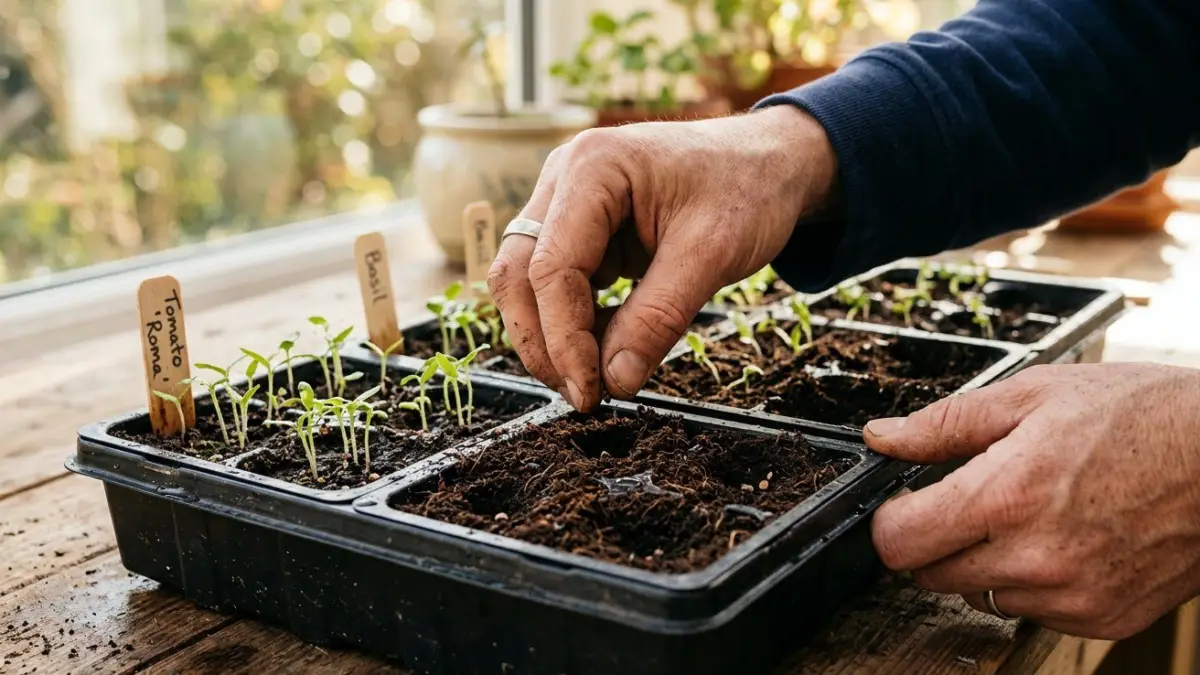
Quick answers
- Why are my seeds not germinating?
- Usually the seed is old, the medium is too cold or too dry, or the seed was buried too deep. Test 10 seeds on a damp paper towel in a bag: if fewer than 7 sprout in the expected time, sow thicker or buy fresh seed.
- How deep should I plant seeds?
- Plant at about 2 to 3 times the seed's own diameter. Fine seeds such as lettuce, petunia and snapdragon need light and are pressed onto the surface; large seeds such as beans and sunflowers go 2.5 to 4 cm deep.
- Should I soak seeds before sowing?
- Only some. Hard-coated seeds such as sweet peas and morning glory benefit from a nick and an 8 to 12 hour soak, but wrinkled peas can rot if soaked and sown into cold wet soil, and carrot seed should never be soaked.
- Can I sow seeds straight into the garden?
- Yes, for carrots, beets, radish, beans, peas, sunflowers and zinnias. Use a fine, firm seedbed, keep the surface evenly moist until emergence, and thin once true leaves appear.
Key takeaways
- Sow at 2 to 3 times the seed's diameter; surface-sow light-needing seed
- Match temperature to the crop: lettuce 10 to 20°C, tomato 20 to 30°C, pepper 25 to 30°C
- Keep the medium evenly moist, never soaking then drying
- Test old seed on a damp towel before sowing a whole packet
Table of contents12 sections
- Plant seeds at a glance
- Test your seeds before you plant them
- Germination temperatures that matter when you plant seeds
- Plant seeds indoors in trays: the method
- Plant seeds straight into the garden
- Light-needing seed, dark-needing seed and seed that needs a cold spell
- Troubleshooting seeds that fail to sprout
- When to plant seeds: working back from your last frost
- What happens inside your seed tray
- How to plant seeds: the step by step cause and effect
- Mistakes to avoid
- What to read next
How to plant seeds step by step is a complete beginner guide, from choosing seed to sowing depth, light and watering.
Plant seed at about two to three times its own diameter in fine, evenly moist, sterile mix, at the temperature that species prefers, and most of it will come up. Failures almost always trace back to four things: seed that was old, medium that was too cold or too dry, seed buried too deep, or seedlings that rotted at the soil line.
This guide is for anyone sowing in trays, pots or garden beds, and it covers depth, spacing, germination temperatures, a viability test, sowing indoors versus outdoors, and troubleshooting. It’s part of the Plant Growing Guides guides, and the natural next steps are transplanting seedlings and watering the right way.
Plant seeds at a glance
| Question | Short answer |
|---|---|
| Depth | 2 to 3 times the seed’s diameter; fine seed on the surface |
| Medium | Fine, sterile seed-starting mix, not garden soil |
| Temperature | Most vegetables 18 to 25°C (64 to 77°F); see the table below |
| Moisture | Evenly damp like a wrung-out sponge, never waterlogged |
| Light after emergence | 14 to 16 hours of bright light, lamp 5 to 15 cm above the leaves |
| Thin or transplant | When the first true leaves are fully open |
Test your seeds before you plant them
Seed packets are dated for a reason. Germination falls each year in storage, and heat and humidity speed the decline. Onion, leek and parsnip seed is often poor after one year. Carrot, lettuce, beans and peas usually keep two to three years, and tomato and brassica seed can stay good for four or five if kept cool and dry.
A simple test saves a wasted season. Dampen a paper towel, lay 10 seeds on it, fold it, slip it into a loosely closed bag and keep it warm. Check at the time the packet gives for germination. Seven sprouted seeds means 70 per cent, which is fine. Four means you should sow roughly twice as thickly, and below three it’s cheaper to buy fresh seed.
Germination temperatures that matter when you plant seeds
Packets say “sow in spring”, but each species has a temperature band. Too cold and seed sits and rots. Too hot and some crops go dormant. Lettuce is the classic case: above about 25 to 28°C many varieties refuse to germinate, so in summer sow it in a cool room or after chilling the damp seed in the fridge for a day.
| Crop | Good germination range | Typical time to emerge |
|---|---|---|
| Lettuce, spinach | 10 to 20°C | 3 to 10 days |
| Peas, broad beans | 10 to 20°C | 7 to 14 days |
| Carrot, parsnip, parsley | 10 to 25°C | 10 to 21 days or longer |
| Brassicas (cabbage, broccoli, kale) | 15 to 25°C | 4 to 10 days |
| Tomato | 20 to 30°C | 5 to 10 days |
| Pepper, aubergine (eggplant) | 25 to 30°C | 7 to 21 days |
| Squash, cucumber, melon, beans (French and runner) | 20 to 30°C | 4 to 10 days |
Root-zone temperature matters more than air temperature. A seedling heat mat under the tray can bring peppers up in a week instead of three, but it will also dry the surface faster, so check moisture twice a day.
Plant seeds indoors in trays: the method
- Fill the container. Use a fine seed-starting mix (see Choosing Pots and Potting Mix) in clean trays or pots with drainage holes. Fill to the rim, tap, and press down lightly so there are no air pockets.
- Pre-wet the mix. Water from below until the surface darkens, then let it drain. Watering after sowing can wash small seed into clumps.
- Sow. Place two or three seeds per cell, or space seed 2 to 3 cm apart in a seed tray. Cover to the correct depth with dry mix or vermiculite.
- Label now. Write the variety and date on a plant label. Seedlings of different tomatoes look identical.
- Keep it moist and warm. A clear lid or loose plastic bag holds humidity. Remove it as soon as the first seedlings show, and open it daily for airflow before that.
- Give light at once. Seedlings that emerge in dim light stretch within a day or two. Use a bright south-facing window or a grow light for 14 to 16 hours, kept a few centimetres from the leaves.
- Thin to one per cell. Snip the weaker seedlings at soil level with scissors rather than pulling, which tears the roots of the one you’re keeping.
Plant seeds straight into the garden
Direct sowing suits crops that dislike root disturbance: carrot, beet, radish, turnip, beans, peas, sweet corn, sunflower and most poppies. Rake the bed to a fine crumb in the top 3 to 5 cm, draw a shallow furrow with a stick, sow, cover and water gently with a rose on the can.
| Crop | Sowing depth | Final spacing after thinning |
|---|---|---|
| Radish | 1 cm | 2.5 to 5 cm |
| Carrot | 0.5 to 1 cm | 3 to 5 cm |
| Beet | 2 cm | 8 to 10 cm |
| Lettuce | Surface to 0.5 cm | 15 to 30 cm for heads |
| Bush beans | 3 to 4 cm | 8 to 10 cm |
| Peas | 3 to 5 cm | 5 cm |
| Zinnia, marigold | 0.5 to 1 cm | 20 to 30 cm |
Carrots and parsley can take three weeks to emerge, and the surface of the bed must not crust or dry in that time. Lay a board or sheet of damp hessian over the row and lift it daily from day 7. Remove it the moment you see green threads. A crust is also the reason small seed often fails in clay soil, so a thin layer of fine compost or vermiculite over the row helps.
Light-needing seed, dark-needing seed and seed that needs a cold spell
- Needs light: lettuce, petunia, snapdragon, celery and many herbs. Press the seed onto the surface and don’t cover it.
- Prefers darkness: phlox, calendula and many beans germinate best covered. Follow the packet.
- Hard seed coat: sweet pea, morning glory and lupin germinate faster if you nick the coat with a file or soak for 8 to 12 hours. Don’t soak longer, as seed can drown.
- Needs cold (stratification): many hardy perennials and wildflowers, such as milkweed and some echinacea, need a moist cold spell. Mix seed with damp sand or mix, seal it in a bag and refrigerate at roughly 1 to 5°C for 4 to 12 weeks, or sow outdoors in autumn and let winter do it.
The soaking tip is only half true. It helps large, hard-coated seed in warm conditions. It hurts wrinkled peas and any seed sown into cold soil, because wet seed with no warmth is an invitation to rot.
Troubleshooting seeds that fail to sprout
| What you see | Likely cause | How to confirm and fix |
|---|---|---|
| Nothing after 3 weeks | Old seed, cold medium or buried too deep | Dig up a few seeds. Soft and rotten means too cold or wet; firm and unchanged means old seed or low temperature. Resow with a viability test |
| Seedlings fall over at the soil line | Damping off, a fungal disease from wet, cool, still conditions | Stem is thin and brown at the base. Remove affected cells, open the lid, add airflow, water from below and use fresh sterile mix next time |
| Tall, pale, floppy seedlings | Too little light or too warm after emergence | Move the light closer, cool the room a few degrees and increase daily light hours |
| Seedlings emerge then vanish outdoors | Slugs, birds or cutworm | Look for slime trails or cut stems at dusk. Use cloches, collars of card or mesh |
| Seed coat stuck on the leaf | Medium dried during emergence | Mist the seedling and wait a few hours; do not pull the coat |
When to plant seeds: working back from your last frost
For indoor sowing, count backwards from your average last frost date. Peppers and aubergines need 8 to 10 weeks, tomatoes 6 to 8, brassicas 4 to 6, and cucumbers and squash only 3 to 4, because they sulk when kept in small pots too long. Lettuce can be sown 3 to 5 weeks before planting out. In hot, dry regions the logic flips and the cool season is the main window, so sow brassicas and lettuce in early autumn. In humid tropical gardens, sow in the drier months where possible and keep trays off the ground. The seasonal planting calendar works through this by season.
What happens inside your seed tray
Cold soil temperature slows germination, so a heat mat protects your tomato and pepper seed from rot. A propagator holds humidity around lettuce and basil seed, but you’ll need to vent it daily to prevent damping-off. Fine compost needs perlite or vermiculite to drain well, because dense mix blocks air and encourages fungus gnat larvae.
A grow light keeps tomato seedlings short and stops the stretching you see on a dim windowsill. Thinning reduces competition, so each carrot and radish gets room to swell. Hardening off protects cabbage and kale from wind and sun, because a cloche or fleece lets the leaves toughen gradually. Frost kills tender courgette and cucumber seedlings, so you shouldn’t move them outdoors until the last frost has passed.
How to plant seeds: the step by step cause and effect
Tomato and pepper seed need warmth of 21°C, while lettuce and spinach germinate best in cool soil. Compost feeds seedlings and improves loam, and perlite or sand drains water and prevents damping-off. Sow seed at twice its width, because deep sowing causes weak growth and shallow sowing dries the seed. Bean and pea need 3 to 5 cm depth, and carrot and radish need only 1 cm. Mulch protects bed seed and reduces crusting, but you should keep it thin. Tomato and basil need light bulbs of 16 hours, and a bright window suits lettuce. Slug eats seedlings, and snail attacks bean, so gravel and traps protect them. Cosmos, zinnia and marigold tolerate direct sowing, and sunflower and nasturtium suit children. Harden off for 7 to 10 days, so you’ll avoid shock. Your extension service or the rhs lists sowing dates. The transplanting guide covers the next step.
Mistakes to avoid
- Using garden soil in trays, which compacts, drains poorly and carries disease
- Burying fine seed, or leaving large seed on the surface
- Letting the medium swing between soaked and dry
- Leaving the lid on after seedlings appear
- Sowing the whole packet at once, then not thinning
- Skipping labels
If your windowsill is dim, a grow light keeps seedlings short and sturdy, as explained in Grow Lights for Seedlings.
For a short list of tools worth buying first, see Best Gardening Tools for Beginners.
What to read next
Once seedlings have two sets of true leaves, follow How to Transplant Seedlings. For tomatoes in particular, see How to Grow Tomatoes, and for crops that forgive beginners, the easiest vegetables to grow. Back to the Plant Growing Guides.
Frequently asked questions
How long do vegetable seeds stay viable?
Carrot, lettuce, beans and peas usually keep two to three years, and tomato and brassica seed can last four or five if stored cool and dry. Onion, leek and parsnip seed is often poor after a year. Test older seed on damp paper before sowing a whole packet.
How do I thin seedlings without damaging the ones I keep?
Snip the weaker seedlings at soil level with small scissors rather than pulling them out. Pulling tears the roots of the neighbour you want to keep. Thin once the first true leaves open, leaving one per cell or the final spacing given on the packet.
Can I use garden soil to start seeds in trays?
No. Garden soil compacts in trays, drains poorly and can carry disease and weed seeds. Use a fine, sterile seed-starting mix instead. It holds even moisture without being heavy, and it is low in nutrients, which suits young roots. Fresh mix also lowers the risk of damping off.
Why do my seedlings fall over at soil level?
This is usually damping off, a fungal disease that rots the stem base in wet, cool, still conditions. Affected seedlings rarely recover, so remove them. Use clean trays and fresh mix, water from below, sow thinly and give the tray some airflow.
Should I cover seed trays with a lid or plastic bag?
Yes, until seedlings show, because a clear lid holds humidity around the seed. Open it daily for airflow and remove it as soon as the first seedlings appear, since leaving it on invites damping off and mould. Keep the tray out of direct sun, which can cook seed under plastic.
Which seeds need light to germinate?
Lettuce, petunia, snapdragon, celery and many herbs need light, so press them onto the surface and do not cover them. Others, such as phlox, calendula and many beans, germinate best covered. Follow the packet, which says whether the seed needs light or darkness.
What is stratification and which seeds need it?
Stratification is a cold, moist spell that breaks seed dormancy. Many hardy perennials and wildflowers, such as milkweed and some echinacea, need it. Mix seed with damp sand, seal it in a bag and chill it at about 1 to 5°C for 4 to 12 weeks, or sow outdoors in autumn.
How do I sow tiny seeds like lettuce evenly?
Mix the seed with a little dry sand or fine mix, or tap it gently from a folded piece of paper, and scatter it thinly over a pre-wetted surface. Press it in lightly without covering. Sowing thinly reduces thinning and cuts the risk of damping off.
Why does the seed coat stay stuck on my seedling leaf?
The medium probably dried out while the seedling was emerging. Mist the seedling and wait a few hours so the coat softens and falls away. Do not pull it off, because you can tear the leaf. Keep the surface evenly damp during germination.
When should I start tomato and pepper seed indoors?
Sow peppers and aubergines 8 to 10 weeks and tomatoes 6 to 8 weeks before your planned planting-out date, which is usually 1 to 2 weeks after the last frost. Counting back from that date avoids leggy, root-bound plants. Cucumbers and squash need only 3 to 4 weeks.
More in Plant Growing Guides
How to Transplant Seedlings Without Killing Them
Harden off, timing, root handling and aftercare, everything you need to move seedlings from tray to garden with zero transplant shock.
Watering Plants the Right Way: How, When and How Much
Deep-and-rare beats little-and-often. Learn to read your plants, check soil moisture properly, and build a watering rhythm that prevents 90% of garden problems.
Choosing Pots and Potting Mix: A Practical Guide
Terracotta or plastic? Potting soil or garden soil? Size and drainage decoded, pick containers and mixes your plants will genuinely thrive in.