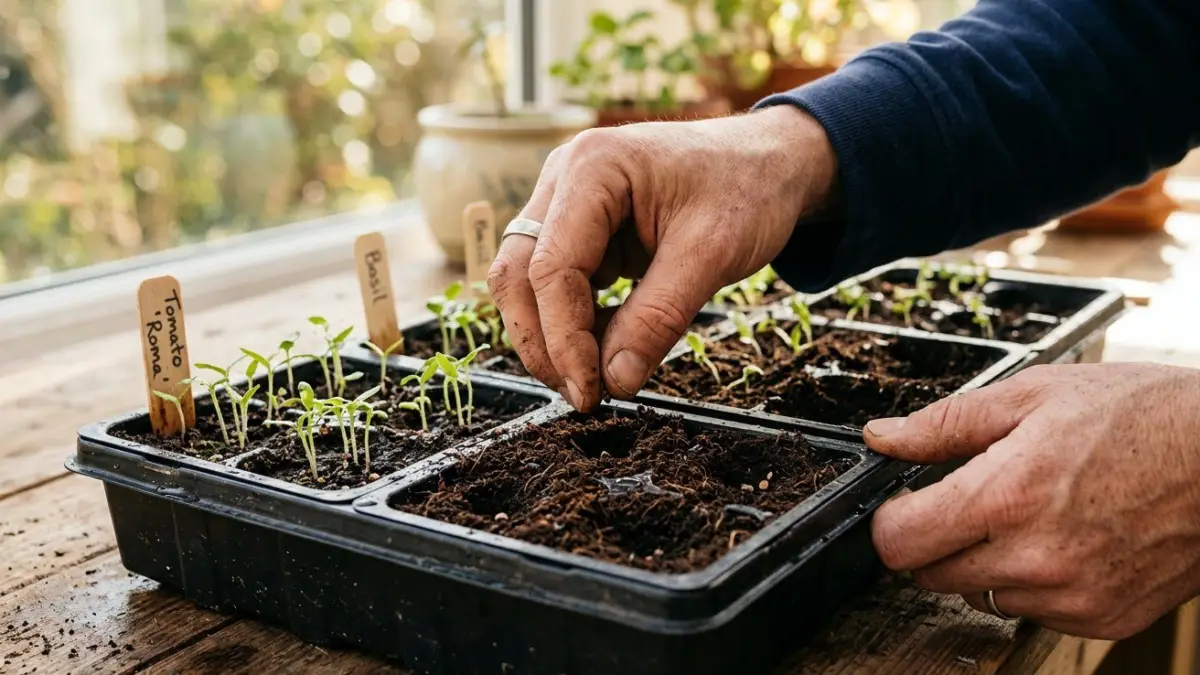
Quick answers
- Do seedlings really need a grow light?
- On most windowsills, yes. Glass filters light and winter days are short, so tomato, pepper and lettuce seedlings stretch toward the glass and grow weak. A grow light gives steady, even light and keeps stems short and thick.
- How far should a grow light hang above seedlings?
- Most full-spectrum LED panels work best 10 to 20 cm above the leaves, and fluorescent tubes 5 to 8 cm. Check the maker's guidance, then raise the light as the plants grow.
- How many hours a day should seedlings get?
- Run the light for 14 to 16 hours and give the plants at least 8 hours of darkness. A cheap plug timer makes this automatic.
- What is the best colour for a grow light?
- A full-spectrum white LED around 5000 to 6500 kelvin suits almost every seedling. Pink and purple lights work but make it hard to judge leaf colour.
Key takeaways
- A grow light fixes stretching by giving seedlings steady light from above
- Hang LED panels 10 to 20 cm above the leaves and raise them as plants grow
- Run lights 14 to 16 hours a day and give 8 hours of darkness
- Full-spectrum white LED at 5000 to 6500 kelvin suits nearly all seedlings
- Pale, leggy or scorched leaves tell you whether the light is too weak, too far or too close
Table of contents12 sections
- Grow light types at a glance
- Why seedlings need a grow light
- How to choose a grow light for seedlings
- How to hang and time the light
- How grow lights affect soil, water and growth
- Reading seedlings under a grow light
- How much light each crop needs
- A worked example: one shelf for spring sowing
- Grow light myths worth ignoring
- Safety and running costs
- Common mistakes
- Next steps
Grow lights for seedlings replace weak winter windowsill light, so choosing the right light, hanging it at the right height and timing it properly gives you short, sturdy plants.
A seedling that stretches toward a window isn’t trying to grow tall, it’s searching for light. This guide explains which grow light to buy, how to hang it, how many hours to run it and how to read the plants when something is wrong. It’s general information, and your local extension service or the Royal Horticultural Society (RHS) can add advice for your climate.
It belongs to the Plant Growing Guides and works with How to Plant Seeds Step by Step, How to Transplant Seedlings and The Seasonal Planting Calendar.
If you only do one thing: hang the light 10 to 20 cm above the leaves, run it for 14 to 16 hours, and raise it as the plants grow.
Grow light types at a glance
| Light type | Typical distance | Running cost | Best for |
|---|---|---|---|
| Full-spectrum white LED panel | 10 to 20 cm | Low, about 30 to 60 W per shelf | Most home seed starting |
| LED strip or bar | 10 to 15 cm | Low | One shelf or a narrow tray |
| T5 fluorescent tube | 5 to 8 cm | Medium | Cool-season crops such as lettuce and kale |
| Pink or purple LED | 10 to 20 cm | Low | Experienced growers who can judge leaf colour |
| Ordinary bulb or desk lamp | Not recommended | Wasteful | Too weak and often too hot |
Prices and wattages vary, so read the label. A small shelf of two trays usually needs 30 to 60 watts of LED, while a bigger rack needs more.
Why seedlings need a grow light
Tomato and pepper seedlings need strong light, because weak light makes stems thin and pale. Lettuce and spinach tolerate cooler, dimmer rooms, but they still stretch on a dark sill. A grow light gives steady light from above, so stems stay short and leaves grow wide. Heat mat warmth helps basil and pepper germinate, but it doesn’t replace light once they sprout.
Window light changes with weather and season. In midwinter a south window may give only 4 to 6 hours of useful light, while a grow light gives the same output every day. That steadiness is what keeps seedlings compact and ready for the garden.
How to choose a grow light for seedlings
Choose full-spectrum white LED at 5000 to 6500 kelvin, because it lights tomato, lettuce and basil evenly and lets you see true leaf colour. Look for a panel that gives strong, even light over the whole tray rather than one bright spot.
Check three things before you buy: coverage, brightness and heat. A panel should cover the whole tray, because plants at the edges stretch toward the light. Brightness matters more than colour, and a light that stays cool lets you hang it close without scorching leaves. Fluorescent tubes suit lettuce and kale, while LED panels suit tomato and pepper.
How to hang and time the light
- Fix the light on chains or a rack. Adjustable hangers let you raise it as the plants grow.
- Start 10 to 20 cm above the leaves. Use a ruler once, then re-measure every few days.
- Set a timer for 14 to 16 hours. Plants need at least 8 hours of darkness to rest.
- Turn trays every 2 days. This keeps growth even if the light isn’t perfectly uniform.
- Add a small fan. Gentle moving air strengthens stems and reduces damping-off.
- Keep the room at 18 to 21°C. Cooler nights make stockier plants.
How grow lights affect soil, water and growth
A grow light dries a tray faster than a windowsill does, so check the compost every day. Perlite in the mix drains water and prevents damping-off, while compost feeds young roots lightly, and a small fan reduces mould on the surface. Overwatering kills tomato and pepper seedlings quickly, so water only when the top of the mix feels dry.
Basil needs warmth and light together, while lettuce tolerates the cooler end of the shelf. Pea and bean grow fast and outgrow a shelf within 2 to 3 weeks, so harden them off sooner than tomato. Marigold, zinnia and nasturtium suit a bright shelf, and a strong, hardened plant survives slug attacks outdoors far better than a leggy one.
Cucumber and squash need warmth of 21°C and strong light, while spinach tolerates a cool room. Compost improves loam when you plant out, and mulch protects the roots and reduces weeds. Soft, overfed tomato growth attracts aphid, so don’t overfeed, and check leaf colour every few days to catch light problems early. A qualified electrician can check any doubtful socket.
Reading seedlings under a grow light
- Tall, thin, pale stems: the light is too weak or too far away. Lower it or add a second panel.
- Crispy, bleached or curled leaf edges: the light is too close or too hot. Raise it by 5 cm.
- Purple tint on leaves: the room is too cold or the plant is short of feed. Warm the room and feed lightly.
- Leaves turning toward one side: light isn’t even. Turn the tray or move the panel.
- Sudden collapse at soil level: damping-off. Improve airflow, use clean pots and water less.
How much light each crop needs
| Crop | Hours of light | Distance (LED) | Note |
|---|---|---|---|
| Tomato and pepper | 14 to 16 | 10 to 15 cm | Strong light prevents weak, pale stems |
| Lettuce, spinach and kale | 12 to 14 | 15 to 20 cm | Tolerate cool rooms and lower light |
| Basil and cucumber | 14 to 16 | 10 to 15 cm | Need warmth of 21°C as well |
| Marigold, zinnia and cosmos | 14 to 16 | 10 to 20 cm | Fast growers; harden off at 3 to 4 weeks |
| Bean and pea | 12 to 14 | 15 to 20 cm | Outgrow a shelf in 2 to 3 weeks |
These are starting points, not rules. Raise the light if leaves crisp, and lower it if stems stretch.
A worked example: one shelf for spring sowing
Take a shelf 60 cm wide with two trays. Hang a 40 W full-spectrum LED panel 15 cm above the trays and set the timer for 15 hours. Sow tomato and pepper in compost mixed with perlite, and put lettuce in the cooler end. A heat mat under the pepper tray keeps the mix at 24°C until the seeds sprout, then you switch it off. Basil likes the warm end, and lettuce tolerates the cool end. Compost feeds the roots lightly, and perlite drains water and protects seedlings from damping-off.
After 10 days the first true leaves appear, so raise the light by 3 cm each week. A small fan on low keeps air moving and strengthens stems. By week 4 tomato and marigold need potting on, and you should harden them off for 7 to 10 days. Mulch protects the transplants outdoors and reduces water loss, while a cloche or fleece shelters lettuce from a late frost. Your extension service or the RHS lists local last frost dates.
Grow light myths worth ignoring
- “Plants need 24 hours of light.” Most seedlings grow best with 14 to 16 hours of light and 8 hours of rest.
- “Purple lights are always better.” They work, but white light lets you see problems early.
- “A bigger wattage is always better.” Even coverage and the right distance matter more than raw power.
- “A windowsill is just as good.” A bright south window helps in spring, but it can’t match a steady light in midwinter.
Safety and running costs
Grow lights run on mains power in damp rooms, so you should use a plug timer, keep cables off wet shelves and plug into a socket protected by an RCD or GFCI. Don’t spray water near the transformer. A 40 W LED running 15 hours a day uses about 0.6 kWh a day, which costs little compared with the value of healthy plants. If you’re unsure about wiring, ask a qualified electrician.
Common mistakes
- Hanging the light too high. Weak light at 40 cm makes seedlings stretch.
- Running 24 hours a day. Plants need darkness to grow properly.
- Using an ordinary bulb. It’s too weak and gets hot.
- Forgetting to raise the light. Leaves touch the lamp and scorch.
- Skipping hardening off. Seedlings raised under lights need 7 to 10 days outdoors before planting.
For how to choose a light for dim rooms, see Best Grow Lights for Houseplants.
Next steps
Set up one shelf with a timer, then sow a tray of lettuce and one of tomato to learn how each reacts. When plants have three true leaves, move on to How to Transplant Seedlings, and check dates in The Seasonal Planting Calendar. The Plant Growing Guides link every step together.
Frequently asked questions
Can I use a regular desk lamp or household bulb as a grow light?
It is not recommended. Ordinary bulbs are usually too weak for seedlings and can get hot enough to scorch leaves. A full-spectrum LED made for plants gives better light for less power. If you do improvise, check that the bulb stays cool at leaf height.
How much does it cost to run a grow light?
A 40 W LED running 15 hours a day uses about 0.6 kWh daily. Multiply that by your electricity rate to find the real cost, which is usually small. Check the wattage on the label, and use a timer so the light does not run longer than needed.
Is it safe to use a grow light on a damp shelf?
Take care, because mains power and water are a risky mix. Keep cables and plugs off wet shelves, use a plug timer, and plug into a socket protected by an RCD or GFCI. Do not spray water near the transformer. If unsure about wiring, ask a qualified electrician.
Why are my seedlings leaning to one side under the light?
The light is uneven, so the seedlings reach toward the brightest side. Turn the trays every 2 days, or move the panel so it covers the whole tray evenly. A panel smaller than the tray leaves the edges dim, so check the coverage.
What causes crispy or bleached leaves under a grow light?
The light is too close or too hot. Raise it by about 5 cm and watch the leaves over the next few days. Bleached or curled edges mean scorch, which will not repair itself, but new growth should come in normally. Hold your hand at leaf height to feel the heat.
Do seedlings need darkness, or can I leave the light on 24 hours?
Seedlings need darkness. Most grow best with 14 to 16 hours of light and at least 8 hours of rest, and a plug timer makes this automatic. Running lights around the clock wastes power and gives most crops no benefit.
When can I stop using the grow light and move seedlings outside?
Once seedlings have about three true leaves and the weather suits the crop, harden them off for 7 to 10 days. Start in a sheltered, shady spot outdoors, then increase sun and wind exposure. Seedlings raised under lights are tender, so do not skip steps.
Should I use a fan with grow lights?
A small fan on low is useful. Gentle moving air strengthens stems and cuts the risk of damping off and surface mould. Point it so leaves sway slightly, but not so strongly that the tray dries out or the plants are blown flat.
How do I know if my grow light is too weak?
Seedlings that are tall, thin and pale, with long gaps between leaves, are not getting enough light. Lower the light toward the 10 to 20 cm range, or add a second panel. Check coverage as well, because plants at the edges of a tray stretch first.
Do I need a heat mat as well as a grow light?
Not always. A grow light supplies light, while a heat mat warms the mix for germination. Warmth-loving seeds such as peppers and aubergines sprout faster on a mat at around 24°C. Switch it off once seedlings emerge, and keep the room at 18 to 21°C.
More in Plant Growing Guides
Reading Plant Signals: What Your Plants Are Trying to Tell You
Decode yellow, brown, curled, purple and leggy plants by leaf age, pattern and soil check, so you fix the real cause instead of guessing.
The First Garden Plan: What to Plant Where, for Beginners
Plan a first garden that works: pick a site with 6 hours of sun, size one bed to reach across, choose forgiving plants and follow a…
Best Gardening Tools for Beginners
Which gardening tools a beginner really needs: the first six to buy, how to judge steel, handles and weight, what to skip, and how to care…