Quick answers
- What is the difference between annuals and perennials?
- Annuals flower, set seed and die in one growing season, so you replant every year. Perennials live three years or more, die back or go dormant in winter and regrow from the same roots. A plant that is perennial in a mild climate may behave as an annual where winters are colder.
- Which is cheaper, annuals or perennials?
- Annuals cost less per plant, but you need 11 to 16 per square metre every year, against 4 to 7 perennials planted once. Bought as plants, a perennial bed usually pays for itself by the second or third year. Seed-raised annuals stay the cheapest way to cover bare soil in year one.
- What is a biennial?
- A biennial makes leaves in its first year and flowers in its second, then dies. Foxglove, wallflower and sweet william are common examples. Many self-seed, so a patch looks permanent even though each plant lives only two years.
- Why did my perennials not come back?
- The usual causes are winter wet around the crown, planting too late for roots to establish, or a plant rated for a warmer hardiness zone than yours. Check whether the crown is soft and rotten. If it is, improve drainage and replant in spring or early autumn.
Key takeaways
- Aim for 60 to 70% perennials and shrubs by area, with annuals in gaps, pots and edges
- Plants needed = area divided by spacing squared: 11 to 16 annuals or 4 to 7 perennials per m²
- Perennials "sleep, creep, leap": expect full effect in the third season
- Check the hardiness zone and winter drainage before calling anything a perennial
Table of contents12 sections
- Annuals, biennials and perennials at a glance
- Three kinds of annual, and the fourth label that matters
- The cost arithmetic
- How long perennials really take
- Hardiness: when a perennial becomes an annual
- Where each type belongs
- Keeping both flowering
- Diagnosing problems
- How annuals and perennials differ in effort and flower
- What to plant where: annuals or perennials
- Common mistakes
- Next steps
Annuals vs perennials is a choice about what to plant where: annuals give one season of fast colour, while perennials return each year with less work.
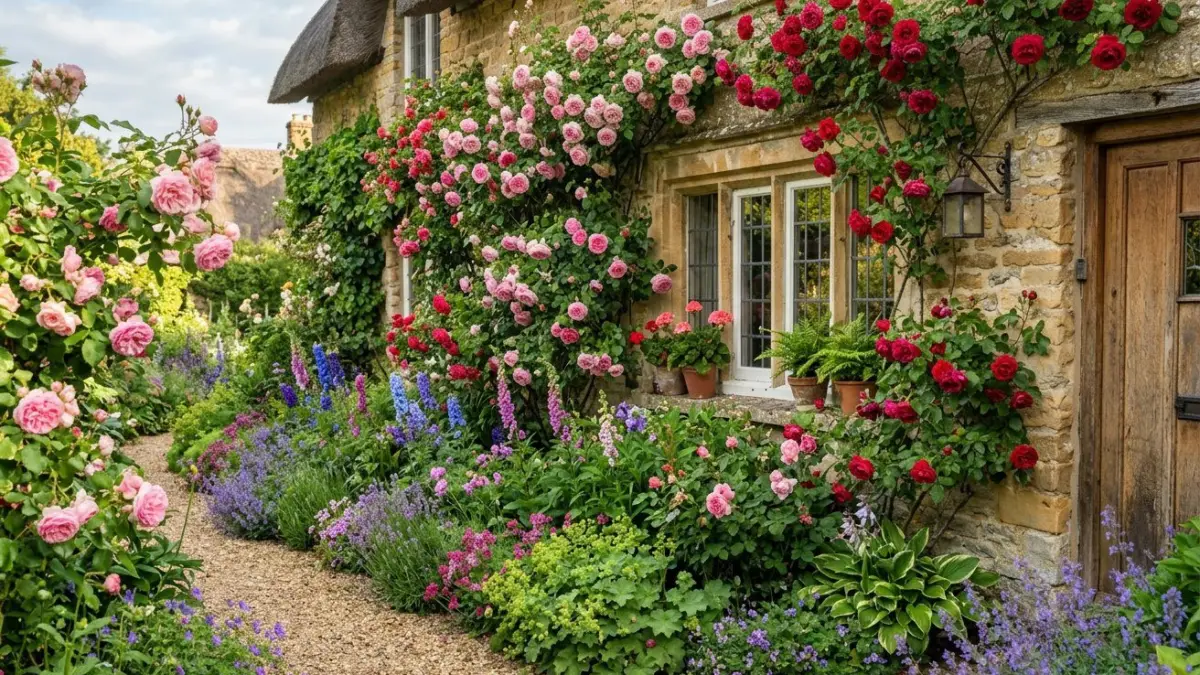
Plant annuals where you want fast, continuous colour and don’t mind replanting each year. Plant perennials where you want a permanent frame that gets cheaper per flower every season. In most gardens the answer is both: roughly 60 to 70% perennials and shrubs by area, with annuals in the gaps, pots and front edge. This guide gives the decision rules, the cost arithmetic and the climate catch that decides which label a plant deserves in your garden.
It sits in the Flower Gardening guides alongside Low-Maintenance Flower Borders, which covers layout and upkeep, and Cutting Garden, which uses annuals for production rather than display.
Annuals, biennials and perennials at a glance
| Annuals | Biennials | Perennials | |
|---|---|---|---|
| Life span | One season | Two seasons | Three years or more |
| Bloom period | 3 to 6 months if deadheaded | 3 to 6 weeks, in year two only | Usually 3 to 8 weeks per species |
| Plants per m² | 11 to 16 (25 to 30 cm spacing) | 6 to 9 (35 to 40 cm) | 4 to 7 (40 to 50 cm) |
| Time to full effect | 8 to 12 weeks from sowing | 14 to 18 months from sowing | Two to three seasons |
| Cost pattern | Repeats yearly | Low, self-seeding | Once, then free divisions |
| Yearly labour | Sow, plant, clear | Sow in early summer | Cut back, divide every 3 to 5 years |
Three kinds of annual, and the fourth label that matters
“Annual” covers plants with very different frost tolerance, and that decides your sowing date more than any calendar does.
| Group | When to sow or plant | Frost | Examples |
|---|---|---|---|
| Hardy annuals | Autumn in mild winters, or 2 to 4 weeks before the last frost | Survive light frost | Cornflower, calendula, nigella, Californian poppy, ammi |
| Half-hardy annuals | Indoors 6 to 8 weeks before the last frost; outside once frost has passed and soil is above about 15°C (59°F) | Killed by frost | Zinnia, cosmos, sunflower, tagetes |
| Tender perennials grown as annuals | Plant out after the last frost; buy as plants or take cuttings | Damaged near 0 to 5°C (32 to 41°F) | Pelargonium, petunia, begonia, coleus, lantana |
The third group is the trap. Pelargoniums and lantanas are true perennials in warm climates but are sold as annuals elsewhere. You can overwinter them as cuttings or in a frost-free room, which turns an annual cost into a one-off one. Sowing dates for your area are in The Seasonal Planting Calendar, and seed handling is in How to Plant Seeds Step by Step.
The cost arithmetic
Plants needed equals the bed area divided by the spacing squared. At 30 cm spacing that’s about 11 plants per m². At 45 cm it’s about 5. Take a 5 m² bed:
- Annuals at 30 cm: about 55 plants, every year.
- Perennials at 45 cm: about 25 plants, once.
- Over five years: roughly 275 annuals against 25 perennials, plus a few replacements.
If a bedding plant costs a third of a perennial, the perennial bed is already cheaper by year two. Seed changes the sum. A packet of zinnia or cosmos seed covers a large area for the price of a few plants, so raised-from-seed annuals are the cheapest way to cover soil in year one. You pay in time and windowsill or greenhouse space instead of money.
How long perennials really take
Gardeners summarise perennial establishment as “sleep, creep, leap”. In year one roots grow more than shoots. In year two the clump widens. In year three it fills its space and flowers heavily. A bed planted with perennials alone looks thin for two seasons, which is why annuals earn their place as temporary filler (zinnia, cosmos and nicotiana all cover ground fast).
Lifespan varies widely, and it affects the real cost.
| Perennial | Typical behaviour | What to do |
|---|---|---|
| Delphinium, lupin | Often fade after 3 to 5 years; slugs target new shoots | Replace with new plants or basal cuttings |
| Coloured echinacea hybrids | Some fade within 3 to 4 years, especially in wet clay; the plain purple type usually lasts longer | Drainage, no heavy feeding; accept replacement |
| Michaelmas daisy (aster) | Centre dies out in 2 to 3 years | Divide, replant the outer growth |
| Hosta, daylily, sedum | Thrive for 5 to 10 years or more undivided | Divide only to propagate or if flowering drops |
| Peony (herbaceous) | Decades if left alone; slow to recover after moving | Plant with buds 3 to 5 cm below the surface; deeper means no flowers |
Hardiness: when a perennial becomes an annual
USDA hardiness zones divide climates into bands of average annual minimum temperature, each 5.6°C (10°F) wide. Zone 6 averages -23 to -18°C (-10 to 0°F) and zone 8 averages -12 to -7°C (10 to 20°F). A plant labelled for zones 5 to 9 should survive winters in any of them, although local conditions can override the number.
- Compare your zone to the plant’s lowest zone. If yours is the same or higher, it should be perennial outdoors.
- Treat the border zone as a gamble. A plant rated to your own zone with no margin can die in an unusually cold year.
- Allow for pots. Roots in a container are exposed on every side, so potted plants are often one to two zones less hardy than the same plant in the ground.
- Remember the warm end. Herbaceous peonies need winter chill and flower poorly where winters are very mild. Delphiniums and lupins sulk in hot, humid summers.
- Check tubers. Dahlia tubers are generally dependable outdoors in zones 8 to 10. In colder zones, lift them after frost blackens the foliage, or mulch heavily in well-drained soil and accept some losses.
Winter wet kills more perennials than winter cold does. A plant that survives -20°C in free-draining soil can rot at -5°C in a cold, waterlogged bed. Raise the bed or add grit before blaming the zone rating. For cold snaps, see Frost Protection Methods.
Where each type belongs
| Situation | Choose | Reason |
|---|---|---|
| Pots and hanging baskets | Annuals and tender perennials | Small soil volume heats, dries and freezes; see Choosing Pots and Potting Mix |
| Brand-new border | Perennials at full spacing plus annuals between | Covers soil in year one without crowding perennials |
| Bare ground you will redesign next year | Annuals sown thickly | Weeds are shaded out and nothing is wasted |
| Slopes and dry banks | Perennial ground covers | Permanent roots hold soil and need no yearly digging |
| Cottage or wildlife borders | Perennials with self-seeding annuals and biennials | Gaps refill themselves |
| Rented or temporary garden | Annuals, plus perennials in pots | Nothing is left behind and pots travel |
For plants that feed insects across the whole season, Flowers That Attract Pollinators shows which of each type to prioritise.
Keeping both flowering
Annuals flower to make seed, so removing spent flowers every few days keeps them producing. Petunias and zinnias that stall in midsummer often respond to a hard cut back by about half, a watering and a light feed. Many perennials can be pushed into a second flush the same way: shear catmint, hardy geranium and salvia after the first flowering and they usually regrow and bloom again within four to six weeks. Others, such as peonies and hostas, only flower once, so cutting back gains nothing.
Diagnosing problems
| Symptom | Likely cause | Fix |
|---|---|---|
| Perennial missing after winter | Winter wet, late planting, or rating too warm | Dig to check for rot; improve drainage; plant in spring or early autumn |
| Flowers fewer each year, dead centre | Congested clump | Divide in spring or autumn and replant the vigorous outer pieces |
| Annuals stop flowering in midsummer | Seed set, drought, or heat stress | Deadhead, water deeply, cut back by half and feed lightly |
| Tall, leafy annuals with few flowers | Too much nitrogen or too little sun | Stop feeding; make sure there are at least 6 hours of sun |
| Biennial flowers once and vanishes | Normal life cycle | Sow every early summer, or allow it to self-seed |
| New perennial border looks sparse | Normal in years one and two | Fill gaps with annuals; do not crowd the perennials |
How annuals and perennials differ in effort and flower
Annuals such as marigold, zinnia and petunia flower all summer and need replanting each year, while perennial echinacea, salvia and peony return and bloom for a shorter season. Deadheading boosts annual bloom and stops seed setting, but perennial plants need division every few years to stay vigorous. Compost and mulch feed both types and reduce the weeds that compete in a new bed.
Annuals suit containers and gaps because you can change colour each year, whereas perennials need a permanent spot that drains well and protects crowns from winter rot. Hardy perennials tolerate frost, while tender dahlia and geranium need lifting or fleece. A mix supports bees and hoverfly all season, which controls aphid on nearby roses. Which should you choose first? Start with a few perennials for structure and fill the gaps with annual cosmos or nasturtium, since you’ll get colour in the first year without waiting.
What to plant where: annuals or perennials
Annual marigold, zinnia and petunia flower for 4 to 5 months and need replanting each spring, so they suit containers and gaps. Perennial echinacea, salvia and peony return for 5 to 10 years, but each flowers for only 3 to 6 weeks. Deadheading boosts annual bloom and stops seed setting, while perennial plants need division every 3 to 4 years to stay vigorous.
Compost and mulch feed both types and reduce the weeds that compete in a new bed. Perennials need a permanent spot that drains well, because wet clay in winter encourages crown rot, while annuals tolerate most soils for one season. Hardy perennials tolerate frost, whereas tender dahlia and geranium need lifting or fleece to survive. A mix supports bee and hoverfly across the whole season, and hoverfly larvae control aphid on nearby rose. Start with 3 to 5 perennials for structure and fill the gaps with cosmos or nasturtium so you’ll get colour in the first year. Your extension service lists plants proven in your zone, and the low maintenance border guide shows a layout.
Echinacea and salvia tolerate drought once their roots reach 30 cm, while petunia and marigold need regular watering because shallow roots dry fast in sand. Mulch holds moisture around both types and reduces weeds, so a 5 cm layer of compost or leaf mould suits any new bed. Dahlia and geranium need fleece or lifting before frost, but peony and hellebore tolerate winter and return each spring. Division every 3 years renews aster and iris, and it gives you free plants for the next border.
Nasturtium and cosmos tolerate poor loam and need little fertiliser, because rich compost encourages leaves and reduces flowers. Lavender and sedum need sharp drainage and 6 hours of sun, so grit improves a heavy clay bed.
Common mistakes
- Planting perennials at pot-width spacing to fill the bed at once. By year three they compete, flop and catch disease in the humid centre. Space at 40 to 50 cm and bridge the gaps with annuals.
- Buying perennials in full flower and planting in summer heat. Roots are small and the plant is spending energy on blooms. Plant in spring or early autumn, and water for the whole first season.
- Planting tender perennials before the last frost date. One frosty night undoes the purchase. Wait, or harden them off first.
- Pulling self-sown seedlings as weeds. Learn what foxglove, nigella and calendula seedlings look like before you hoe.
- Skipping soil preparation for annuals because they are “only” annuals. Fast growth needs loose soil and 5 cm of compost, or you get thin, short-lived plants.
- Choosing only by flower colour. Check light, drainage and zone first, because a stunning plant in the wrong place becomes a short-lived one.
Next steps
Raise your own annuals with How to Plant Seeds Step by Step. Build a permanent frame using Low-Maintenance Flower Borders. Use annuals for stems and vases in Cutting Garden. Back to Flower Gardening.
Frequently asked questions
Can I plant annuals and perennials together in the same bed?
Yes, and it is the usual approach in a new border. Plant perennials at full spacing for structure and fill the gaps with fast annuals such as cosmos or zinnia. The annuals cover bare soil while the perennials establish. Thin them if they crowd perennial crowns, because shade slows young plants.
When should I sow hardy annuals like cornflower and calendula?
Sow them in autumn where winters are mild, or two to four weeks before the last spring frost. Hardy annuals survive light frost. Half-hardy types such as zinnia must wait until frost has passed and the soil is above about 15°C (59°F), so check which group your seed belongs to.
Can I overwinter pelargoniums and other tender perennials?
Yes. Take cuttings in late summer, or lift the plants before the first frost and keep them in a bright, frost-free room, watering sparingly. Pelargonium, lantana and coleus are all handled this way. It turns a yearly purchase into a one-off cost, though it needs windowsill space.
How many perennials do I need for a 5 square metre bed?
About 25 plants at 45 cm spacing. The sum is bed area divided by spacing squared, so wider spacing means fewer plants, and 4 to 7 per square metre is the usual range for perennials. Fill the gaps with annuals in year one so the bed does not look thin.
Why do my annuals stop flowering in midsummer?
Usually they have set seed, dried out or stalled in the heat. Annuals flower to make seed, so removing spent flowers every few days keeps them producing. Cut petunias and zinnias back by about half, water deeply and feed lightly, and most flower again within a few weeks.
Should I deadhead perennials as well as annuals?
Only those that rebloom. Shear catmint, hardy geranium and salvia after the first flowering and they usually bloom again within four to six weeks. Peonies and hostas flower once, so cutting back gains nothing. Leave echinacea seed heads standing if you want birds and winter structure.
Are perennials in pots less hardy than perennials in the ground?
Yes, often by one to two hardiness zones, because roots in a container are exposed on every side. In cold winters move pots against a house wall, wrap them, or shelter them in an unheated garage. Compare the plant's lowest zone with yours before leaving it outside.
How long do new perennials take to fill out?
Expect two to three seasons. Roots grow most in year one, the clump widens in year two and flowering peaks in year three, often summarised as sleep, creep, leap. Planting at full spacing and filling gaps with annuals keeps the border looking good while you wait.
How often do perennials need dividing?
Most clumps need dividing every 3 to 5 years, in spring or autumn, or sooner if the centre dies out or flowering drops. Replant the vigorous outer pieces. Hostas, peonies and daylilies can stay undisturbed far longer, so divide those only to make more plants.
Is it OK to buy perennials in flower and plant them in summer?
It works, but spring or early autumn is better. A plant in full bloom has small roots and is spending energy on flowers, and summer heat adds stress. If you plant in summer, water deeply through the whole first season and shade the plant for a few days.
More in Flower Gardening
Cutting Garden: Growing Flowers for Bouquets
Plan a production bed that gives bouquets from spring to frost: close row spacing, pinching, the right cutting stage, succession sowing and conditioning for vase life.
How to Grow Dahlias: Planting Tubers, Staking, Pinching and Winter Storage
A practical guide to growing dahlias from tubers: when to plant, how to stake and pinch for more blooms, how to feed, and how to lift…
Best Trellises and Plant Supports
How to choose trellises and plant supports for climbers, roses and tall flowers: materials, sizes, fixing, spacing and which support suits sweet peas, clematis, dahlias and…