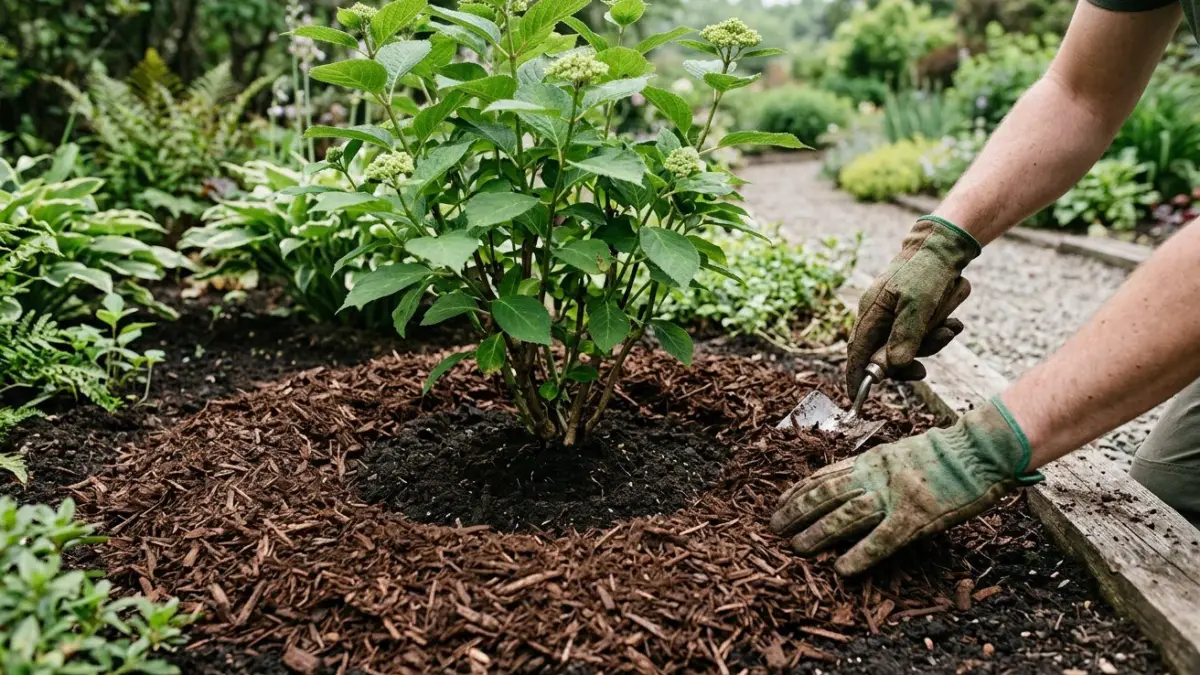
Quick answers
- How deep should mulch be?
- Most coarse organic mulches (wood chips, bark, shredded leaves) work best at 5 to 8 cm (2 to 3 in). Fine compost needs only 2 to 3 cm, straw settles to the same depth from a 10 to 15 cm fluffy pile, and gravel needs 3 to 5 cm. Past about 10 cm you risk starving roots of air.
- Does wood mulch steal nitrogen from plants?
- Only a thin layer where chips touch the soil is affected, so established plants rarely notice. The risk is real if chips are dug into the soil, or for seedlings with very shallow roots in a new bed. Keep chips on the surface, and see our fertilizer guide if you need to top up nitrogen.
- What is volcano mulching and why is it harmful?
- It is a cone of mulch heaped against a tree trunk. It holds moisture on bark that should stay dry, which encourages rot and cankers, and it can lead to stem-girdling roots and rodent damage. Spread mulch in a flat ring and keep it 5 to 10 cm away from the trunk, as our tree mulching guide also explains.
- When is the best time to mulch?
- Mulch after a good soaking, once the soil has warmed in spring (about 15 to 18°C (59 to 64°F) for tomatoes, peppers and squash). Autumn is also good for trees and perennials, because it holds warmth in the soil and protects roots over winter.
Key takeaways
- Coarse organic mulch goes 5 to 8 cm deep; fine compost only 2 to 3 cm
- Keep mulch 5 to 10 cm off trunks: a flat ring, never a volcano
- Nitrogen tie-up matters only where wood is mixed into the soil
- Mulch wet soil, because mulch keeps moisture in but will not add it
Table of contents11 sections
- Mulching mastery at a glance
- Choosing a mulching material
- How to mulch a bed properly
- Mulching trees: the donut, never the volcano
- Mulching and nitrogen tie-up: myths and facts
- Mulching vegetables, flowers and climate
- Mulching problems and fixes
- How mulch protects your soil and plants
- How mulching mastery protects your soil and plants
- Common mistakes
- Next steps
Mulching mastery is the one habit that transforms gardens, since a thick layer holds moisture, feeds the soil and stops weeds.
Spread 5 to 8 cm (2 to 3 in) of coarse organic mulch over damp, weeded soil, keep it clear of stems and trunks, and top it up once a year. That single routine slows evaporation, blocks most weed germination, evens out soil temperature, stops rain splashing soil and disease spores onto leaves, and feeds soil life as it rots. This guide covers depth for each material, the volcano mistake, the truth about nitrogen, and how to choose between mulches.
Mulching sits in the Soil, Water & Fertilizer guides alongside Drip Irrigation & Smart Watering (mulch and drip are a natural pair) and Preventing Soil Compaction, since a mulch layer also cushions raindrops and footsteps.
Mulching mastery at a glance
| Question | Short answer |
|---|---|
| Coarse organic mulch depth | 5 to 8 cm (2 to 3 in) |
| Fine compost depth | 2 to 3 cm (1 in), refreshed each season |
| Gap round woody trunks | 5 to 10 cm (2 to 4 in) of bare soil or bark |
| Gap round soft stems | 3 to 5 cm (1 to 2 in) |
| Ring size for a tree | At least 1 to 1.5 m (3 to 5 ft) across, ideally to the drip line |
| Best timing | After rain or deep watering; spring once soil has warmed, or autumn |
| Annual loss | Typically 2 to 3 cm of organic mulch decomposes each year |
| Cover from 1 m³ | About 20 m² at 5 cm, or 12 m² at 8 cm |
Choosing a mulching material
No mulch wins everywhere. Pick by what the bed needs: feeding, weed control, longevity or looks.
| Material | Depth | Lasts | Best for | Trade-off |
|---|---|---|---|---|
| Wood chips (arborist chip) | 5 to 8 cm | 2 to 4 years | Trees, shrubs, paths, perennial borders | Slow to feed; avoid chips of diseased trees |
| Bark nuggets or fine bark | 5 to 7 cm | 2 to 5 years | Ornamental beds | Costs more; fine bark can crust |
| Straw (seed-free) | 10 to 15 cm loose, settling to 5 to 8 cm | One season | Tomatoes, strawberries, squash, potatoes | Slugs shelter in it; hay brings weed seed |
| Shredded leaves or leaf mould | 5 to 8 cm | 1 to 2 years | Woodland and shade beds | Whole broad leaves mat and shed water |
| Garden compost | 2 to 3 cm | 6 to 12 months | Vegetables, annuals, soil building | Weeds sprout if the heap ran cool |
| Grass clippings (dried, herbicide-free) | 1 to 2 cm per layer | Weeks | Between vegetable rows | Thick wet layers turn slimy and smell |
| Plain cardboard | 1 to 2 layers, under chips | 3 to 6 months | Smothering turf on a new bed | Strip tape and glossy print; overlap the edges |
| Gravel or stone | 3 to 5 cm | Permanent | Lavender, succulents, dry gardens | No feeding value; dark stone heats shallow roots |
Pine needles and shredded bark are sometimes said to acidify soil. In practice the effect on garden soil is small and slow, so choose them for looks and drainage rather than to change pH. If acidity is the real goal, Soil pH Explained covers amendments that actually shift it.
Cocoa shell mulch contains theobromine and can poison dogs that eat it. Avoid it if a dog uses the garden. In regions with wildfire risk, keep bark and wood chips at least 1.5 m (5 ft) from buildings and use gravel in that band.
How to mulch a bed properly
- Weed by the root. Mulch suppresses seedlings but not established bindweed or dandelion. For a lawn-to-bed conversion, mow short, then lay overlapping cardboard and 8 to 10 cm of chips on top.
- Soak the soil. Dry soil under mulch stays dry, because light rain is caught by the layer. Water until moisture reaches 15 to 20 cm down.
- Feed first if needed. Scatter fertilizer or compost on the soil, then mulch over it (rates are in Organic vs Synthetic Fertilizers).
- Spread evenly to the depths in the table, working from a wheelbarrow with a rake.
- Pull it back from stems. Leave a clear collar so bark stays dry.
- Check after a month. Break up any crust, fill thin spots, and top up to full depth each spring or autumn.
Mulching trees: the donut, never the volcano
A mulch ring should be flat or very slightly dished, out to the drip line if you can manage it, and no more than about 8 cm deep. The trunk flare, where the trunk widens into the roots, should stay visible. Piling mulch against the trunk (a volcano) holds moisture on bark designed to stay dry. The results include rot and cankers at the base, roots that circle and later girdle the stem, and a warm, sheltered home for voles and mice that gnaw bark in winter.
Volcano mulch also tempts roots to grow up into the mulch itself, where they dry out in a heat wave. If you inherit a volcano, pull it back by hand until you find the flare. For watering routines around mulched trees, see Tree Watering & Mulching.
Mulching and nitrogen tie-up: myths and facts
Wood is rich in carbon and poor in nitrogen. Microbes that decompose it pull mineral nitrogen from the surrounding soil, a process called immobilisation. That much is true. What is exaggerated is how far it reaches.
| Claim | Verdict |
|---|---|
| “Wood chips on top of the soil starve plants.” | Mostly myth. The effect is confined to the top centimetre or so of soil, and established shrubs, trees and perennials draw from deeper roots. |
| “Chips dug into the soil are fine.” | Myth. Mixing wood through the root zone ties up nitrogen for months and can stunt vegetables. |
| “Fresh chips must age first.” | Mostly myth for beds and trees. Fresh chips are fine on the surface, though piles left sealed and wet can sour and should be spread out for a few days. |
| “New vegetable seedlings can suffer under chips.” | Fact where roots are shallow and the bed is new. Use compost or straw for annuals, or add a nitrogen top-dress. |
| “Sawdust is the same as chips.” | Fact it is worse: the particles are tiny, break down fast and demand more nitrogen. Use only as a thin layer, or not at all in food beds. |
If leaves turn pale green across a bed that has just received a lot of woody mulch, apply a modest nitrogen feed (around 2 to 3 g of nitrogen per m², the amount in about 25 to 30 g of blood meal or 20 g of a 15 percent nitrogen granule) and water it in.
Mulching vegetables, flowers and climate
- Wait for warmth. Mulch on cold spring soil delays warming. Hold off until soil reaches the temperatures in the at-a-glance advice above for heat-lovers.
- Use straw or compost near fruit so strawberries and tomatoes stay off the soil.
- Keep seed rows clear. Use 1 to 2 cm of fine compost until seedlings are 10 cm tall.
- Mulch paths thickly, 10 cm of chips, to protect the soil from boots.
- Go thinner in heavy clay or wet climates. Slow-drying soil under 8 cm of mulch can stay soggy; 3 to 5 cm is plenty.
- Go thicker in hot, dry spells, but keep stone mulch light-coloured in full sun.
Push a finger through the mulch every week for the first month. If the soil beneath is dry, water. If it’s soggy, pull the mulch back a little and wait.
Mulching problems and fixes
| Symptom | Likely cause | Fix |
|---|---|---|
| Weeds pushing through | Layer under 4 cm or perennial roots left in | Top up to 5 to 8 cm; dig out roots first |
| Hard, water-shedding crust | Fine mulch or matted leaves | Rake loose and blend in coarser chips |
| Vinegar or sour smell | Anaerobic fermentation in a deep wet pile | Spread thin in the sun for a few days |
| Fungus or white threads | Harmless wood decomposers | Leave alone, or rake to disturb |
| Slug damage under straw | Damp shelter | Mulch later; keep straw off seedlings |
| Pale plants after mulching | Nitrogen tie-up from mixed-in wood | Remove mixed material; feed lightly |
How mulch protects your soil and plants
A 5 to 8 cm layer of compost or leaf mould holds moisture, cools the roots and reduces weeds, so tomato, cabbage and rose need less watering. Straw suits vegetable beds and breaks down to feed earthworms, while bark lasts longer around shrub and tree. Mulch feeds the soil as it rots and improves clay structure over time.
Fresh wood chip can pull nitrogen from the topsoil near the surface, so you should keep it away from seedlings. Mulch against a stem encourages rot and hosts slug and snail, which means you’ll leave a gap around each trunk or crown. A dark mulch warms soil in spring and a pale one reflects heat in summer. When should you mulch? Lay it on warm, damp soil in spring, because cold soil stays cold under a blanket. Your extension service can recommend local materials that suit your climate.
How mulching mastery protects your soil and plants
A 5 to 8 cm layer of compost or leaf mould holds moisture, cools the roots and reduces weeds, so tomato, cabbage and rose need less watering. Straw suits tomato and bean beds and feeds earthworm activity as it breaks down, while bark mulch lasts longer around shrub and tree. Mulch feeds the soil as it rots and improves clay structure over time.
Fresh wood chip can draw nitrogen from the topsoil and reduces growth, so you should keep it away from lettuce and bean seedlings. Mulch against a stem encourages rot and hosts slug and snail, which means you’ll leave a gap of 5 cm around each crown. A dark mulch warms the soil temperature in spring and a pale straw mulch cools roots in a summer heatwave. Mulch laid on warm, damp topsoil in spring holds moisture, because cold clay stays cold under a blanket. Gravel mulch suits lavender and thyme and drains fast, while compost mulch feeds hungry squash. Seaweed and manure boost potassium and nitrogen under a topping of straw. A layer of cardboard under mulch blocks weeds for 6 months, and mulch protects the roots of fig and citrus from frost. Your extension service can recommend local materials, and the soil compaction guide shows how mulch protects structure.
Common mistakes
- Volcano mulch. It traps moisture against bark. Pull it back to a flat ring with the trunk flare exposed.
- Mulching dry soil. The layer intercepts light rain, so roots stay dry. Soak first, then mulch.
- Going over 10 cm. Deep fine mulch cuts off oxygen and sheds water. Stay within the depths above.
- Digging chips in. That is what ties up nitrogen. Wood stays on top, compost goes in.
- Using treated or dyed waste wood on food beds. You can’t be sure what it contains. Use arborist chips or bagged bark of known origin.
- Using thin wet grass clippings. They mat into slime. Dry them and spread 1 to 2 cm at a time.
Mulch and stored rainwater work together, as shown in Rainwater Harvesting for Gardens.
Next steps
Make your own mulch material with Composting at Home, find out what is under it with Reading Your Soil, and plan irrigation under mulch with Watering Plants the Right Way. For the bigger picture, return to the Soil, Water & Fertilizer guides.
Frequently asked questions
What is the best mulch for vegetable gardens?
Straw, shredded leaves and well-aged compost suit vegetable beds because they break down and feed the soil. Apply about 5 to 8 cm of loose straw or leaves. Use hay only if you know it is free of seeds and herbicide residue.
Can I use grass clippings as mulch?
Yes, in thin layers of 1 to 2 cm, preferably dried first. Use clippings only from lawns not treated with weed killer. Thick, wet layers turn slimy and smelly and can heat up, so add small amounts more often instead.
Is cardboard or newspaper good under mulch?
Yes, it suppresses weeds well. Use plain, uncoated cardboard with tape and labels removed, overlap the edges and wet it thoroughly. Cover it with 5 to 8 cm of mulch so it stays in place and breaks down. Avoid glossy or colored print.
Does mulch attract slugs, snails or termites?
Mulch can shelter slugs and snails, so watch soft young plants. In termite regions, keep wood mulch away from house walls and foundations. Mulch does not usually cause termite damage by itself, but follow local pest control advice. Pulling mulch back from foundations also helps keep damp away from the building.
Should I remove old mulch before adding new?
Usually not. Rake the old layer loose and top it up to a total of 5 to 8 cm. Remove it if it has matted into a hard crust, smells sour or came from diseased plants. Piling fresh layers on old ones gets too deep.
Is gravel a good mulch for plants?
Gravel suits drought-tolerant plants such as lavender and rosemary, and it works well on paths. It adds no nutrients and can heat up in full sun. For most beds organic mulch is better for the soil. Keep gravel to 3 to 5 cm deep.
Are mushrooms growing in my mulch harmful?
Mushrooms in mulch are common and usually harmless to plants, because they are fungi breaking down wood. Remove them if children or pets might eat them, since some mushrooms are poisonous. Raking the mulch to dry it out also helps.
How often should I top up garden mulch?
Top up once or twice a year as it breaks down. Wood chips often last one to two years, while straw and leaves rot faster. Add just enough to restore the 5 to 8 cm depth, not a complete new layer.
Can I use fresh wood chips from a tree service?
Yes, as surface mulch around trees and shrubs. Keep them on top of the soil, not dug in. Avoid chips from diseased trees, and be cautious with black walnut chips near tomatoes and other vegetables. Fresh chips are best used within a few weeks, since heaps can heat up and sour in the middle.
Should I mulch before or after planting?
After planting is easiest for most plants. Plant, water well, then spread mulch and leave a gap around stems. For seed rows, wait until seedlings are up, because seeds sown under thick mulch struggle to emerge. Water well before spreading it, because mulch holds soil moisture but will not add any.
More in Soil, Water & Fertilizer
Preventing and Fixing Soil Compaction in the Garden
How to test for compacted soil, what causes it, and the methods that actually fix it: no-dig, aeration, organic matter, cover crops and raised beds.
Reading Your Soil: Simple Tests Anyone Can Do
Six home tests tell you what your soil is made of, how fast it drains and how alive it is: jar, squeeze, percolation, worm count, smell…
Rainwater Harvesting for Gardens: Water Butts, Storage and Use
How to collect and use rainwater in the garden: sizing a water butt, connecting it to a downpipe, keeping stored water clean and getting the most…